
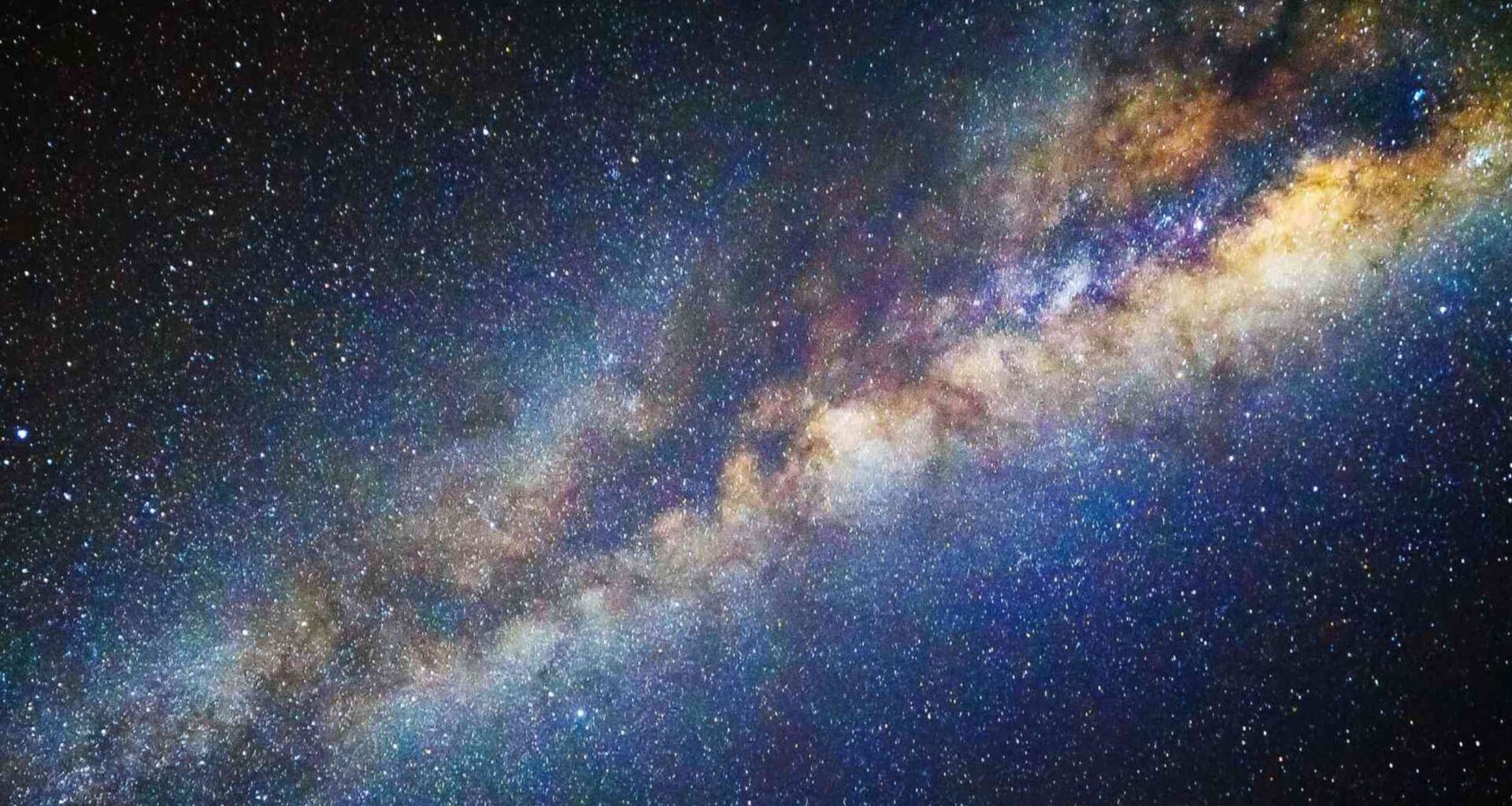
In 2012, astronomers spotted a strange blob of glowing gas spiraling toward the black hole at the center of our galaxy. They named it G2, watched it for years, and argued about where it came from – a disrupted star, an evaporating disk, a passing nova.
One answer nobody seriously pursued: that G2 was just one bead on a longer string. A new study found the string.
A third clump appears

For more than a decade, astronomers have watched G2 swing around Sagittarius A* (Sgr A*). It’s a compact, dusty blob of glowing gas weighing only a few Earth masses.
G2 made a famously close pass at the black hole in 2014 before sailing back out on its long elliptical orbit. A second clump named G1 had followed a nearly identical path 13 years earlier.
Now there’s a third. Dr. Stefan Gillessen, an astronomer at the Max Planck Institute for Extraterrestrial Physics (MPE), led the team that identified a fainter clump trailing G2 along the same orbit.
They named it G2t. Together with G1 and G2, it forms what the team calls the G1–2–3 streamer – a thin trail of gas easing its way toward Sgr A*.
Three matching orbits
Three objects on nearly the same path are no small coincidence. Working from more than a decade of data, the team rebuilt G2t’s orbit.
Its plane, shape, and tilt agree with G1 and G2 to within a few degrees. Random alignment would require something close to a miracle.
Gillessen’s group calculated the odds of three unrelated objects sharing those parameters by chance at just two in a million, making a common source the much likelier explanation.
Following the trail
To track the clouds, the team used precision instruments at the European Southern Observatory’s Very Large Telescope – first SINFONI, then its sharper successor ERIS.
Both split incoming light to catch a specific wavelength that hot hydrogen emits – and each cloud glowed in it clearly.
That pinned down each clump’s position and speed – and all three orbits trace back to the same place: the clockwise disk of young, massive stars circling Sgr A*.
A pair of stars
One star in that disk stood out: IRS 16SW. It’s a contact binary – two massive stars so tightly bound that their outer layers overlap.
Both drive ferocious stellar winds, outflows streaming away at hundreds of miles per second (hundreds of kilometers per second). That much material flowing outward provides the raw fuel for everything that follows.
What clinched the connection was a subtle mismatch between the three cloud orbits. Each orbit’s ellipse tilts slightly differently – a shift of about three-quarters of a degree per year from one cloud to the next.
That rate matches how fast IRS 16SW was moving around Sgr A* roughly 150 years ago – when the clumps were likely forming and breaking off.
Where clumps form
How does a smooth stellar wind turn into individual, Earth-mass clumps? Recent computer simulations from the same group trace the process to a messy collision at the binary’s edge.
As IRS 16SW moves through the dense gas near Sgr A*, the models show a wave of compressed gas building up in front of it. That wave turns out to be unstable – in the simulations, it appears to cool and fragment into dense knots that drift inward.
Wind speeds around 300 to 400 miles per second (around 500 to 650 kilometers per second) produce this effect. Faster ones don’t. The wave stays stable, and no clumps form.
Earlier work had ruled IRS 16SW out as a source, partly by assuming faster winds. The contact-binary geometry slows the outflow enough to make clump formation possible.
Feeding the giant
Sgr A* eats slowly – it only needs to swallow about one Earth-mass clump every decade to match its observed intake. The G1–2–3 streamer delivers close to that pace.
After each clump passes its closest point to the black hole, it appears to lose energy to the thin swirl of infalling gas. It slows. Drifts inward.
The streamer, the researchers argue, is the main current source of material feeding Sgr A*.
Production isn’t steady – clumps form most readily when IRS 16SW swings close to Sgr A*, where the surrounding gas is denser. That uneven cadence could explain X-ray echoes seen nearby – hints of louder activity in past eras.
What this changes
Until this study, no one had ruled out a stellar source for G2. A slowly evaporating star, a nova explosion, even a partial tidal disruption by Sgr A* were all on the table.
With three nearly identical orbits pointing to one source, those alternatives become much harder to defend. A specific star is now the leading suspect.
The next test is already on the calendar. G2t will swing through its closest approach to Sgr A* in mid-2031. Astronomers will be ready to watch it stretch, slow, and surrender part of itself to the black hole.
A possible fourth clump may already be forming in the trailing gas behind G2t. If it appears on cue, the case for IRS 16SW as a steady supplier will tighten considerably.
The study is published in Astronomy & Astrophysics.
—–
Like what you read? Subscribe to our newsletter for engaging articles, exclusive content, and the latest updates.
Check us out on EarthSnap , a free app brought to you by Eric Ralls and Earth.com.
—–