
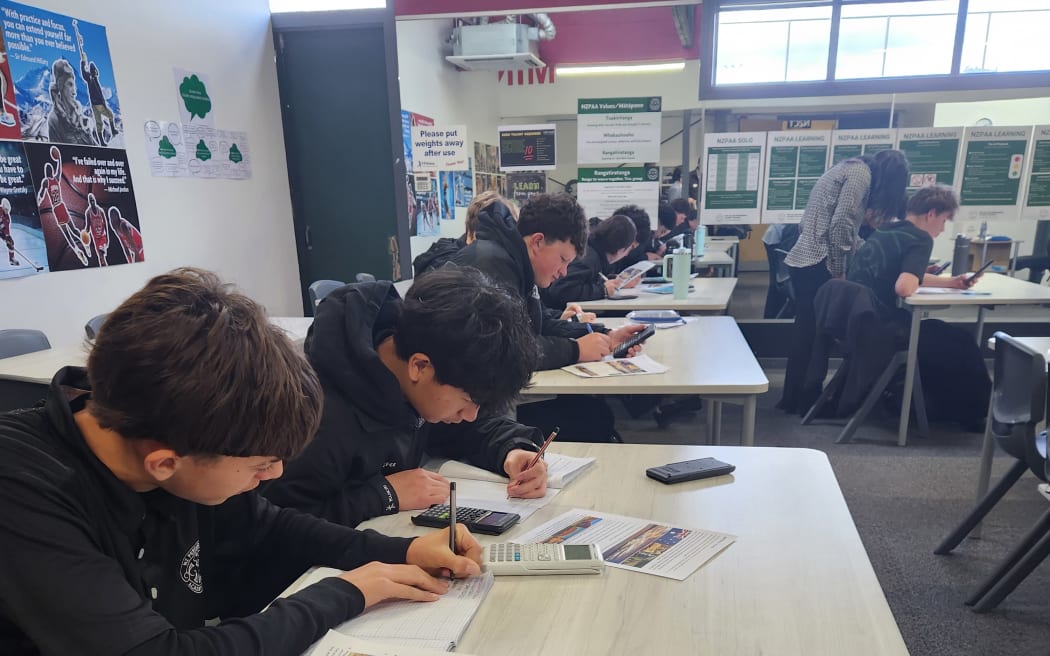
A maths class at the New Zealand Performance Academy Aotearoa.
Photo: RNZ / John Gerritsen
Some state schools have stopped short of becoming charter schools because they do not want responsibility for expensive property problems, says the associate education minister
David Seymour has repeatedly stated that conversions by regular state schools to the bulk-funded charter model are imminent but so far none have made the switch.
During a visit to recently-established charter the New Zealand Performance Academy Aotearoa in Trentham, Seymour told RNZ about 20 state schools had investigated the charter model and a conversion could happen at “almost any moment”.
“There’s been I think about 20 who have gone from various stages of kicking the tyres right up to signing a contract and none have yet largely because… once they realise the liabilities that any state school has they’re actually unwilling to take it on,” he said.
“You take on the liabilities for the property and the maintenance. There’s been examples where they’ve said ‘we’re good to go but this school’s got asbestos’.”
Seymour said another reason was converting schools would keep staff collective agreements negotiated with teacher unions and they were not flexible
“That’s really exposing your ability to direct teachers under these contracts and change around your staff and basically do stuff to get better results for your students is a bit more limited,” he said.
The charter schools established to date were focused on particular student groups or subject specialities.
Seymour said they showed that education could be different.
“These aren’t big schools but they are all schools that are filling a need for particular students,” he said.
He said one charter school – Northwest College in Auckland – recently asked to extend its target roll to 450.
During an open day at the New Zealand Performance Academy Aotearoa this week, classes of about 10 students were studying subjects in lessons invariably linked to sport.
A science class was testing pulse rates after exercise, a history class learned about world events and social movements through the lens of the Olympic Games, and an English class was down to study Foreskin’s Lament – a play set in a rugby training room.
Some of the school’s more than 80 students told RNZ the school allowed them to focus more on sport than their previous schools and they were enjoying smaller class sizes.

Year 11 students Ryan Dednam and Waikareao Tapurau.
Photo: RNZ / John Gerritsen
Year 11 student Waikareao Tapurau said she was one of two netballers at the academy and their programme included two hours training each week with the coach of the Pulse netball team.
She said small class sizes helped a lot and she felt the teachers were more supportive of students.
Another Year 11 student Ryan Dednam said the academy was very different to his previous school where he said some teachers didn’t know his name after a year of classes.
“It’s a lot more personal,” he said.
Dednam said he was the only student focused on volleyball and played the sport for the under-17 Wellington team.
Academy principal Ryan Clark said the school did not have enough students to field teams in several sports and those students played for other schools or for club sides.
The school was set up by the owners of the Wellington Phoenix Football team and Clark said 38 of the school’s students were footballers.
He said those who were in the Phoenix’s academy team played for that team while the others played club football.

New Zealand Performance Academy Aotearoa principal Ryan Clark.
Photo: RNZ / John Gerritsen
But Clark said not all of the school’s students were high-performing athletes and the academy was focused on being a school first and a sports academy second.
He said a student who struggled at his previous school had flourished at the academy because of its focus on establishing a sense of belonging and identity.
Meanwhile, the Charter School Agency said charter schools were cheaper to set up than state schools of the same size, primarily because they were funded for fewer staff for less time prior to opening their doors.
For example principals were paid for four terms before a new state school opened and two terms before a charter school opened.
It said a 100-student primary school would receive $638,249 in establishment funding while a charter would receive $401,675 with most of the difference in staffing – $360,288 compared to $188,260.
A 100-student secondary school would receive establishment funding of $951,399 as a state school including $644,886 for staffing, and $478,758 as a charter including $236,461 for staffing.
Sign up for Ngā Pitopito Kōrero, a daily newsletter curated by our editors and delivered straight to your inbox every weekday.