
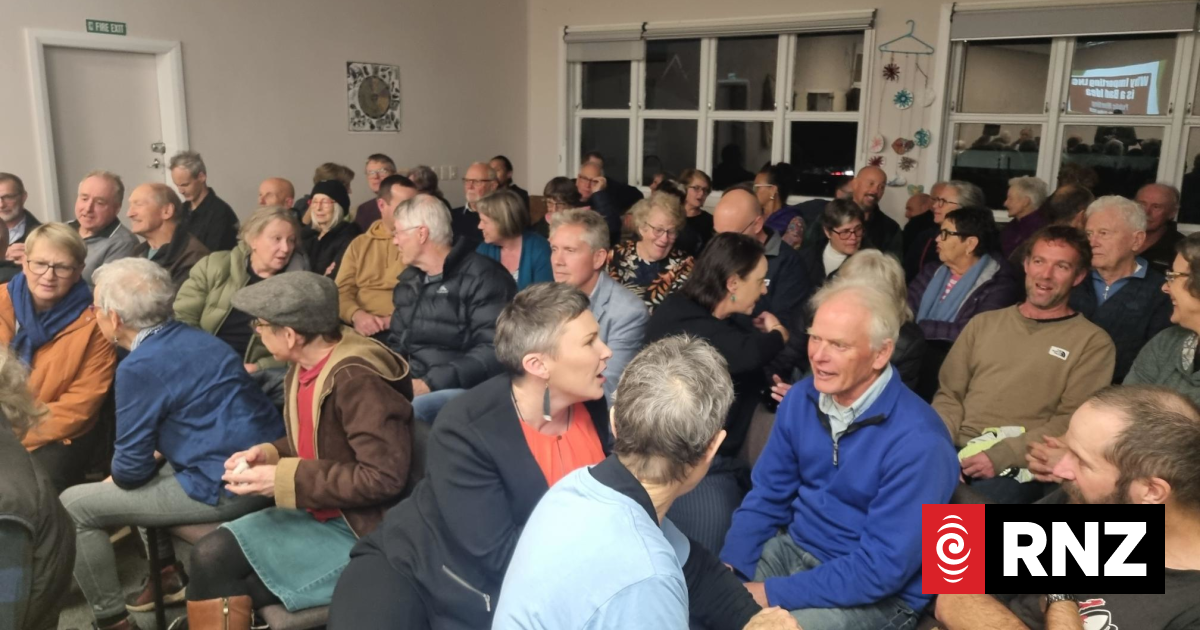
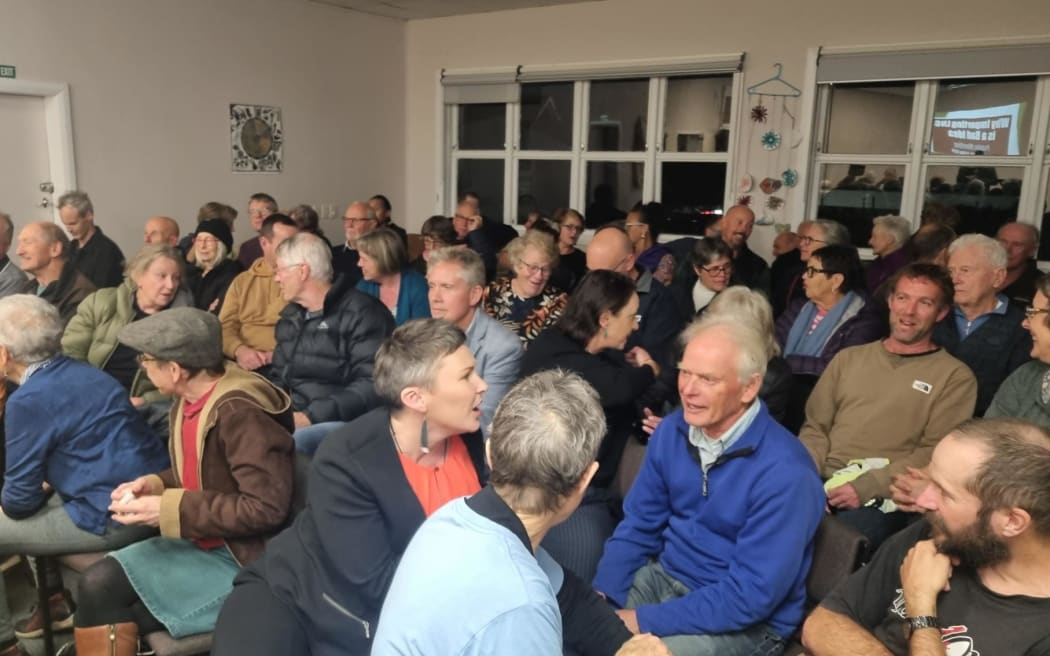
About 100 people attended the “Why importing LNG is a bad idea” event in the St Mary’s Peace Hall in New Plymouth.
Photo: RNZ / Robin Martin
About 100 people have packed into the St Mary’s Peace Hall in New Plymouth to hear from critics of a proposal for a liquified natural gas import facility at Port Taranaki.
The government says with gas supply dwindling, LNG will shore up electricity supply during dry years, keep the lights on and prevent businesses closing. Opponents believe it locks New Zealand into a fossil-fuelled future and is hazardous.
Extra seats had to be rolled out at the “Why importing LNG is a bad idea” event, hosted by Climate Justice Taranaki, Taranaki Energy Watch and Community Energy Taranaki.

Retired energy systems analyst Steve Goldthorpe doesn’t think New Zealand needs LNG for power generation.
Photo: RNZ / Robin Martin
Retired energy systems analyst Steve Goldthorpe told the crowd LNG imports were not necessary.
“It’s difficult and expensive and managing the hazards is a major difficulty and it’s simply the wrong technology for New Zealand. It will lock us into importing expensive gas when we don’t really need it for power generation.”
He said alternatives already existed.
“Big grid-scale batteries to do the daily ups and downs and we’ve always had the ability to up and down the flow through some of the hydro turbines.
“And then for the long-term storage, the power companies are getting together to have a nice big stockpile of coal outside Huntly power station ready to do the dry-year job.”
Goldthorpe said the coal could eventually be replaced by emissions-free wood chip technologies, which would also help remove forestry slash from New Zealand’s hillsides.
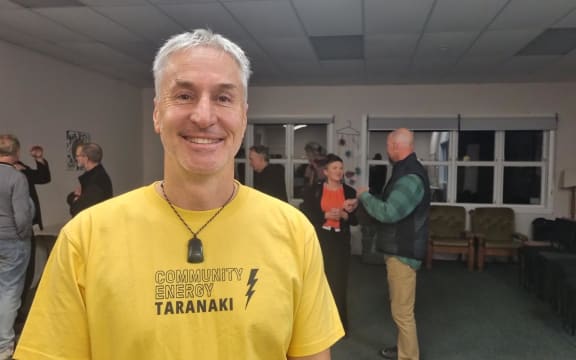
Community Energy Taranaki’s Steve Francis says with solar now being the cheapest form of energy he could not see the need for an LNG terminal.
Photo: RNZ / Robin Martin
Community Energy Taranaki’s Steve Francis thought renewables was the way to go.
“I mean we’re all about a positive future and saying yes to electrification, saying yes to renewables, and so based on what we’re seeing in the market at the moment the tipping point for solar [has been reached].
“Like solar is the cheapest form of energy now and with increased electrification we just don’t see any need for LNG.”
Francis wanted to see cheap loans made available for residential solar.
“Solar uptake in New Zealand is something like 3 percent of residential. In Australia it’s 40 percent so we’ve got enormous potential to electrify things, to get solar panels on our roofs. And it’s good for the cost of living, good for greenhouse gas emissions, it’s even good for local employment.”
Energy Minister responds
In a statement, Energy Minister Simeon Brown said New Zealand was fortunate that 88 percent of electricity already came from renewable resources – mostly hydro but also wind, geothermal and solar.
“However, from time to time, most recently just two years ago, the country experiences a ‘dry year’ when lakes are low, the wind isn’t blowing, the sun isn’t shining and there is insufficient generation to meet peak demand – often in the evenings during winter. These conditions can continue for weeks.”
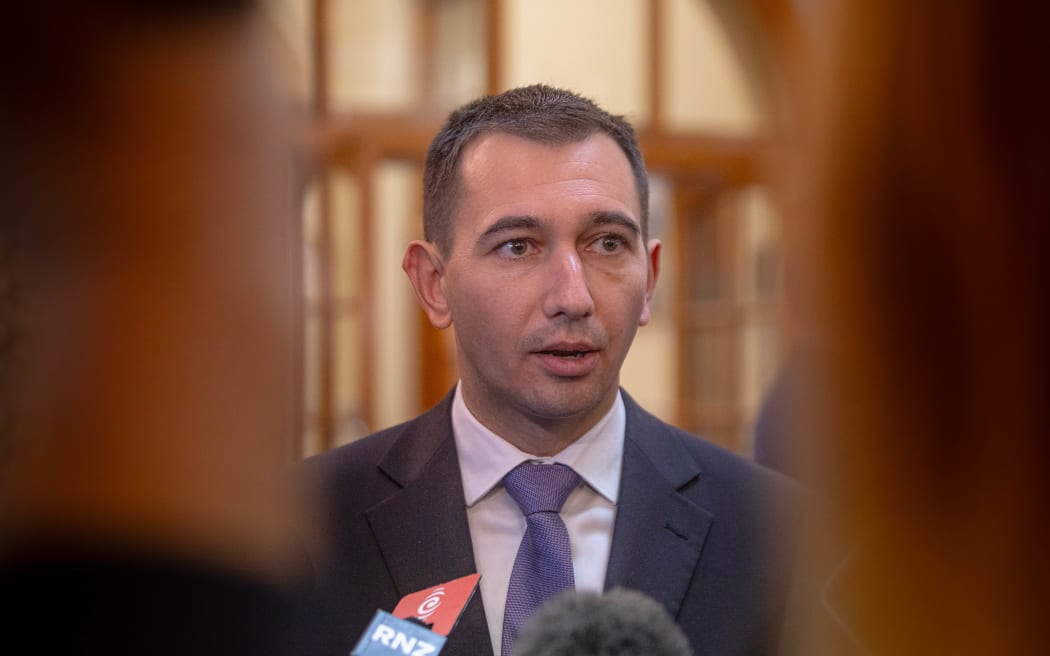
Energy Minister Simeon Brown.
Photo: RNZ / Mark Papalii
Brown said New Zealand had relied on burning coal and gas for back-up, or “firming”, in these circumstances.
“As gas supplies dwindle, LNG is a potential back-up for generating electricity to keep the lights on for all New Zealanders and to prevent manufacturing shutting down, thereby threatening jobs and incomes.
“It’s an insurance policy so that all users can have confidence in a reliable electricity supply.”
Brown said the government totally supported renewables and had fast-tracked several renewable electricity generation projects that were now in the pipeline.
“But unlike the previous government that banned oil and gas exploration, we are not so one-eyed that we will let the lights go out rather than ensure there is back-up electricity generation for New Zealanders when it’s needed. LNG can provide that.”

Energy Watch Taranaki’s Sarah Roberts, left, and Chrissie Ryeburn.
Photo: RNZ / Robin Martin
Energy Watch Taranaki’s Sarah Roberts worried about the safety of a LNG terminal at Port Taranaki.
“Basically it’s the wrong place. No one is looking at the location. Why do we have to put it right next to thousands of people’s homes, schools – you know, communities that live and play at the beach?
“And here we are wanting to put a major industry – bigger than what we’ve ever had before – right in the middle of it.”
She said in a worse-case scenario, fatalities could be expected over a wide area from an explosion at a facility at Port Taranaki.
Brown said the government was going through a procurement process and no final decisions had been made.
“But LNG is a proven and safe energy option. No health and safety standards would be compromised to allow for LNG firming capacity.”
Most meeting-goers were against the proposal.
Alex thought it was a no-brainer.
“I don’t think it’s a good idea. I think the idea of tying us to a carbon future when we have all the evidence we need on climate change is absolutely ridiculous.”
Oil and gas worker Steve was not convinced either.
“I don’t think it’s right for Taranaki and I don’t think it’s right for the port. It’s a lot of money to invest. I’d like to see more in renewables.”
For Chrissie Ryeburn, it was personal.
“I’m still concerned because we are in the blast zone but also all of the schools which are so close to that blast zone, which is about seven.”
The government was aiming to finalise a location for an LNG import terminal and contract a preferred provider by the middle of this year.
If the procurement process was successful, the facility could be operational in 2027.
Sign up for Ngā Pitopito Kōrero, a daily newsletter curated by our editors and delivered straight to your inbox every weekday.