
Photo: RNZ/Liam K. Swiggs
The Budget boosts spending on curriculum changes and trade training for teens, freezes nearly all tertiary subsidies and fast-tracks a modest boost for early childhood services.
The Budget increased spending on schools and early childhood education by nearly $2 billion over the next four years.
It provided a 2 percent increase to schools’ operations grants and a 1.5 percent increase to early childhood subsidies, raising the annual spend on each by about $45 million and $42m respectively with the ECE increase applied in July this year.
The single largest area of spending was $334 million over four years to build more classrooms and schools to keep up with population growth.
The government is introducing a new school curriculum and, from 2028-30, a new secondary school qualification.
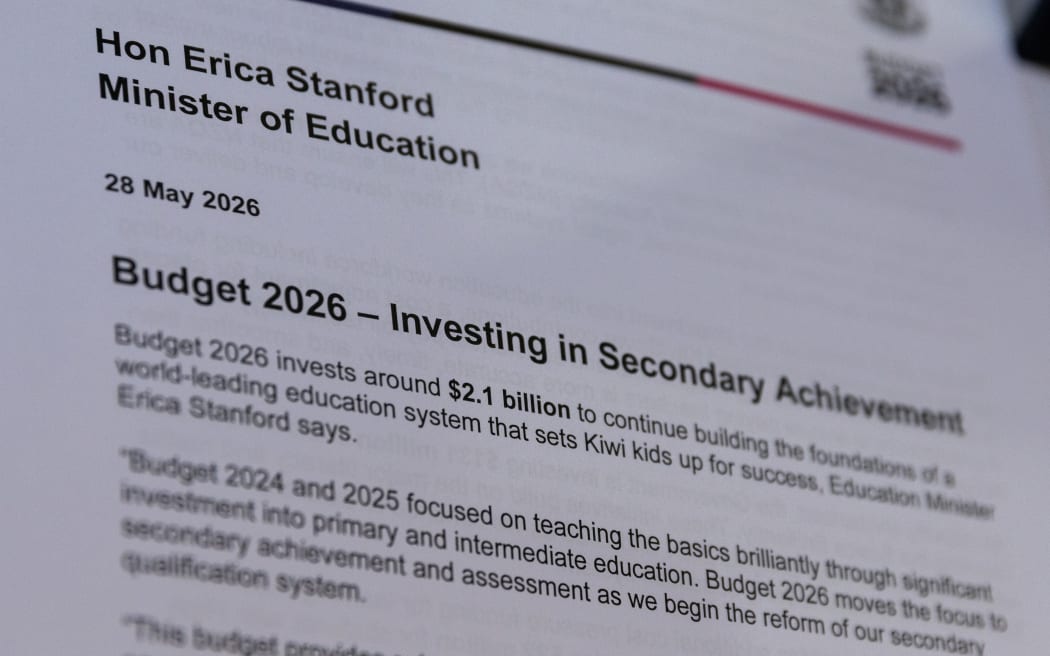
Photo: RNZ / Samuel Rillstone
That work attracted about $240m in new spending.
The largest of those initiatives was a previously announced $131m for reading, writing and maths training, resources and tests.
The Budget allocated a further $61m for resources for secondary schools for the new curriculum, $5.6m for music teaching kits for primary and intermediate schools, and $20m over four years for professional training to prepare the 32,000-strong secondary teaching workforce for the changes – equating to about $625 per teacher.
There was also $15m to pay newly created Industry Skills Boards to develop vocational secondary school subjects and the Qualifications Authority was allocated $8.4m to start work on the new secondary school qualification.
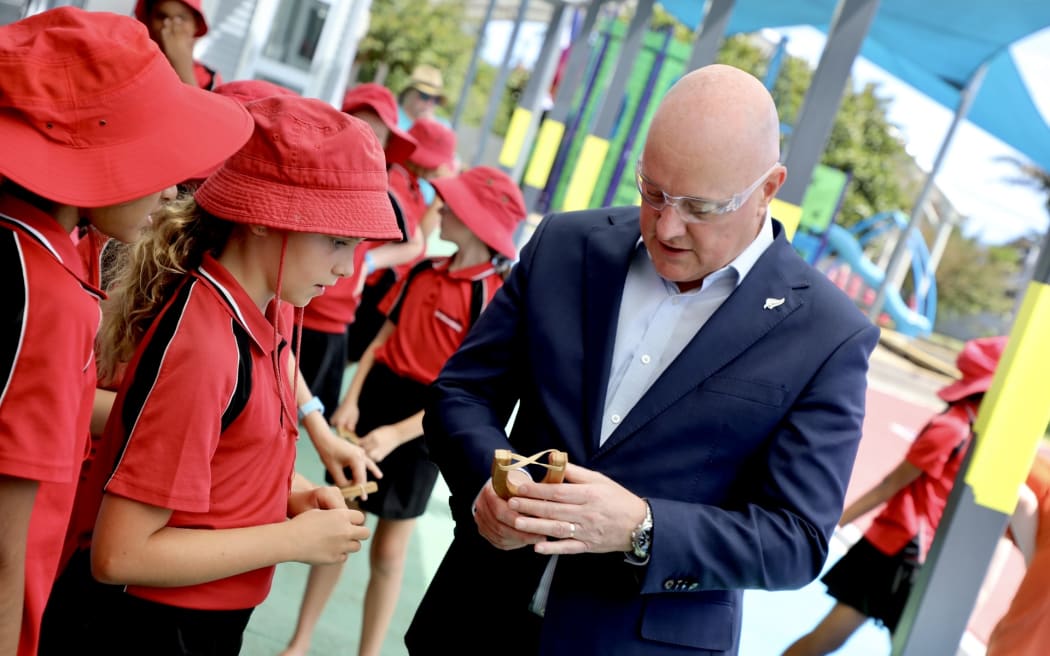
Prime Minister Christopher Luxon visits an Auckland school recently.
Photo: RNZ / Marika Khabazi
NZQA also received $44.5m over four years to plug a shortfall in funding for running NCEA and Scholarship and $31m for technology upgrades, including work on machine learning for marking.
Trades Academies, which provided tertiary vocational courses for school students, were allocated an extra $69m over four years to double the number of students to 20,000 by 2030. The money came from the axing of the fees-free scheme for tertiary students.
The Budget included $212m to continue the free school lunch programme in 2027.
It provided $10m spread over this year and next to help schools cope with an immigration-driven increase in the number of students needing English language support.
There was also $22m over four years to provide teacher aides to enable an additional 100 children with significant health needs to attend school and $12m to help children in care attend and engage in school.
The Budget reprioritised $65m in education spending over four years from programmes including Positive Behaviour for Learning, teacher professional development, the Te Rito IT project, and a fund that helped primary school children at risk of disengaging but had limited evidence of success.
The Education Review Office’s received a $3m-a-year boost to set up a “Schools of Concern” programme to focus on schools with the worst results.
Tertiary subsidies freeze
The Tertiary Education Budget showed the government saved $1b over four years by axing the fees-free scheme.
It provided $284m, most of it in 2026 and 2027, to cover increased enrolments in tertiary education – addressing under-funding that has seen many institutions carrying unsubsidised students.
However, subsidy rates remained unchanged except for a 2 percent increase for foundation courses.
Tertiary institutes would be permitted to raise their fees for domestic student by up to 6 percent next year – the third consecutive 6 percent rise.
The Budget redirected $22m a year ($87m over four years) from the fees-free savings to provide 1000 more places in the Youth Guarantee scheme for students enrolling in foundation courses at tertiary institutes.
It said $37.5m would be cut from the Education Ministry, Tertiary Education Commission, and tertiary education budget.
Sign up for Ngā Pitopito Kōrero, a daily newsletter curated by our editors and delivered straight to your inbox every weekday.