
Point your face at a foreign menu and read the English version floating in your lenses. Shoot a hands-free video of the meal. Ask ChatGPT what to order, then take walking directions that hang in the air in front of you. No phone in your hand for any of it.
That gadget is now on sale in Australia, and it weighs 49 grams.
Chinese AI and AR pioneer Rokid officially launched its smart glasses range here on 29 May 2026, at an invitation-only showcase called “The Future, In Sight” at Art + Gallery in Potts Point, Sydney. Local distribution is exclusive to Sydney-based 360 International Trading, the same crew that put Roborock, Segway-Ninebot and Bambu Lab on Australian shelves.
The pitch for the flagship Rokid Glasses is simple enough: hands-free photos and video, an onboard AI assistant, and real-time translation across 89 languages with live subtitles, all from a frame that reads as ordinary eyewear. The harder question, the one iTWire readers will actually care about, is whether the hardware backs up the talk. Having spent time with the spec sheet, the live demo and the glasses in my hands and of my face to review, I think it’s closer than the smart-glasses category has managed before.
There is, of course, the Meta Ray Ban Display. It’s not available to buy yet in Australia, and you need an appointment at a US store to get them.
Meta’s glasses have a colour display in the right lens only, rather than across the two lenses in green appearing as one much larger image in front of your eyes as Rokid AI/AR glasses offer, and as you’ll see in the various videos interspersed throughout this article from YouTube.
This includes my own recording of the Australian launch event on Thursday 28 March, which the video playing above this description may well already be playing, and the article also features interviews with Rokid’s Global General Manager, Zoro Shao, launching Rokid on what is also his first visit to Australia, and Ted Wu, a Director of the aforementioned 360 International Distribution. The third presenter of the launch below Peter Zhuang, also a director 360.
All three officially launched Rokid in Australia at its launch event below – after which this article continues, please watch and read on!
What’s actually packed into the frame
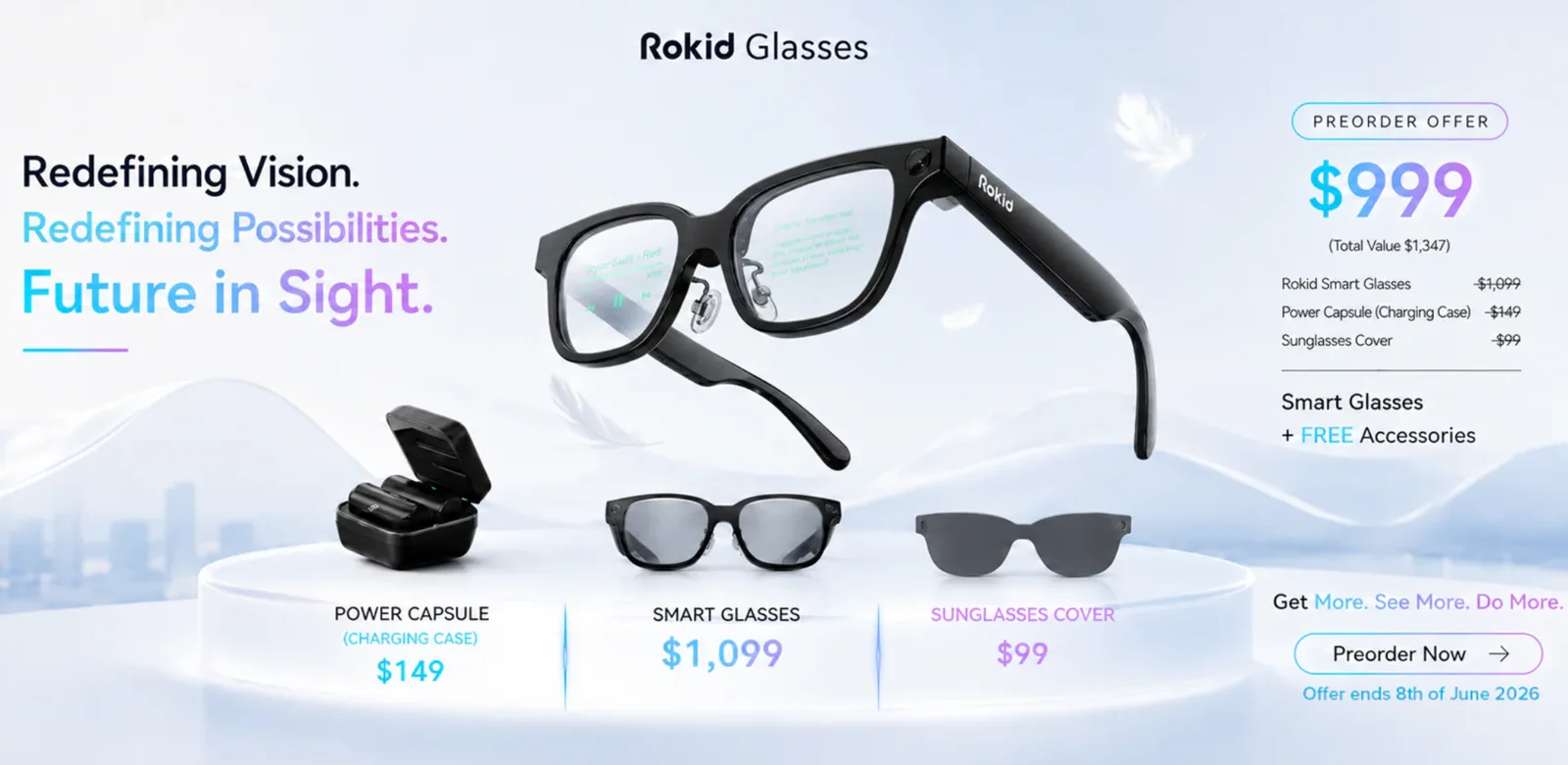
At 49 grams, Rokid Glasses sit in the same featherweight class as Meta’s Ray-Bans, except the Rokid Glasses have a screen. 2 of them, in fact: dual-eye micro-LED displays driven through micro-waveguides that project a heads-up view onto both lenses.
It’s in green lettering, reminiscent of computing’s green screen monitor days, and even the original Terminator movie’s heads up display for Arnie the terminating nightmare android killer robot from the future, no less. Easily viewable and large green screen AR is now real, with ChatGPT or Gemini letting you ask and see the answer as text, right in front of your eyes.
360 International Distribution Director Peter Zhuang explaining this made the point that matters in this country. The display hits 1500 nits, so it stays readable under the Australian sun, then goes fully transparent when it’s idle. Anyone who’s tried to read a dim wearable display on a Sydney summer day will appreciate the brightness. And while Meta’s Ray Ban Display glasses with neural band is public knowledge, it’s not on sale in Australia, only the US, and you need an in-store appointment and visit to actually buy one, and no such stores exist in Australia – yet.
The camera is a 12-megapixel Sony sensor shooting up to 1680P video (Rokid quotes 4K-grade stills at the launch). There are open-ear stereo speakers, a 4-microphone array for voice pickup and translation, and an IPX4 splash rating. Battery life runs all day on standby, with around 6 hours of live translation.
The clever part for the four-eyes among us: prescription and astigmatism lenses snap on via magnets. The demonstrator, who wears glasses himself, kept the clip-ons on all day and noted that non-prescription users just pop them off and treat the frame as plain AI glasses.
When the battery runs low, a “power capsule” (available as a separate purchase) can be clipped to the back like a top-up charger and hits 80% in about 20 minutes. There’s also a female USB-C to magnetic attachment cable and a charging case for travel, AirPods-style, with the charging case also available as a separate purchase.
Pick your AI: Gemini or ChatGPT
Here’s the bit that separates Rokid from the walled gardens. The glasses don’t lock you into a single assistant. You choose between Google Gemini and OpenAI ChatGPT, with Google Maps and Microsoft services also in the mix.
“It pairs with a 12-megapixel camera and the premium audio functions, and it’s enabled with LED display delivering a truly immersive smart experience,” said 360 International Trading Director Ted Wu at the launch. “It comes with an open ecosystem. It’s compatible with both ChatGPT and Google Gemini. It gives the end user the total freedom to choose their preferred AI agent.”
That open stance is the company’s core strategy, and it’s a genuine point of difference against Meta, which routes you through its own Meta AI. Rokid Global General Manager Zoro Shao told the room the glasses have shipped more than 400 hardware and software iterations since launching last year, so the device keeps improving after you buy it. 2-finger AI shortcuts (or simply saying Hi Rokid) trigger the assistant without menu-diving.
The full Rokid range
The Sydney showcase walked through Rokid’s full lineup rather than a single hero device.
The flagship Rokid Glasses are the all-day pair with the dual displays, camera and translation. The Rokid AI Glasses Neo drop the display for an even lighter 38.5-gram frame with swappable lenses (myopia, astigmatism, anti-scratch or photochromatic) in 6 colours, aimed at people who want audio, comfort and voice AI without a heads-up screen.
Then there’s Rokid AR Spatial, a bigger 75-gram pair built for sit-down use rather than all-day wear. Paired with its Station 2 companion box, it does giant-screen movie viewing, 3D cinema, spatial media capture and console gaming, with a sports mode that stabilises the image if you’re watching while moving. It’s myopia-friendly with an on-device focus adjustment, so glasses-wearers can leave their specs off.
I tried Rokid’s AR Spatial glasses at the launch event, too and yep – they work as advertised. Very cool and show a massive screen in front of you, without the Vision Pro heft, but clearly not in the same class as the full-fat Apple Vision Pro experience.
For iTWire’s enterprise and developer readers, the more interesting hook is the ecosystem behind the hardware. Rokid claims more than 30,000 registered XR developers and 5,000 enterprise partners worldwide, working on translation, accessibility, productivity, field-service and other industry workflows. The company says it wants to recruit Australian developers, creators and solution providers next.
Why now: the numbers behind the hype
Rokid isn’t a startup chasing a trend. Founded in 2014, it calls itself an AI unicorn, says more than 60% of its staff are R&D, and has shipped 11-plus generations of AR glasses across products sold in over 100 countries.
The crowdfunding track record is the eye-catching part, so to speak. As a pundit, that pun in intended.
Rokid Glasses closed the most-funded XR campaign in Kickstarter history at just over US$4 million from roughly 5,800 backers across 80-plus countries. In Japan, it became the most successful AI glasses project on Makuake, clearing ¥200 million in 10 days. Shao says Rokid has now sold more than 500,000 units to a global community north of 1 million users, with international business up 300% year on year.
The trophy cabinet is filling up too. Rokid Glasses took a 2026 Red Dot Design Award, the lighter Style model landed a Best of CES 2026 nod, and the company points to 5 iF Design Awards and a gold medal at the Geneva International Exhibition of Inventions. Shao says Rokid kit is now stocked in premium retail including Selfridges in the UK and Optica 88 in Hong Kong.
Shao leaned on a line from tech forecaster Kevin Kelly, who reportedly told the company during a visit that “smart glasses will be the next iPhone.” Shao’s own framing: “The era of staring at the smartphone is ending. The era of looking up at the world with spatial AI is here.”
The category just got more crowded – even though the big competitors aren’t actually here yet
Rokid is arriving as the smart-glasses fight goes mainstream. Industry estimates have AI glasses shipments jumping from around 6 million units in 2025 to roughly 20 million in 2026, with Meta’s Ray-Ban range leading after selling 7 million-plus units last year.
Google has entered with Gemini-powered glasses featuring an in-lens display, we saw a prototype at Google I/O 2025, but at Google I/O 2026, the focus was on audio-only AI glasses, with AR glasses set to come “later”.
Google is definitely set to ship audio-only AI glasses this year, but its in-display AR glasses will like arrive sometime in 2027.
And while Apple’s long-rumoured pair of audio-only AI glasses might be a surprise launch later this year, they probably won’t arrive until 2027 – and how much longer before Apple AR glasses in the style of Rokid’s glasses will arrive? 2027 too, or longer?
Against that field of still to ship competitors (barring Meta’s Ray Ban glasses), Rokid’s selling points are weight, a bright display the rivals don’t all offer, open choice of AI, and snap-on prescription lenses. The risk is obvious: brand recognition. Most Australian shoppers know Ray-Ban and Google long before they know Rokid.
There’s also a neat Australia-specific angle. Shao made a point of the translation feature for what he called “a proud multicultural nation,” and live language demos ran throughout the event. For a country where roughly a quarter of residents speak a language other than English at home, real-time subtitles in your eyeline is more than a party trick.
What it costs, and when you can get it
Rokid Glasses are available to pre-order now at rokidstore.com.au. Order between 14 May and 8 June 2026 and the price is A$999, which is A$100 off RRP, with 2 freebies thrown in: a battery capsule and a clip-on sunglass. Standard pricing of A$1,099 kicks in from 9 June 2026.
Every Rokid product bought in Australia carries a 1-year warranty, with local support at [email protected] and the Rokid website. Wider retail availability through authorised stores is promised “in due course,” which is the usual wording for “watch this space.”
“We’ve been watching Rokid’s momentum globally and knew the time was right to bring this technology to Australian consumers,” said 360 International Trading Director Peter Zhuang. “Smart glasses have often felt like a concept rather than an everyday product. Rokid changes that, and we’re excited to introduce it to this market.”
Shao put the ambition more grandly: “This launch represents more than introducing a product. It is about opening a new chapter for AI-powered interaction and spatial computing in the region.”
The verdict on smart glasses has been “nearly there” for the better part of a decade. A 49-gram frame with a bright dual display, your pick of ChatGPT or Gemini, snap-on prescription lenses and a sub-$1,100 price is the most convincing “nearly there” I’ve seen land in Australia. Whether Aussies reach past the Ray-Ban they already recognise is the A$1099 ($999 until June 8, 2026).
I’m happily wearing a pair of Rokid’s glasses to find out, and a full review will be forthcoming.