
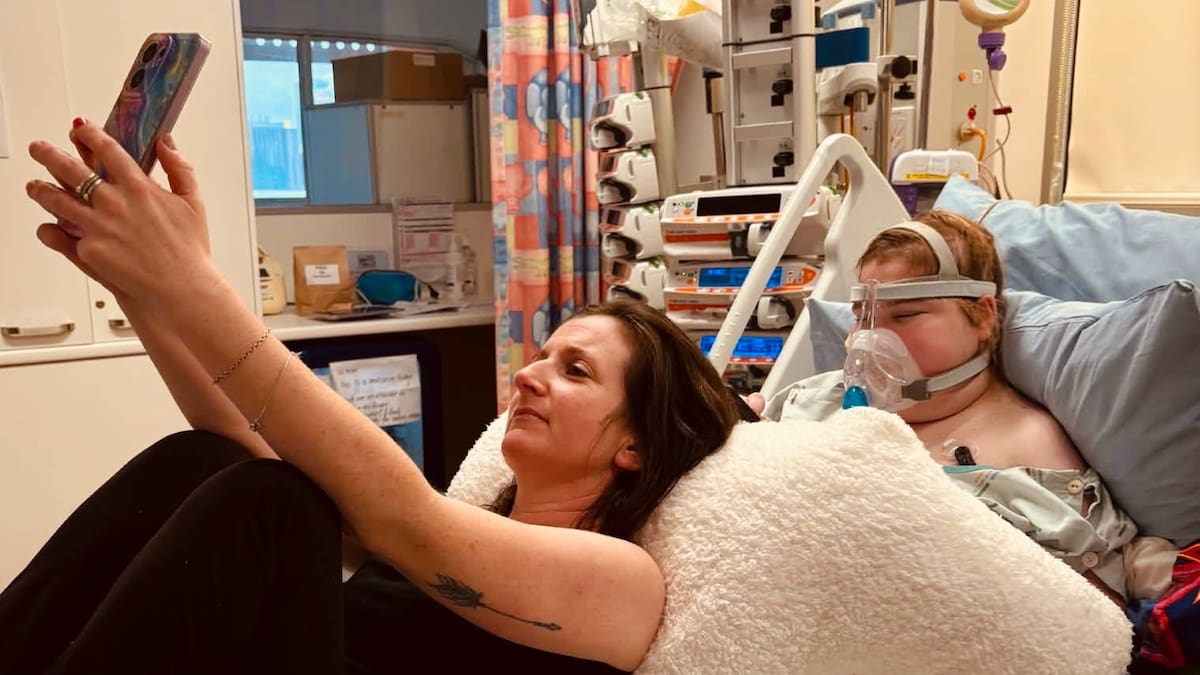
Gailey told the Herald she was asked to “gather the family” last Friday, as her daughter wasn’t expected to survive the night.
Tayler and her sibling Hunter.
A Givealittle page has been set up by a family member to help raise funds for travel, food, and accommodation costs for Tayler’s family while they travel from Taumarunui to Auckland to care for her.
The latest diagnosis brought a cruel twist.
Gailey said a further biopsy showed “three gene mutations identified [in her tumour] are those of which you would see in radiation-induced [tumours]”.
“Because it’s within a certain time frame and within the radiation field, it’s classified as that.”
Gailey said Tayler was due to receive further radiation in an attempt to slow the tumour’s growth.
“But once again, it’s because she’s palliative, like she’s not expected to see any side effects of it.”
When her daughter was first diagnosed at 2, Gailey said the radiation side effects “were never meant to matter”.
Tayler was diagnosed with diffuse intrinsic pontine glioma (DIPG) in 2011, and was given nine months to live.
She underwent “aggressive” radiation treatment, then was placed in palliative care, then hospice.
Doctors were “convinced she had DIPG”, a disease with few long-term survivors.
“She was never meant to live to see them.”
Against all odds, Tayler survived.
Tayler Paige was diagnosed with diffuse intrinsic pontine glioma (DIPG) in 2011. Photo / Lisa Gailey
Her mother said she lived with “a lot of radiation injury”, including mobility and cognitive difficulties, speech impediments, multiple surgeries, and a hip replacement.
Despite the challenges, Gailey said her daughter carried herself “with pride” over the past 15 years.
Then, on her 17th birthday in February, Tayler made a comment that changed everything.
“Don’t you just hate it when half your face is numb?”
She was taken to Waikato Hospital where an MRI revealed “another bigger and deeper” tumour deep within her brainstem.
“After 15 years, you think you got away with it, like you think you got really lucky,” Gailey said.
“All of a sudden [it’s back].”
Gailey said she was later told by doctors that it’s “very rare” for someone to get a radiation-induced tumour, with chances between 1 and 2%.
Tayler was supposed to start radiation on May 20 at Waikato Hospital, but developed pneumonia three days before starting.
She was transferred to Starship children’s hospital, where she continued to fight before another setback.
Her lung collapsed, and she’s only breathing with a “small portion” of her right lung now.
Gailey said Tayler was caught in a heartbreaking cycle: she was due to receive radiation intended to slow the tumour’s growth, but her pneumonia had to improve before treatment could begin.
“It’s the first time ever that the cancer has actually taken anything from her.
“It’s the first time it stopped her progressing.”
The Gailey family before Tayler was diagnosed on her 17th birthday. Photo / Jess
Gailey said she remains uncertain about what another round of radiation could mean for her daughter.
“I don’t know neurologically how another dose of radiation will leave her, it can be pretty destructive,” she said.
“But until now, it’s the only thing that can stop it in its tracks and relieve some of the symptoms.”
She wants other parents in a similar situation to ask the hard questions about radiation side effects.
“I have a sense of guilt, like what if I’d gotten a second opinion? I was only 23 at the time, and I just really didn’t know I could argue,” Gailey said.
“Now, I can pretty accurately find the information on Google and ask the right questions, but back then, I couldn’t … This time I’m definitely way more informed.”
Still, Gailey said she has reached a “sense of acceptance”.
“Watching her struggle to breathe and being miserable in a hospital bed, I just don’t want her to suffer.
“I don’t want to preserve her in a body that doesn’t work so she can watch everyone else live.
“She spent her whole life trying to be just like everyone else.”
Tayler is the second-youngest of four siblings and the family has faced the journey together since her diagnosis.
Her youngest brother was just 12 weeks old when she was diagnosed. The pair, only 20 months apart in age, were toilet-trained together and attended kindergarten together.
When the family was told Tayler might not survive the night, he drove 29 hours from Invercargill to be by her side.
“Because he’s never known life without her.
“All my kids are very close. It’s going to destroy them.”
For now, though, Tayler remains herself.
Gailey said her daughter still has “the biggest smile on her face”.
“Cognitively, she’s still all there. She still has sass and attitude some days, and a sense of humour. She very rarely complains.
“She’s too good for this world, too gentle.”