

Sharad Jain, Mastercard’s country director for Vietnam, Laos, and Cambodia, speaks with VnExpress about the emergence of a new digital lifestyle in Vietnam.
– What strikes you most about Vietnam’s digital payments market?
– Vietnam is one of the most dynamic digital payments markets I have ever seen. Our New Payments Index report shows that 70% of Vietnamese consumers prioritize new and modern payment methods, the highest figure in the Asia-Pacific region.
What stands out is not just the pace of growth, but how deeply digital payments have woven themselves into everyday life. In many other countries, digital payments are mainly concentrated in major cities or among younger users. In Vietnam, it is far broader, reaching people across all walks of life.
You can see QR codes everywhere, from coffee shops and taxis to street vendors, showing how quickly Vietnamese people adapt to new technology and how strongly they favor mobile devices. They are also very open to new solutions. If something is convenient enough, they will change their habits very quickly.
Digital payments in Vietnam are no longer a new technology. They are gradually becoming the default experience in daily life.
– From your perspective as a foreigner living in Vietnam, how is that experience different?
– I would sum it up in two words: convenience and deep integration.
In many markets, there is still a clear gap between modern retail systems and small individual businesses. But in Vietnam, you can genuinely go out all day without needing a physical wallet.
From booking a ride and paying bills to buying street food, almost everything can be done on a phone. This reflects both how Vietnamese people embrace technology and a truly “mobile-only” way of life.

Sharad Jain, Mastercard’s country director for Vietnam, Laos, and Cambodia. Photo by Le Thi
– What do you think about QR codes becoming the dominant payment method in Vietnam after Covid-19?
– The rapid rise of QR payments in Vietnam is a remarkable phenomenon. Our 2024 data shows QR is the most widely used payment method in the country, with around 65% of consumers using it. We have seen similar trends in China, India, and Indonesia. But Vietnam is going beyond payments alone.
Vietnamese users are forming a “digital lifestyle”; they want every experience to be fast, simple, and phone-based. This is also reflected in the data when a Mastercard report found that 93% of Vietnamese users tend to flexibly use five or more payment methods.
– But the popularity of QR codes has also created difficulties for foreign visitors, as some shops no longer have POS terminals or accept international cards?
– This is a challenge that appears in markets with fast-growing QR payment adoption. It is understandable that small businesses prefer phone-based payments, since it is more cost-effective than investing in traditional POS terminals. However, this unintentionally creates a barrier for international visitors who are accustomed to paying with contactless cards or global digital wallets.
From a tourism economy perspective, accepting multiple payment methods matters greatly. When visitors can pay easily, they tend to spend more and engage with more local services.
The challenge now is not about QR codes replacing cards or vice versa, but about making these methods coexist and connect. We have worked with local partners to enable international visitors to pay at domestic QR code points. Another approach is helping merchants turn their smartphones into payment devices in place of traditional POS terminals.
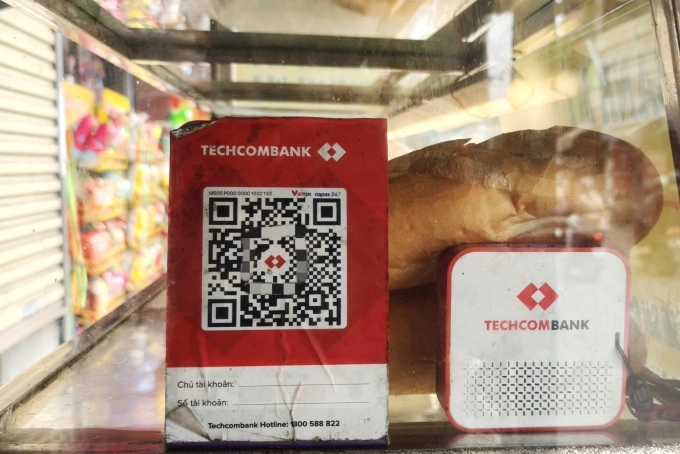
A QR code for bank transfers and a payment notification speaker at a banh mi stall in Hanoi. Photo by Trong Dat.
– What does Vietnam gain by continuing its digital transformation in payments?
– Digital payments help remove many friction points when users interact with digital services. For local residents, the obvious benefits are convenience, speed, and better spending management. For tourists, the impact is even more tangible; they no longer have to worry about exchanging cash or finding places that accept cards, making the overall experience far smoother and encouraging international visitors to spend more.
From an economic standpoint, digitizing transactions increases transparency and promotes financial inclusion. With digital transaction data available, small businesses also find it easier to access formal financing to grow.
– As digital payments become mainstream, what will be the industry’s next frontier?
– Over the next five to ten years, the focus of the payments industry may shift from expanding the user base to improving the experience.
One major trend is “embedded payments”, which means integrating payment into every user experience. This is especially evident in e-commerce and social media, where the gap between discovering a product and buying it is narrowing all the time.
The next trend is AI becoming more deeply involved in commerce. AI assistants may help users complete certain transactions such as booking rides, handling routine purchases, or planning trips. However, as payments become increasingly “invisible,” digital trust in data protection will become the defining factor.