
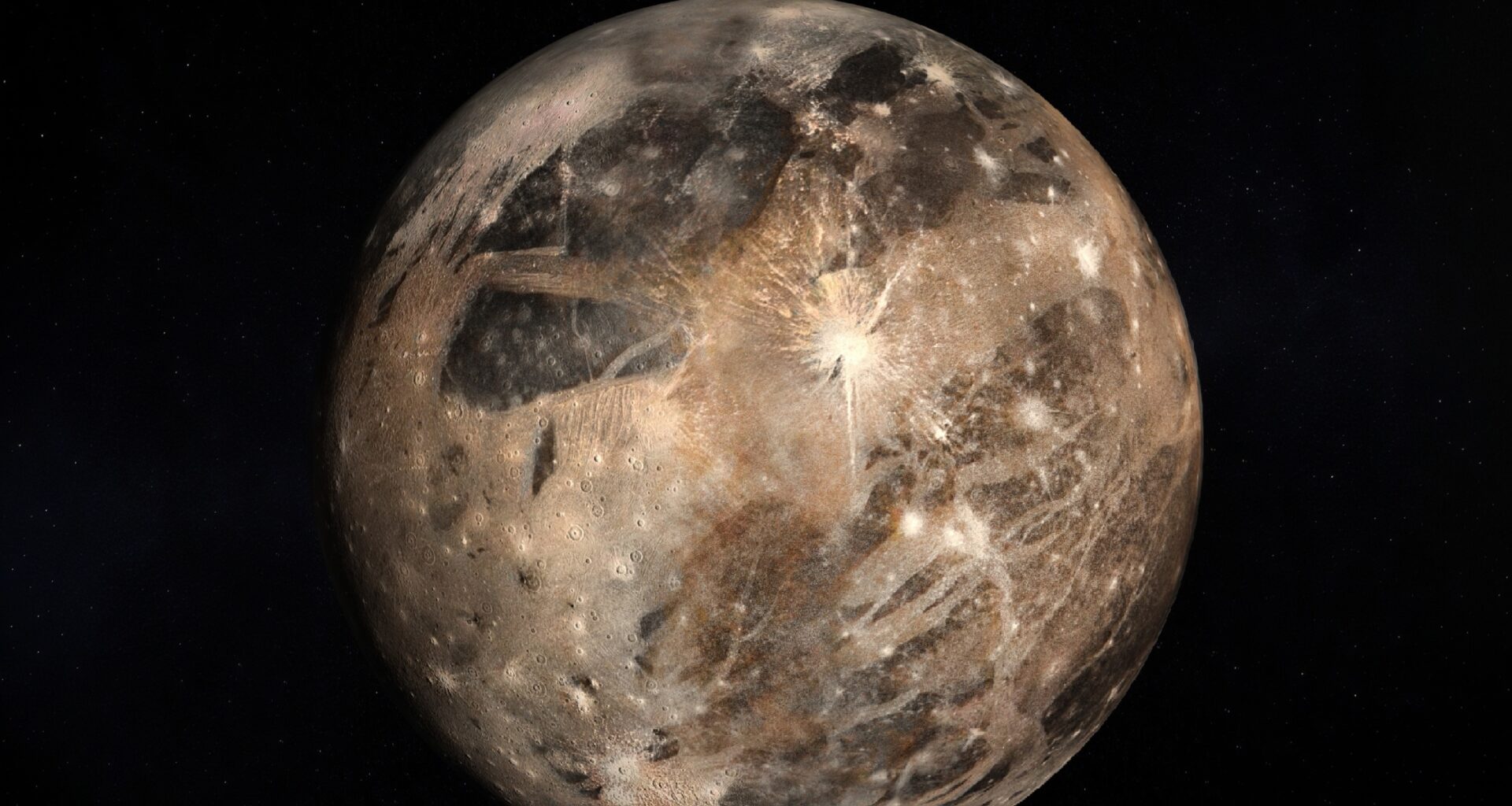
In 1996, NASA’s Galileo spacecraft flew past Ganymede, Jupiter’s largest moon and the largest moon in the Solar System. It detected something scientists never expected to find there: a magnetic field.
Every other moon in the Solar System is magnetically dead, inert rock with nothing moving inside.

Magnetic fields require a dynamo: conductive material churning in the deep interior, generating electrical currents that sustain the field.
Planets do this routinely. Ganymede, uniquely among moons, seems to do it as well.
A new paper proposes an answer – and if it’s right, Ganymede isn’t just unusual. It’s unique in a way that nobody anticipated.
The magnetic field, the researchers suggest, may be powered by a core that is still forming.
The standard explanation
The way Earth generates its magnetic field is reasonably well understood. The outer core – a shell of liquid iron and nickel surrounding the solid inner core – churns constantly, driven by heat and compositional differences.
Those motions generate electrical currents which sustain the magnetic field. It’s been running for billions of years, and it’ll keep running as long as the core stays liquid enough to move.
For Ganymede, researchers proposed a variation called iron snow. The idea is that liquid iron near the top of the core cools enough to crystallize, sinks through the warmer liquid below, and re-melts deeper down.
That cycling motion drives the convection the dynamo needs. It’s plausible, and for a while it was the leading explanation.
But it rests on the assumption that Ganymede formed hot enough – and early enough – for metals to separate out and build a core back when the Solar System was young.
Some researchers have questioned that assumption. They argue that icy moons may have formed too cold for rapid differentiation – the process that separates dense metals from lighter material and builds a core.
If so, Ganymede’s core could be far less developed than scientists have assumed.
A core building in slow motion
Kevin Trinh, a planetary scientist at Caltech, and his colleagues decided to take that cold-start scenario seriously and model what would happen.
In their simulations, Ganymede begins cold and warms gradually over billions of years – heated by the radioactive decay of heavy elements in its rocks and by the constant gravitational kneading of Jupiter’s enormous tidal pull.
Over time, that warmth does two things. It releases water from the rocks, feeding the vast subsurface ocean Ganymede is known to have.
The heat also melts iron-rich material. This begins a long, slow trickle down toward the moon’s center, building a core grain by grain over geological time.
As that iron drips in and accumulates, it stirs the liquid interior around it. Fresh, dense metal arriving continuously drives convection – and that convection is enough to sustain a magnetic dynamo.
In many of their simulations, this process is still running today. The core isn’t finished and the act of building it is what generates the magnetic field.
“I’m used to thinking of core formation being this ancient process,” Trinh said. The new model suggests it might be delayed by billions of years in the right circumstances.
A narrow range of conditions
There’s a reason this scenario hasn’t been proposed before. It only works within a fairly narrow range of conditions.
If Ganymede had started out too cold, the iron would never have melted and begun separating at all.
If it had started out too hot, the core would have finished forming long ago. This mechanism would have shut down before humans ever existed to wonder about it.
Ganymede, in this picture, happened to form under conditions that have kept the process running for billions of years and haven’t finished yet.
That’s a remarkable coincidence, and some researchers are understandably cautious about it.
Some questions still remain
“In principle, the story sounds interesting and reasonable,” said Doris Breuer, a planetary scientist at the German Aerospace Center, who wasn’t involved in the study.
But with so many factors in play, she’s not totally convinced the model has accounted for everything.
Tina Rückriemen-Bez, a planetary scientist at the University of Münster who reviewed the paper, put the broader implication plainly.
If the still-forming core turns out to be real, “maybe people have to revise how they think about magnetic field generation.”
The next chapter
The good news is that this won’t stay a theoretical question for much longer.
The European Space Agency’s JUICE mission (Jupiter Icy Moons Explorer) is on its way and due to arrive at Ganymede in 2031.
Its instruments will measure the moon’s gravity field with enough precision to reveal how mass is distributed in the deep interior.
The mission will clarify whether iron is concentrated in a compact, fully formed core, or still spread more broadly through the moon’s insides.
Magnetic measurements will add further detail about the core’s size and state.
A world that’s still evolving
If the measurements confirm that the core is still forming, Ganymede will become something genuinely without parallel in the known Solar System.
It would be the only world where a process scientists assumed ended billions of years ago is still quietly unfolding today.
Galileo’s 1996 flyby made Ganymede unique among moons. Nearly three decades of thinking about what that magnetic field means has led to a suggestion that it might be unique among worlds entirely.
The study is published in the journal Science Advances.
—–
Like what you read? Subscribe to our newsletter for engaging articles, exclusive content, and the latest updates.
Check us out on EarthSnap, a free app brought to you by Eric Ralls and Earth.com.
—–