
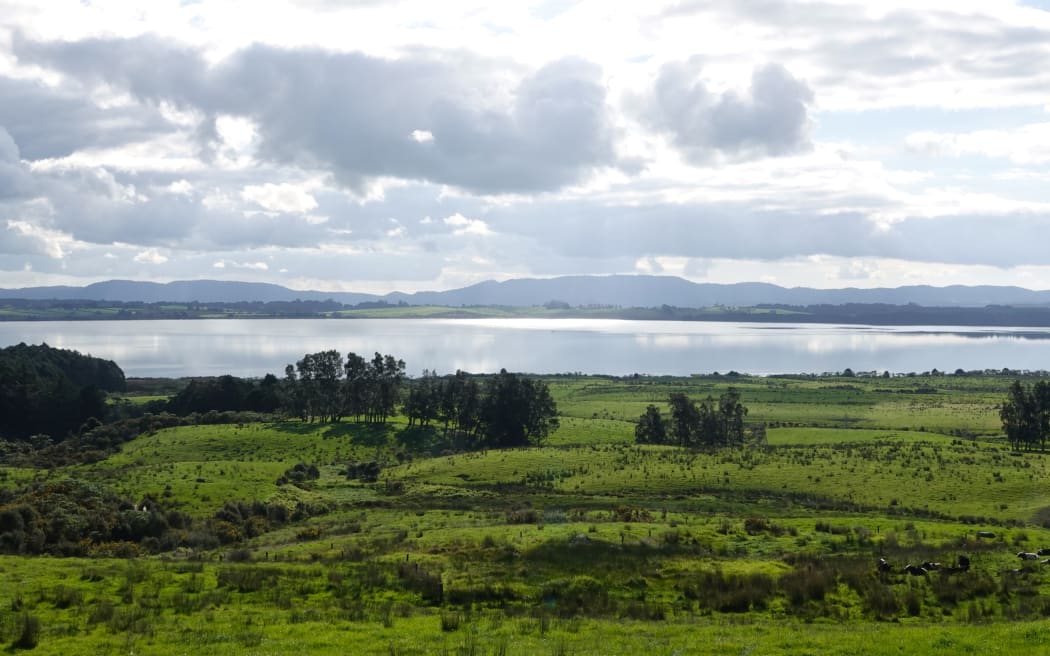
Lake Ōmāpere, north of Kaikohe, is Northland’s largest lake.
Photo: RNZ / Peter de Graaf
It was once known as the food basket of Ngāpuhi – but now Northland’s biggest lake is a lurid green dead zone where little survives the regular algal blooms. Locals have been talking about restoring the lake for decades, but little progress has been made … until now.
When 93-year-old Ani Martin was a child, Lake Ōmāpere was as clear as a bush stream.
“It was just a beautiful lake that we lived around and got our food from. Nice and clean and all that. You could drink it and you could swim in it and you could see things in the water,” she said.
Martin, a Te Uri o Hua kuia, said the lake used to be a place of abundance.
“There was so much eels and fish, we lived on those. Not only that, we had the bush around us, so there was always something we could find to eat. As well as whatever Mother Earth gave us that grew in our gardens. So it was perfect.”
However, all that changed in the 1980s.
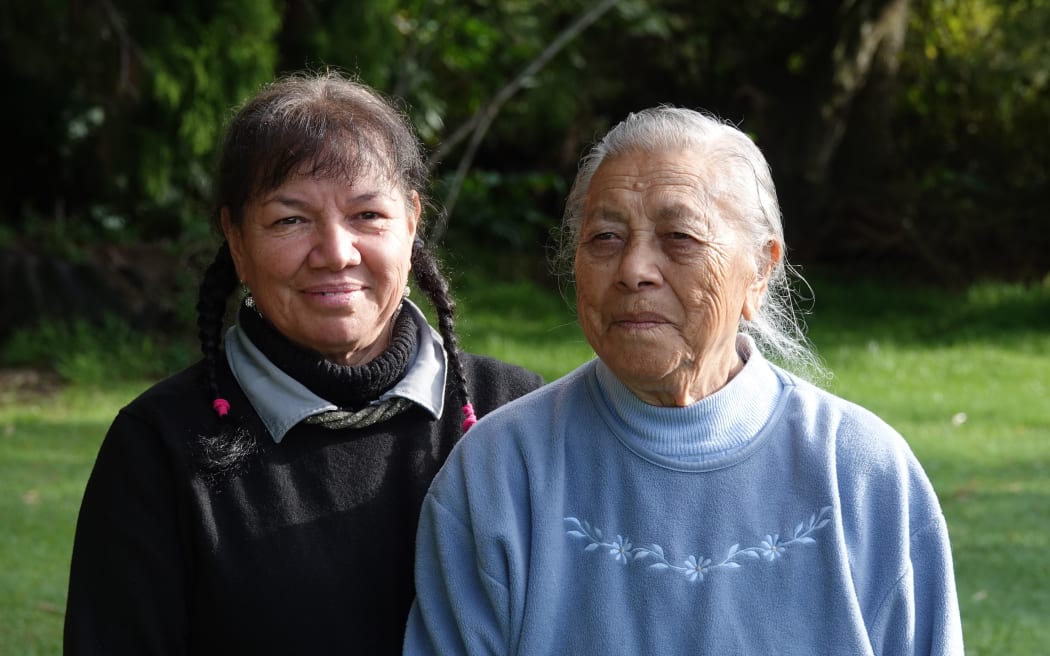
Ani Martin, 93, with daughter Kay Martin, says the lake was as clear as a bush stream when she was a child.
Photo: RNZ / Peter de Graaf
Fish, freshwater mussels and unique aquatic plants disappeared as the 1200-hectare lake, Northland’s biggest, was afflicted by a series of toxic blooms.
The “algal” blooms, actually caused by a type of bacteria, are fuelled by excess nutrients washed from the land ever since Northland’s great kauri forests were cleared more than a century ago.
Now the water supports only swans and a few hardy tuna, or eels.
Martin said she sometimes still put out a hīnaki, or woven trap, to catch tuna so she could show her mokopuna.
But they weren’t for eating – the blooms had put a stop to that.
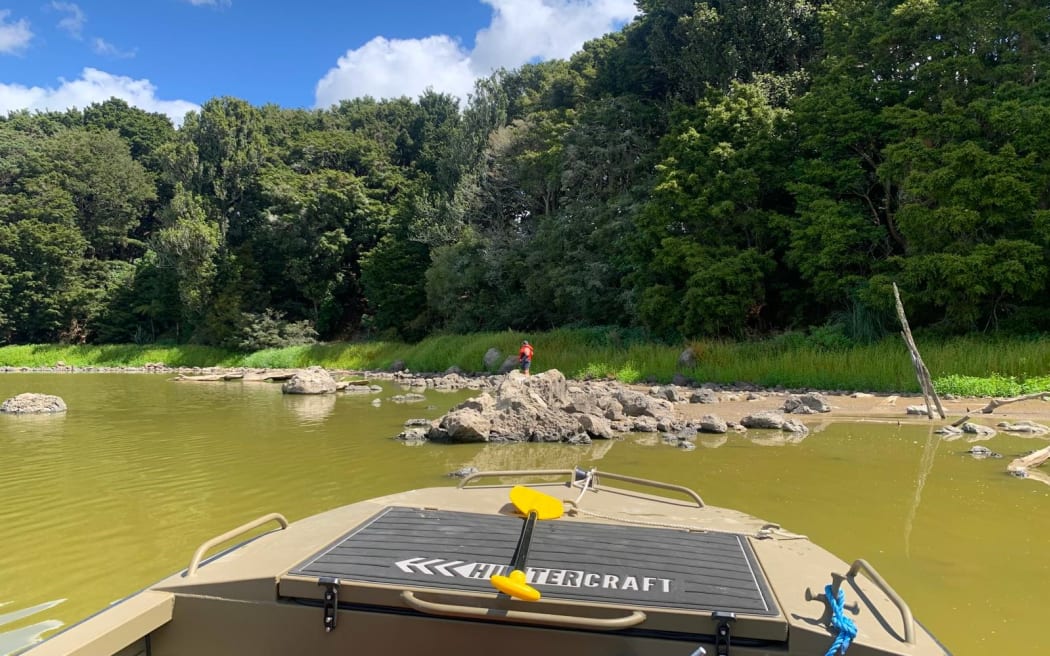
A bloom in March 2025 turned the water a lurid green.
Photo: Supplied / NIWA
For decades locals and experts alike have talked about cleaning up the iwi-owned lake, but their plans have always become bogged down in politics, disagreement or lack of funding.
Other plans have turned out to be impractical, though parts of the shoreline have been planted in native trees and shrubs to reduce nutrient runoff from farms.
Now, however, there is renewed hope the lake can be brought back from the brink.
The Lake Ōmāpere Trust, working with an international expert in freshwater restoration, has come up with a plan it says is workable, cost-effective, and can be sustained into the future.
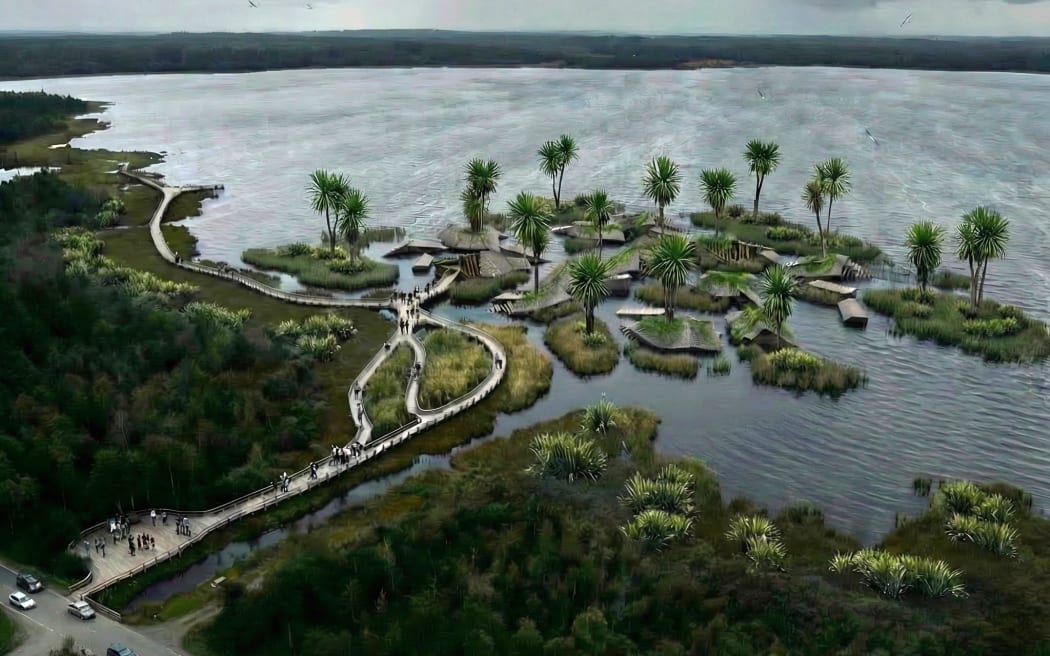
Artist’s impression of the motu tātari, or “filtering islands” to be built around the lake exit.
Photo: Derek Kawiti, Victoria University of Wellington School of Architecture
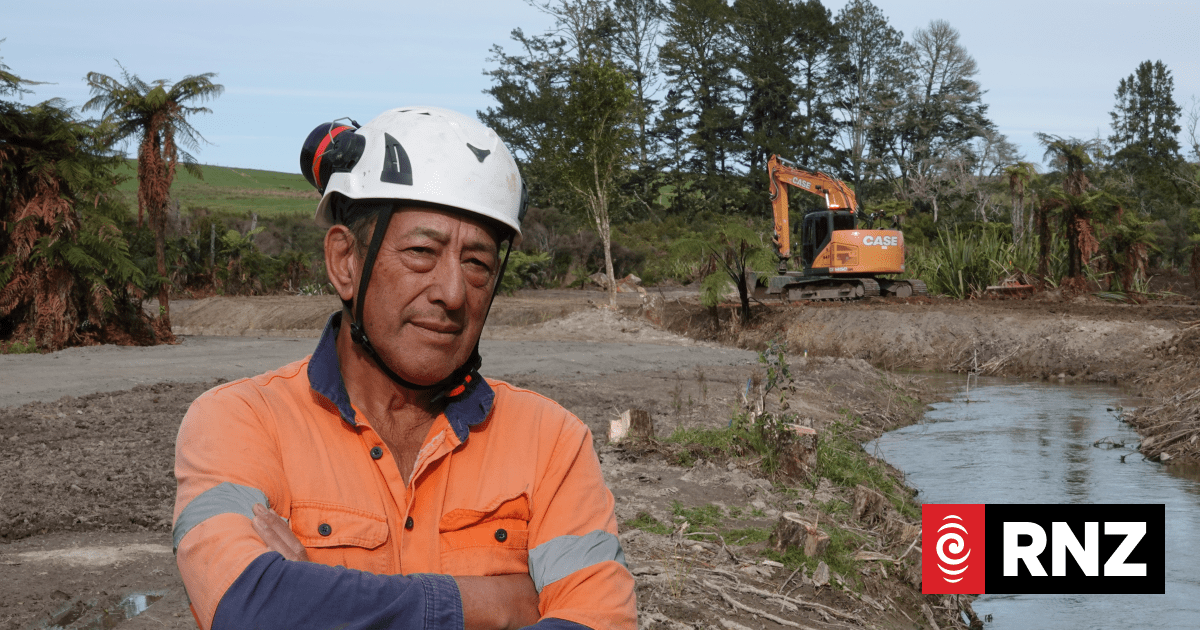
Project manager Hone Dalton said the situation had become urgent.
“I think what the lake is showing us right now is that the system’s in total collapse. We don’t have the amount of time people think we have to restore the mauri [life force]. If we don’t intervene now, it’s never going to happen,” he said.
“Right now we have a really good chance. We’ve got a good plan that we’ve been working on for two-and-a-half years. It’s not like something we plucked out of our bum yesterday.”
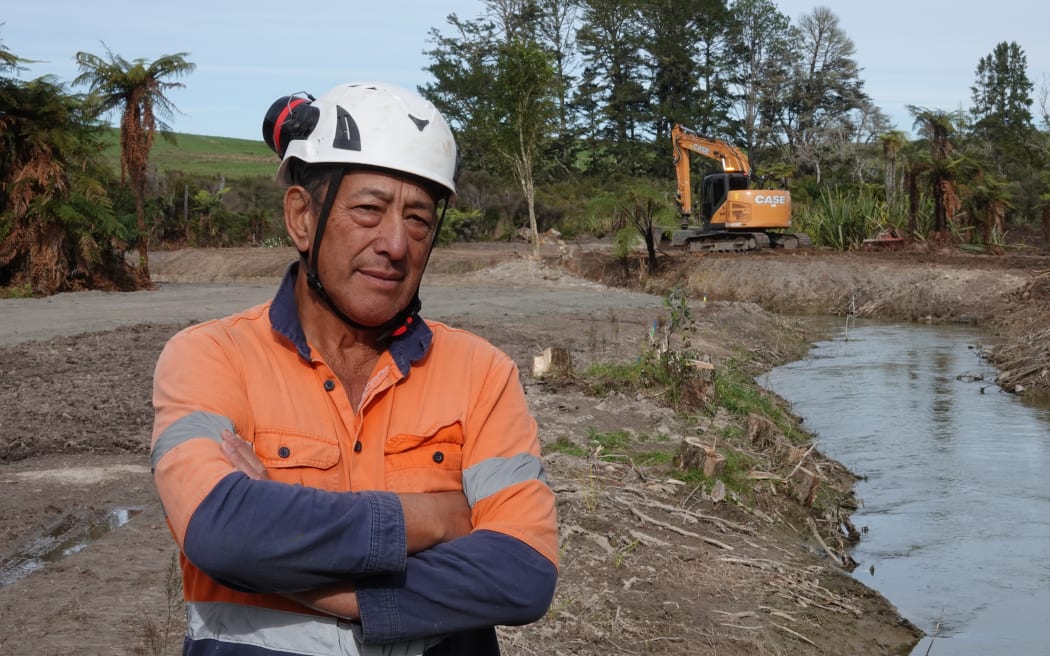
Lake Ōmāpere restoration project manager Hone Dalton.
Photo: RNZ / Peter de Graaf
Dalton said a lot was at stake.
“We see the lake as our mother. She has sustained our people for generations, and her future and our future are intrinsically entwined. So whatever happens to her will happen to us.”
‘You don’t treat cancer with a sticking plaster’
Dalton said current efforts were focused on Te Kuaha, or the lake outlet.
More than a dozen log jams had been cleared and invasive weeds were being removed to improve the flow.
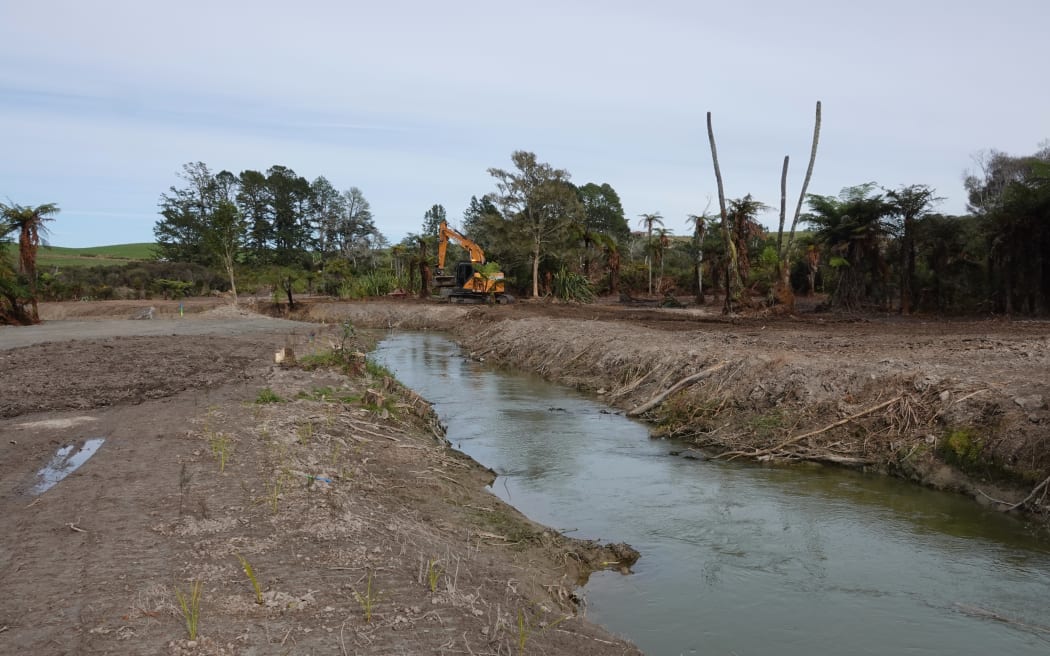
The project’s first stage involves clearing blockages and invasive weeds from Te Kuaha, the lake’s outlet.
Photo: RNZ / Peter de Graaf
The next step would involve building a series of motu tātari, or filtering islands, around the lake exit.
They would be made from local rocks and plants anchored in gabion baskets.
The “constructed wetland” would help absorb nutrients and clean the water before it flowed down the Utakura River into the Hokianga Harbour.
A later, and more challenging, phase would involve dredging out the thick layer of sediment that carpeted the bottom of the shallow lake.
Dalton said dredging was key to the success of the project, because until the phosphate and nitrogen-rich sediment was removed, the blooms would keep coming back.
While the blooms were not always toxic, they killed aquatic life regardless by consuming all the oxygen in the water.
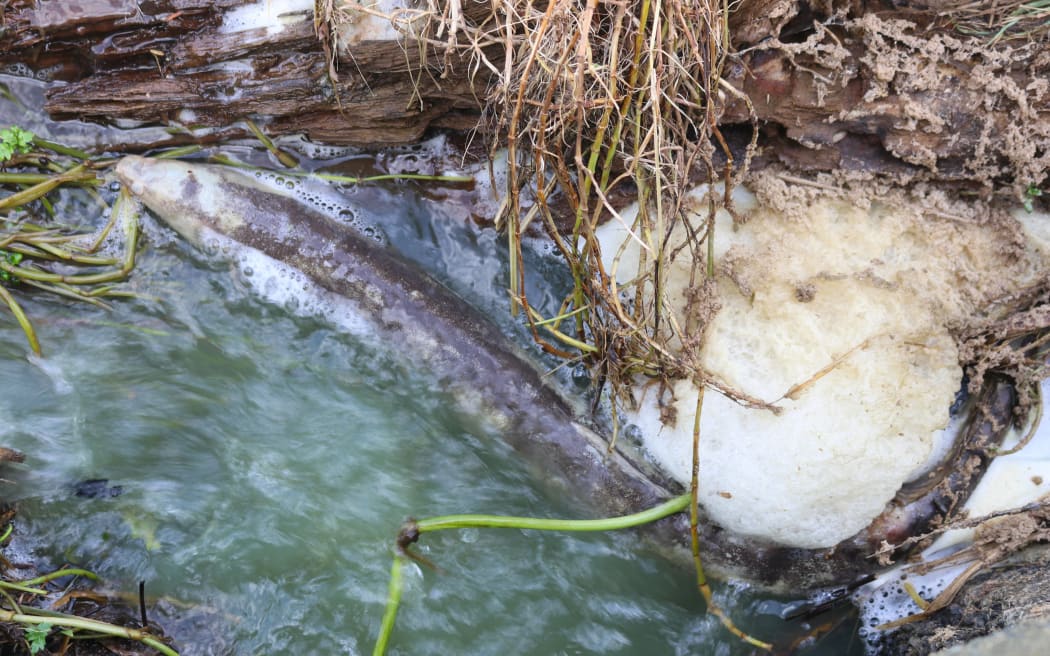
The 2018 algal bloom killed vast numbers of eels downstream in the Utakura River.
Photo: Peter de Graaf
Sampling, surveys and ground-penetrating radar had shown the sediment layer to be about 700mm deep.
Once dried and mixed with crushed shells and sawdust the nutrient-rich sediment could be sold to farms and orchards, Dalton said.
As conditions in the lake improved, the trust hoped to reintroduce freshwater mussels, which were powerful water filters in themselves.
“So we plan to use a mixture of environmental and standard practices to get our lake back into shape. I’m not sure if the dredging fits in with that, but you don’t treat cancer with a sticking plaster. Something really radical has to be done,” he said.
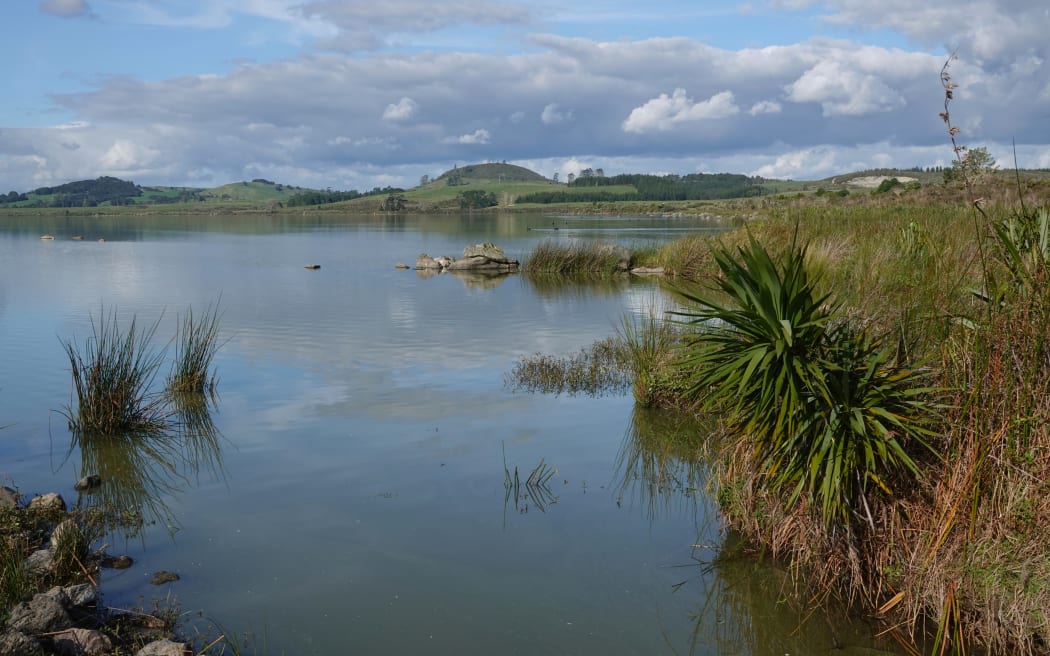
The shoreline of Lake Ōmāpere near the outlet.
Photo: RNZ / Peter de Graaf
No easy fix
Neville Lewis has farmed on the Utakura River, about a kilometre downstream from the lake, since the early 1970s.
Like Ani Martin, he had seen drastic changes in water quality.
“Back then, the river was beautiful. We used to draw water off it for our house and the farm. But in the mid-80s, we had to change that because the water went bad. We used to swim in it all the time over the summer period, we haven’t done that for a long time.”
During the lake’s worst bloom to date, in 2018, Lewis said the river turned bright green, the water was capped with a thick layer of stinking foam, and dead eels washed up in vast numbers.
“It was horrendous,” he said.
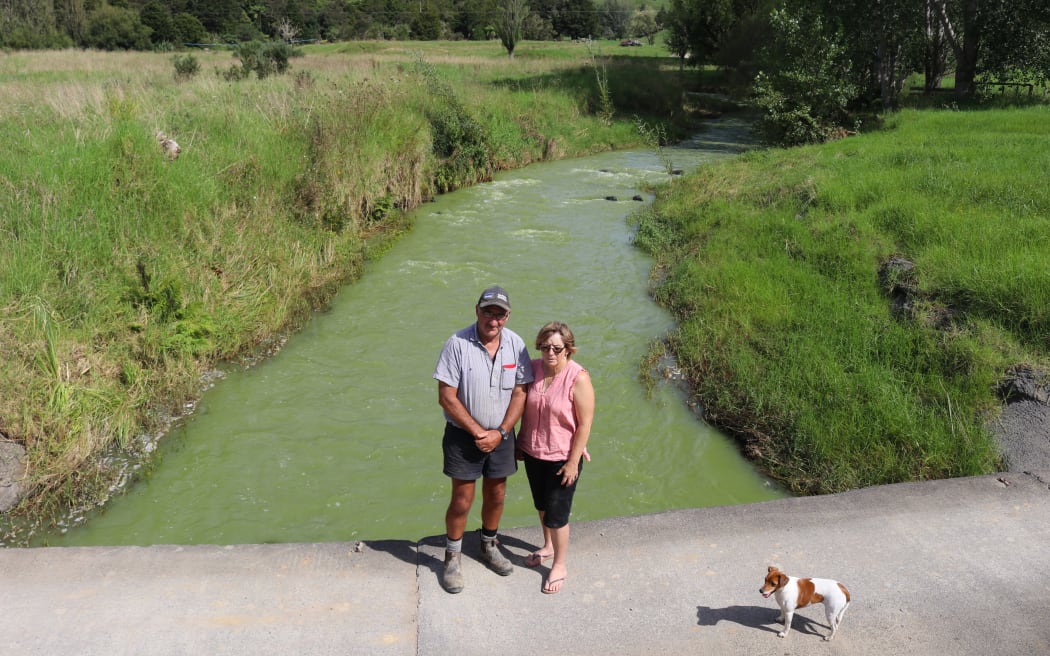
Utakura Valley farmers Neville and Linda Lewis during the “horrendous” bloom of 2018.
Photo: Peter de Graaf
Lewis said the restoration project was the most positive development he had seen at the lake in decades.
“And to be honest, it’s not going to be an easy fix. All credit to Hone and the people that he’s working with. They’re not going to solve it quickly, but they’ve got to start somewhere.”
Meanwhile, Dalton said the project was about more than cleaning up a lake.
“My dream is to get the lake restored, but it’s also about our people. It’s about our own ability to pull ourselves up out of the situation that we’re currently in. A lot of people take it for granted that that’s who we are, and yet this place was a place of incredible wealth for us, spiritually and physically.”
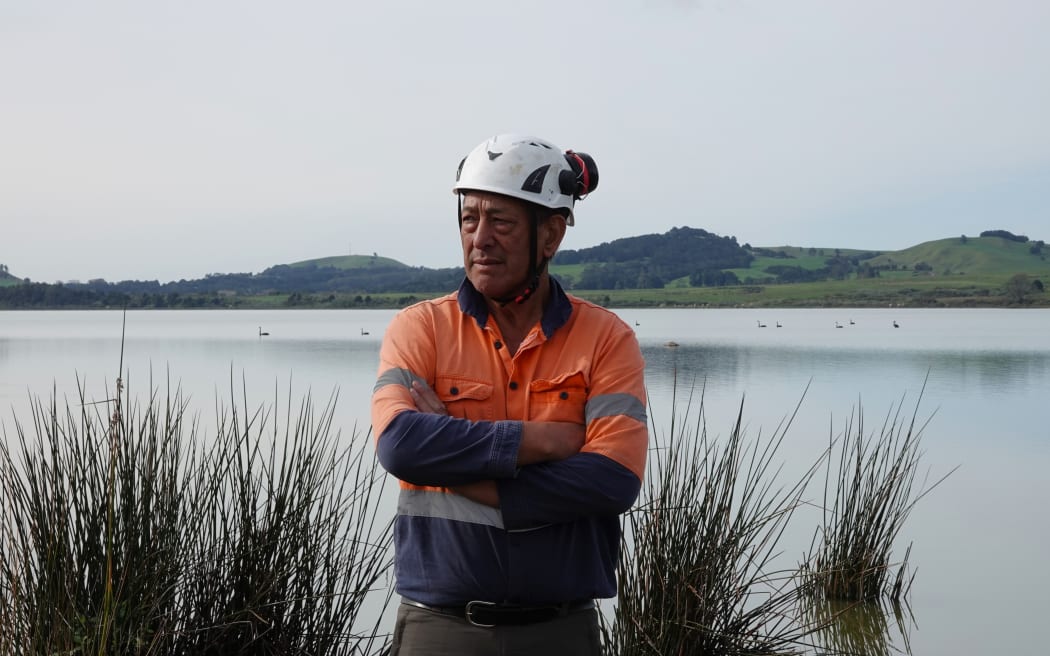
Hone Dalton says Lake Ōmāpere is like a mother to local people, because it sustained their lives for generations.
Photo: RNZ / Peter de Graaf
Bigger than other lakes combined
John Vujcich, a Far North District councillor and member of Northland’s Joint Economic Development Committee, said a restored lake could bring huge benefits to an area where jobs were scarce and incomes low.
As well as its historical and cultural significance, Lake Ōmāpere had great recreational and tourism potential.
It was located beside one of New Zealand’s “Great Rides” – the Twin Coast Cycle Trail from the Bay of Islands to the Hokianga – and many years ago it was a popular destination for raft races and even sailing speed record attempts, due to its high elevation and unfettered winds.
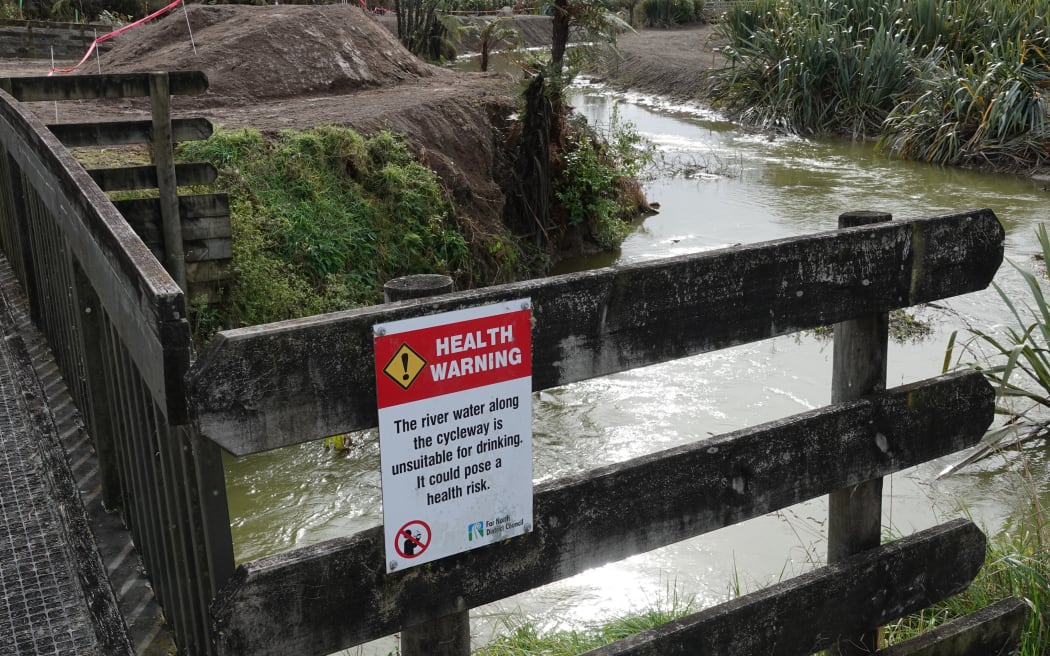
A warning sign where Pou Herenga Tai-Twin Coast Cycle Trail crosses the lake outlet.
Photo: RNZ / Peter de Graaf
The sediment could be sold for use in farms and orchards, but perhaps most significant was the lake’s potential as a water supply for irrigation and the nearby town of Kaikohe.
Vujcich said with an area of 1200ha, the top metre of the lake alone contained 12 million cubic metres of water – more than all other lakes in the Mid North combined.
The volcanic soils around the lake were fertile and suited to horticulture, and Kaikohe, which currently depended on a bore and a small, drought-sensitive stream for its town supply, regularly ran out of water in summer.
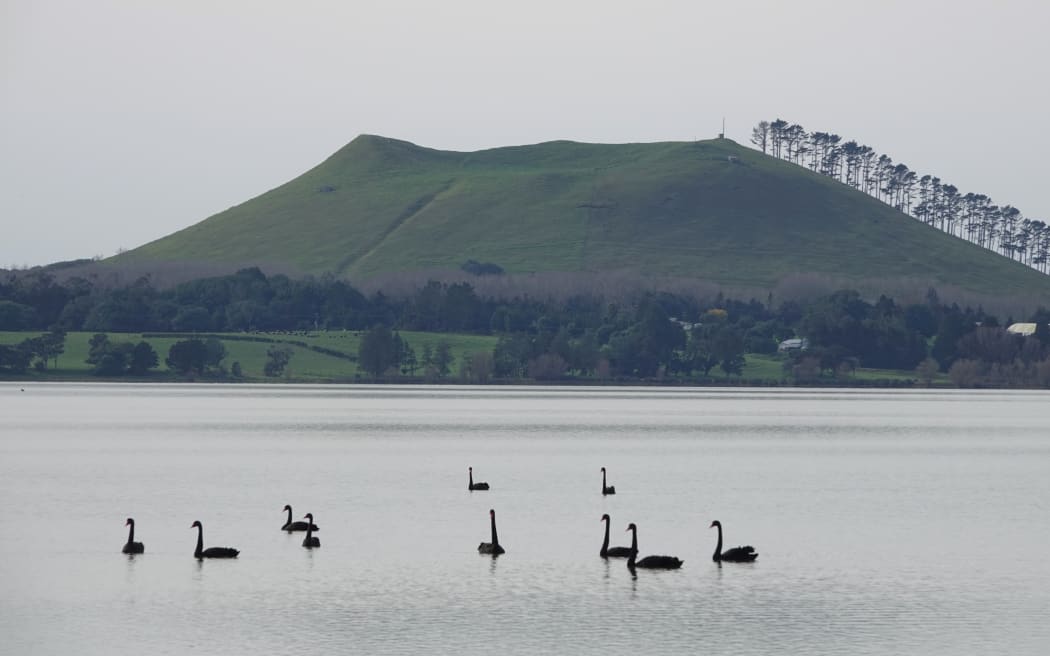
Large numbers of swans add to the lake’s pollution woes.
Photo: RNZ / Peter de Graaf
Excitement tempered by sorrow
Ani Martin said she had called for dredging and planned to make her own floating wetlands using hay bales 40 years ago – but was told she would be prosecuted if she went ahead.
She was delighted to see work to improve the lake was underway at last.
That was, however, tempered by sorrow for the people who had tried to clean up the lake in the past, but would never see it restored.
“I’m quite excited with all these things that are going on, because it’s been going on for years. Too many years actually … but I think of the people that were here to help and they’ve all gone. Those are the people I’m thinking about.”
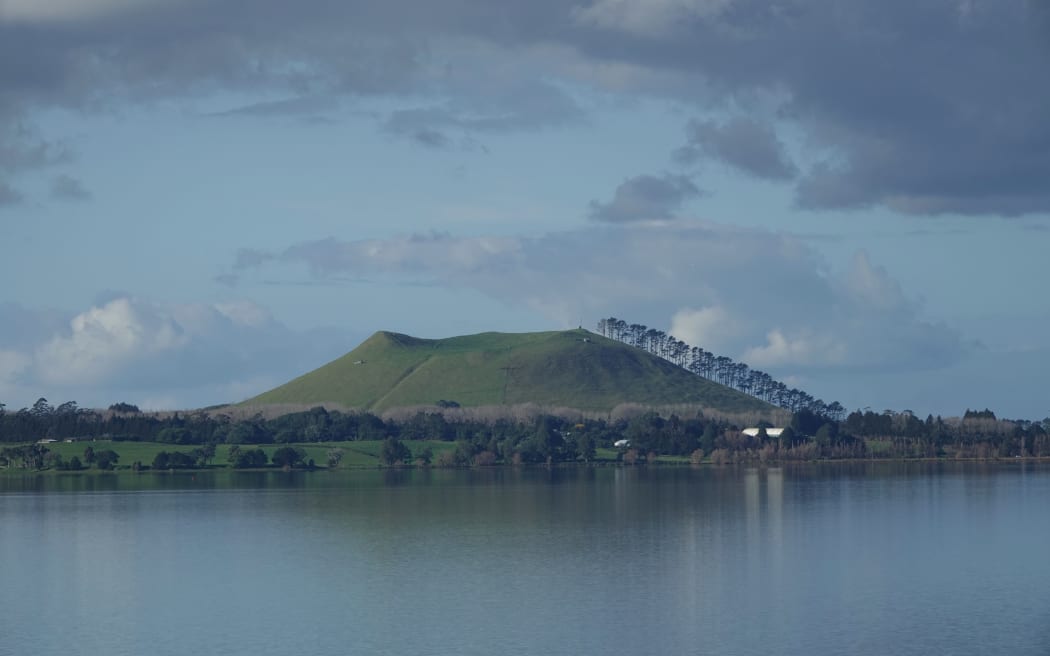
The maunga Te Ahuahu is reflected in Lake Ōmāpere.
Photo: RNZ / Peter de Graaf
The Lake Ōmāpere Trust said current work at the lake outlet was supported by the Lottery Grants Board’s Environment and Heritage Fund.
Funding for future stages was still being sought but long-term the project would be self-sustaining, with the sale of water expected to be a key source of income.
Previous restoration plans had called for the lake level to be raised by 2 metres but that would have destroyed 150ha of wetlands and imposed huge costs.
The trust said the current “commonsense” plan would see only a marginal rise in the water level, inundating 0.4ha of wetland.
MPI-funded trials around commercial use of the sediment were being carried out by Plant and Food Research.
The trust said “finger-pointing” about the causes of the lake’s decline was pointless because NIWA study had found it started when the area was deforested more than a century ago.
Sign up for Ngā Pitopito Kōrero, a daily newsletter curated by our editors and delivered straight to your inbox every weekday.