
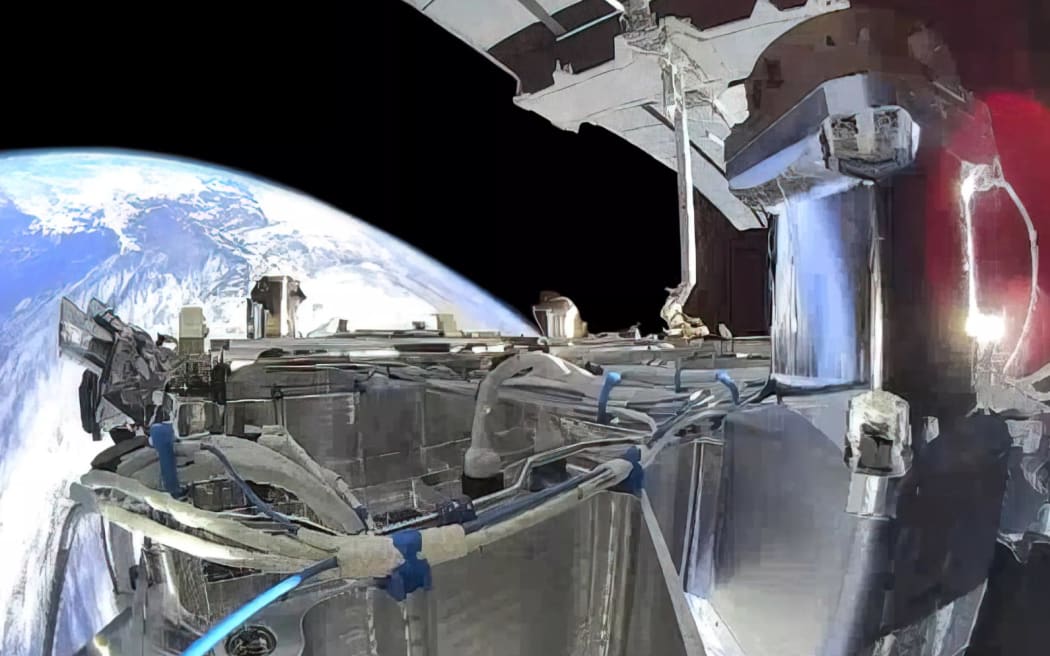
SpaceX says its Starshield system uses “high-assurance cryptographic capability to host classified payloads and process data securely”.
Photo: SpaceX
The NZ Defence Force (NZDF) is testing a satellite system developed by Elon Musk which has been used with drones in the Iran war.
Starshield is a military version of Starlink that can be used for internet access and phone calls.
Reuters first revealed in 2024 that the billionaire was adding Starshield satellites – under a contract with the US spy agency the NRO – to his Starlink constellation, which now consists of an estimated 10,000 satellites.
When US kamikaze drones began hitting Iran in March, they were satellite-guided by the constellation – although Reuters reported last week that Musk’s company SpaceX got the Pentagon to increase by five times what it was paying for the targeting connection.
Musk rejected that as fake news, but in a post on X last week said: “There is a US government arm of SpaceX called Starshield, which has a different set of satellites than Starlink, which is for civilian use.
“The company that makes the suicide drones incorrectly used the civilian system, instead of the Starshield.”
‘NZDF seeks new and innovative capabilities’
The NZDF has been using Starlink for unclassified work.
But a list of briefings shows it has also presented a business case to the government about using Starshield.
The briefing list to Defence, Space and Spy Minister Judith Collins in December carried the title: ‘Business Case: Deed of Indemnity for the New Zealand Defence Force’s Request Starshield Global Access Subscription.’
The NZDF told RNZ on Friday the deed of indemnity was a standard NZ-US government agreement.
“The US government requires a deed of indemnity as part of its due-diligence and compliance,” it said in a statement.
Asked why it might need Starshield, a spokesperson said: “The NZDF seeks new and innovative capabilities to support operations.
“An exercise is currently being conducted to determine the feasibility of utilising Starshield (SpaceX’s dedicated military and government service) to support NZDF operations.
“The outcome of the exercise will determine what its uses are, if any.”
The Starshield website mentioned SpaceX having “other partners” as well as the Pentagon.
‘You better have the same capabilities’
US Defence Secretary Pete Hegseth told allies and partners at an Indo-Pacific security summit over the weekend that America’s message was “you better have the same capabilities that we do because if we don’t our alliance is meaningless”.
Hegseth also promised “expanded intelligence sharing” to countries that stepped up with defence spending to a level that matched US’s “resolve”.
Starshield’s capabilities have been a source of controversy and speculation since it came to light, and that has grown since the Iran war began three months ago.
“You can’t hide,” the head of the National Reconnaissance Office (NRO) was quoted in 2024 about its ability to quickly spot adversaries’ installations.
It relies on hundreds of small, cheap spy satellites in low earth orbit (LEO) and some analysts speculate it also links in to the much larger unclassified Starlink network.
This is the sort of “proliferated” system being built to anchor President Donald Trump’s Golden Dome missile tracking-and-targeting system.
The Pentagon just signed a US$4 billion deal with Musk to build a “backbone” for the dome using Starshield satellites
Many analysts say the ultimate aim is to achieve light-speed command and control of weapon systems on Earth, using laser communications between satellites without having to funnel the communications through ground networks.
The Starlink-Starshield-linked LUCAS (Low-Cost Unmanned Combat Attack System) drones used against Iran point the way.
“The effectiveness of enemy drone strikes will increase by an order of magnitude” because using satellite guidance made them harder to jam or distract, Russian war commentators were quoted saying online in March.
It has been reported it cost just $100,000 to build the drone, plus a one-month fee to connect to Starshield.
The classified satellite system has also been widely reported in the US as Musk’s bid for a bigger share of the national security market.
That has prompted multiple US defence commentators to argue the Pentagon is too reliant on Musk, whose SpaceX rockets can carry far heavier pay-loads of multiple satellites into orbit than any other launch company.
The second Trump Administration has doubled down on the Pentagon shifting to work with commercial partners like SpaceX much more, rather than develop its own systems, propelled by Starlink’s usefulness to Ukraine’s military.
RNZ asked the NZDF if it would use Starshield for classified drone work, and also what any deal would cost.
“We are working on a response to your other questions around cost and other fiscal details,” the spokesperson said on Friday.
Sign up for Ngā Pitopito Kōrero, a daily newsletter curated by our editors and delivered straight to your inbox every weekday.