
The Renewable Energy Systems Laboratory (RESL), a joint initiative between the T&T Association of Energy Engineers (TTAEE) and The University of the West Indies (UWI), has officially begun operations.
Funded by the Digicel Foundation and energy company Shell, the laboratory was established as a renewable energy training centre aimed at bridging the gap between research and practical application in T&T’s agricultural sector.

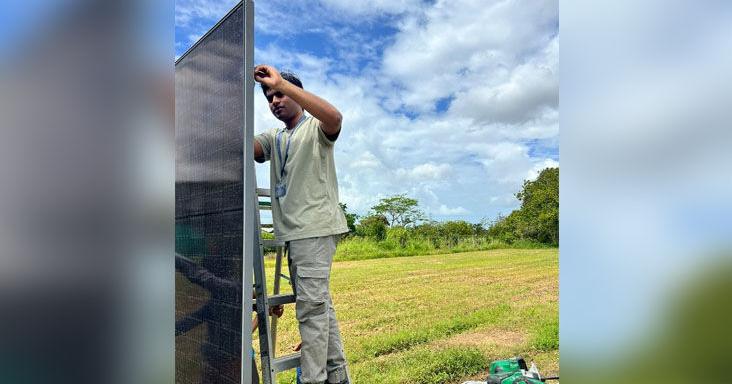
Participants in the Renewable Energy Systems Laboratory project gather at the University Field Station after completing a solar installation aimed at supporting agricultural research and farmer training.
Thomas Jackson, TTAEE’s business development director, said the project represents exactly what both organisations envisioned when they partnered to create the facility.
“It moves beyond theory and places students and farmers in real-world environments, generating data and solutions that are directly relevant to T&T,” Jackson told Express Business.
“For too long, farmers have had to rely on guidance developed for completely different climates. What these students have done is begin building knowledge specific to our conditions, and that is a critical step in making renewable energy work for our communities.”
Jackson described the RESL as more than a research initiative, noting that UWI students designed and installed a functioning solar system, improved conditions at the university’s field station and shared their knowledge directly with farmers.
“That is the kind of practical, meaningful impact we want to see,” he said. “It also highlights the strength of our local talent. When given the right platform, our students are not only learning, they are solving real problems and contributing to the country’s energy transition in a tangible way.”
He said the project marks the first major initiative undertaken since the laboratory’s establishment and is intended to serve as a foundation for broader renewable energy adoption across rural T&T.
“The experience, data and relationships built through projects like this will help scale renewable energy solutions across rural communities,” Jackson said. “There is exceptional talent in T&T, and it is about bringing the right people together to move the country forward.”
The initiative centres on a comparative study of bifacial and monofacial solar panels under Caribbean conditions. Conducted through UWI’s Community Service-Learning programme and supported by funding from the Digicel Shell Foundation, the project aims to generate region-specific data that can be used in farmer training programmes hosted at the laboratory.
According to Jackson, one of the project’s primary goals is to address the shortage of Caribbean-specific information on renewable energy systems.
“Farmers in T&T often rely on information from North America, where environmental conditions differ significantly,” he said. “This project allows us to collect real-world performance data under local conditions so future recommendations are practical, relevant and optimised for T&T.”
The solar installation is already delivering benefits at the University Field Station.
Jackson said solar power now provides lighting for a potting shed that previously had no electricity, improving safety and allowing staff to work later in a properly lit environment. The system was also designed to accommodate future expansion for additional research and agricultural development projects.
The initiative extends beyond the university campus. Following the installation, students worked directly with farmers, providing guidance on system installation, maintenance and safety practices.
“This transfer of knowledge ensures the impact goes beyond a single site and supports wider adoption of renewable energy solutions throughout the agricultural sector,” Jackson said.
Agronomy technician in UWI’s Department of Food Production and local farmer Rayard Khan praised the students for their work.
“Your commitment, enthusiasm and work ethic have been nothing short of inspiring,” Khan said.
“Because of you, I can stand in the potting shed, flick a switch and the space comes alive. No longer do I have to use my car headlights while working late.”
Khan said many farmers still operate without reliable access to electricity.
“As engineers, imagine trying to manage water efficiently without powered systems, preserve harvests without cold storage, or process produce without basic machinery,” he said. “This is not a distant problem; it is a daily reality. It limits not just productivity, but possibility.”
“Your introduction of solar energy into agriculture is not just a technological upgrade; it is a lifeline.”