
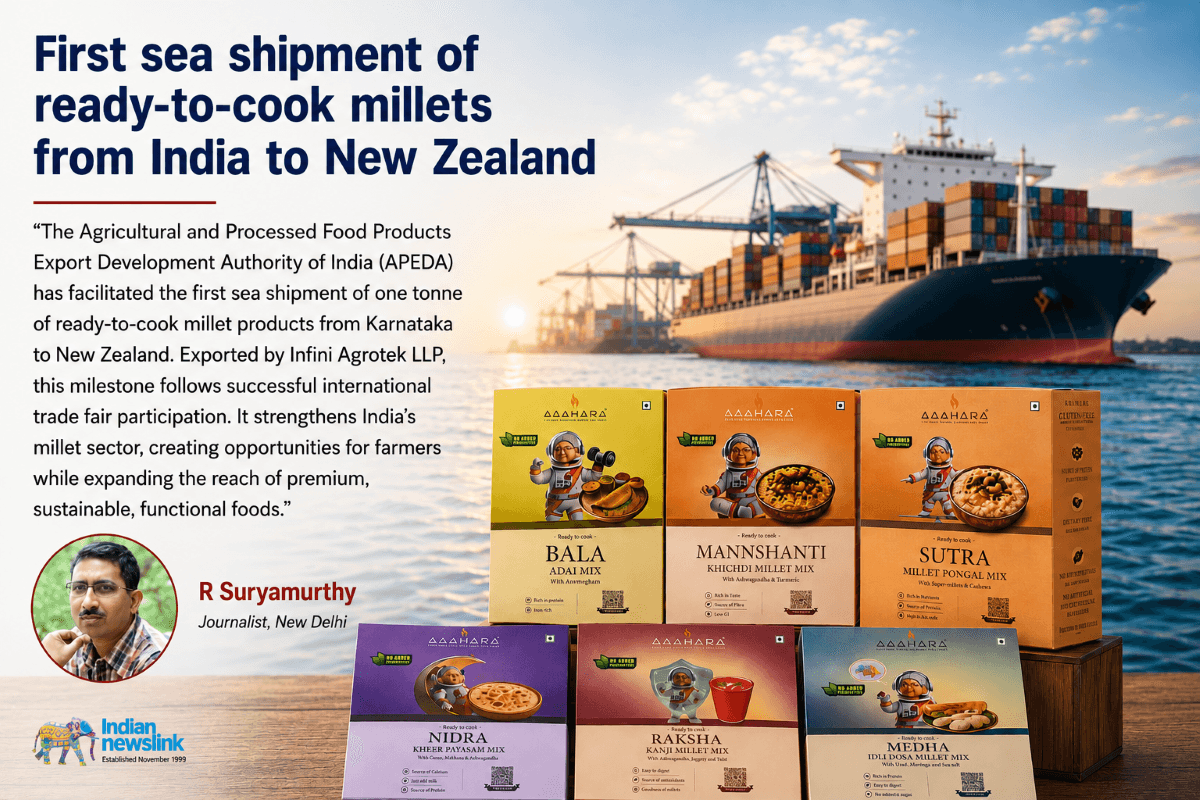
R Suryamurthy
New Delhi, June 5, 2026
In a milestone for India’s growing agri-food exports, the Agricultural and Processed Food Products Export Development Authority (APEDA) has facilitated the first-ever sea shipment of botanical-infused, ready-to-cook millet functional foods from Karnataka to New Zealand, opening a new overseas market for value-added millet products.
The consignment, comprising one metric tonne of millet-based functional foods, was exported by Bengaluru-based Infini Agrotek LLP and dispatched on June 3, 2026.
A milestone for value-added exports
The shipment marks a significant step in India’s efforts to expand exports of value-added agricultural products and capitalise on rising global demand for healthy, sustainable and nutrient-rich food alternatives.
Officials said that the export order was secured following the company’s participation in several APEDA-supported international trade promotion events, including World Food India 2025, Indus Food 2025 and Gulfood 2026. These platforms enabled the exporter to establish contacts with overseas buyers and strengthen its presence in international markets.
APEDA Chairman Abhishek Dev virtually flagged off the shipment and described it as an important achievement for India’s millet sector. He congratulated the company for developing innovative millet-based products and successfully entering a new export market.
The development underscores the growing international acceptance of Indian millet products, particularly those positioned in the functional food segment, which combines nutrition with health-promoting botanical ingredients.
Industry observers say that demand for such products has been rising globally as consumers increasingly seek natural, plant-based and wellness-oriented food options.
Growing importance of Indian Millets
The export is also expected to create new opportunities for millet farmers by generating additional demand for their produce and encouraging greater value addition within the supply chain. Policymakers view value-added exports as critical to increasing farm incomes and enhancing the competitiveness of India’s agricultural sector in global markets.
Millets have gained prominence in recent years due to their nutritional profile, climate resilience and suitability for sustainable farming systems. The government’s sustained promotion of Millets, particularly following the International Year of Millets in 2023, has helped position the grains as a key component of India’s agricultural export strategy.
APEDA has been actively supporting exporters through market development programmes, capacity-building initiatives and participation in major domestic and international trade fairs.
The authority believes that expanding exports of processed and value-added millet products can help diversify India’s agri-export basket while strengthening the country’s position in the rapidly growing global health food market.
The New Zealand shipment is being viewed as a test case for future exports of innovative millet-based products and could pave the way for wider market access in developed economies where demand for functional foods continues to rise.
As Indian food processors move beyond bulk commodity exports and focus on premium, branded and value-added offerings, industry stakeholders expect millet-based products to emerge as an important growth segment in the country’s agri-export ecosystem.
R Suryamurthy is a Journalist based in New Delhi. The above article, sent to Indian Newslink, is under Copyright ©
Our Staff Reporter adds:
A New Horizon for Ancient Grains
New Zealand will officially welcome its first sea shipment of ready-to-cook functional foods derived from Indian Millets after the Free Trade Agreement signed between New Zealand and India, although not necessarily because of it.
This landmark arrival, originating in Karnataka, marks a significant milestone in agricultural trade between the two nations. The consignment of one metric tonne of value-added products underscores the growing global appetite for India’s traditional, nutrient-dense grains, often referred to as Shree Anna. This development not only enhances the availability of these climate-resilient foods in local markets but also opens new economic avenues for Indian farmers and food processors who are increasingly championing the cultivation of these hardy crops.
The Resurgence of Traditional Superfoods
Millets have long been a cornerstone of Indian agriculture, prized for their ability to thrive in challenging environmental conditions. Unlike water-intensive crops, varieties such as Bajra, Jowar, and Ragi require minimal irrigation, fertiliser, and pesticide use.
Their inherent drought resistance and short growing cycles make them an ideal solution for sustainable farming in an era of climate uncertainty. By reducing dependence on costly inputs, Millets provide smallholder farmers with a more secure and reliable harvest, effectively lowering financial risks while promoting better soil health.
Nutritional Powerhouses for Modern Diets
Beyond their agricultural benefits, Millets are gaining widespread recognition for their exceptional nutritional profile.
As consumers globally become more conscious of lifestyle-related health concerns, these ancient grains offer a compelling alternative to refined cereals. Millets are naturally gluten-free and rich in essential dietary fibre, protein, iron, calcium, and various vitamins. Their low glycemic index makes them particularly beneficial for those managing blood sugar levels and cardiovascular health. Furthermore, they are often consumed alongside legumes, a combination that provides a complete protein source, enhancing overall digestibility and nutrient absorption.
A Sustainable Future on the Plate
The global interest in Millets extends beyond individual health, reflecting a broader movement toward food systems that are both sustainable and nutrition-centric.
Through initiatives like the promotion of value-added products, India is positioning itself as a leader in the global millet trade, reaching over 139 countries.
The versatility of these grains, which range from functional health foods to traditional culinary staples, ensures that they can easily be integrated into modern diets.
As New Zealand consumers begin to explore these products, they participate in a global shift toward agricultural practices that honour traditional wisdom while meeting the urgent needs of modern food security and environmental conservation.