
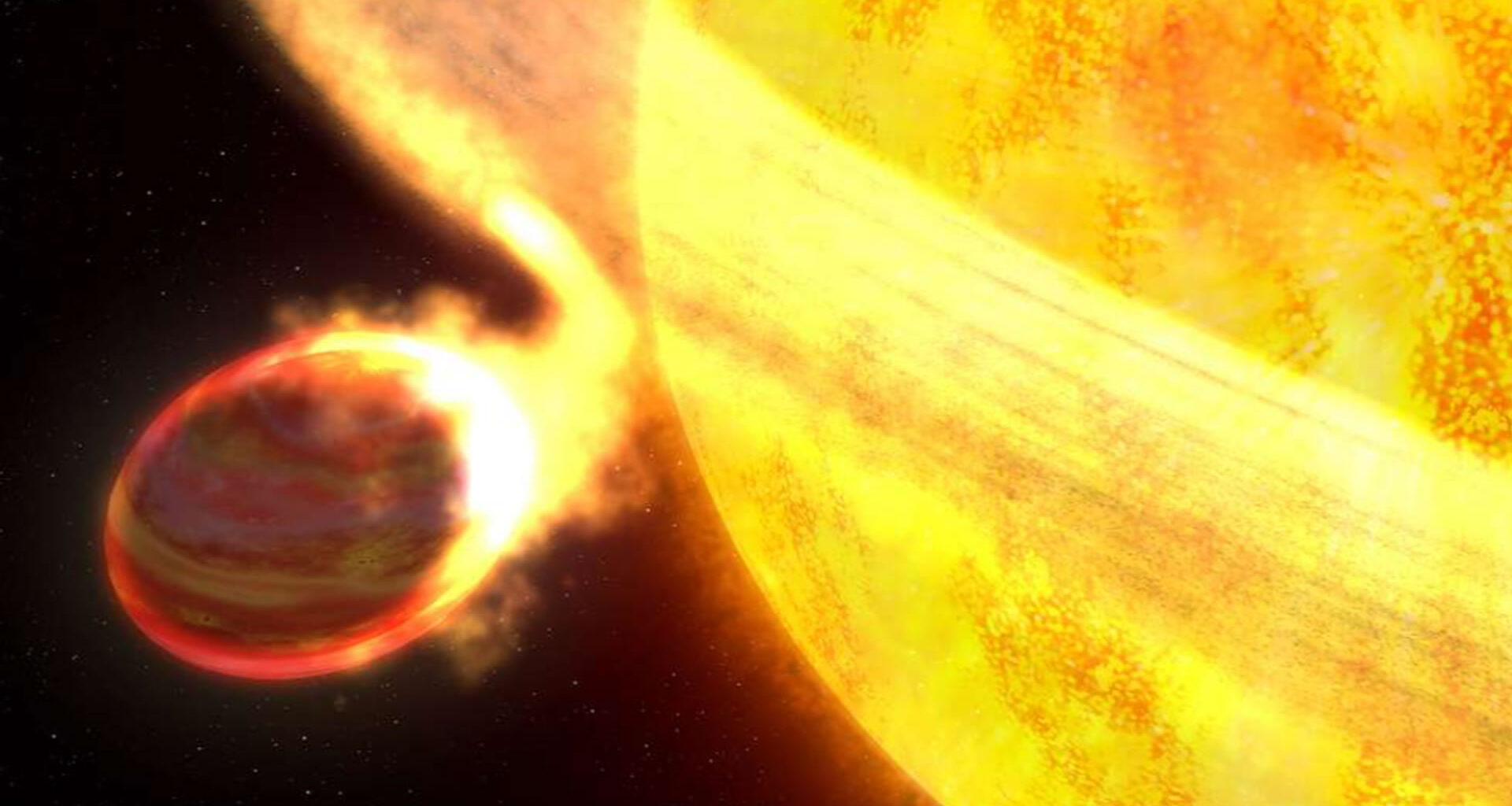
Astronomers believe they may have found evidence that one star in a faraway binary system may have eaten its own planets in the past. If true, this may well violate the generally accepted rules governing the formation of binary star systems.
The star system in question, HD 81809, lies in the constellation Hydra and is roughly 90 to 101 light-years from Earth. It consists of one main primary star, HD 81809A, which is now in its twilight years, having spent its hydrogen fuel.
The second, HD 81809B, is still a main-sequence star, but also has a noticeably different composition from its larger twin. Under “normal” circumstances, at least as far as we believe, binary stars typically form together from the same gas cloud. They also tend to form at roughly the same time.
According to researchers from the Technical University of Denmark, studying it, it has significantly more lithium, and the iron content appears different between them, too. In fact, the difference is about 3.7 times (0.57 dex in technical speak).
A case of hungry, hungry stars
While some variance would be expected, the research team believes that the differences are too large to be ignored. Something else has happened in the past, but what?
Well, the only logical answer seems to be that the “metal-rich” star must have swallowed planets or other planetary material sometime in the past. Likely candidates would be rocky planets (like our own Earth), which tend to be rich in iron, silicon, magnesium, etc.
If a star consumes them, its outer layers become chemically enriched, which can be detected from afar. This hypothesis is also supported by other evidence, such as what appears to be a debris disk around the star.
What likely happened, the team explains, is that the planet spiraled inwards towards the star, became orbitally unstable, and was eventually absorbed. All well and good, but the high levels of lithium may point to a very recent event.
Lithium usually doesn’t survive very long inside stars and may point to very fresh planetary materials being introduced. However, computer modeling suggests that the star would have needed to eat huge amounts of planetary material, roughly between 25 and 75 Earth-like bodies.
Planet-munching star caught red-handed?
But if this were the case, the level of lithium should be much higher than observed. “The models predict that such a metal-rich accretion would over-enrich lithium at the surface; matching the observed lithium instead requires accreting less than 6 M⊕,” the team writes in the paper.
“This tension highlights the need for precise knowledge of the accreted material’s chemical composition,” they added.
While they cannot be entirely sure, the team believes that engulfment was likely recent and may have involved “unusual” composition planets. Either that, or only certain kinds of planets or materials were actually absorbed by the star.
Likely, we may never know, but whatever is going on with HD 81809B certainly deserves further research.
You can view the study for yourself in the journal arXiv.