
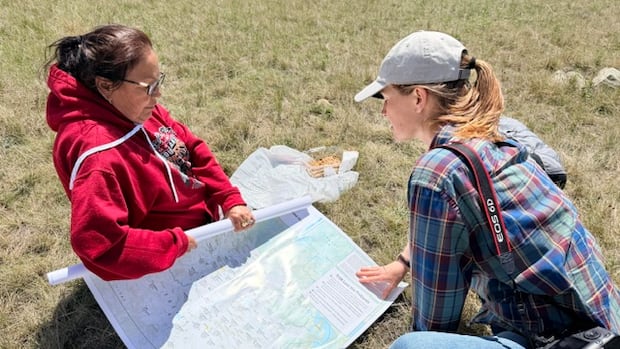
Linda Obey-Lavallee learned all about plants — how to read them, how to pick them properly, their medicinal properties — from her late husband Harold Lavallee, who learned from his grandparents.
Obey-Lavallee, from Piapot First Nation, is a traditional picker and knowledge keeper of medicinal plants.
Whenever she enters an area, she makes sure to say a prayer and lay down tobacco before picking. It shows respect to the land and to Mother Earth for providing the medicines we need, she said.
“When I am out there picking, I’ll only take what I need,” she said. “If it’s the flower tops, I’ll cut off the flower tops, if it’s the root, then I’ll dig up the root and put the whole tops back into ground and pat it down to make it look like I wasn’t even here.”
You put things back the way you found it, she said, and in return the plants will regrow.
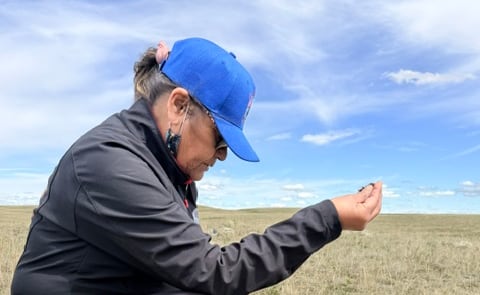 Linda Obey-Lavallee is traditional harvester and knowledge keeper from Piapot First Nation. (Darla Ponace/ CBC)
Obey-Lavallee was hired by the Treaty Land Sharing Network (TLSN) to help create an inventory of medicinal plants at 65 locations where landowners and farmers have agreed to share the land and resources with Indigenous people.
TLSN started in 2019, after the death of Colten Boushie and the Gerald Stanley trial, with a goal of creating safer spaces and building connections between landowners and Indigenous people.
It launched its map in 2021, and now has 59 locations across Saskatchewan and six in Alberta.
98 Ranch, close to Lake Alma, 175 kilometres south of Regina, is one of them.
Ross MacDonald has lived there for more than 20 years. He became a part of TLSN when it first started. He has shared his land with Indigenous communities for activities like hunting and berry picking ever since.
WATCH | Knowledge keepers exploring private land to create medicinal plant inventory: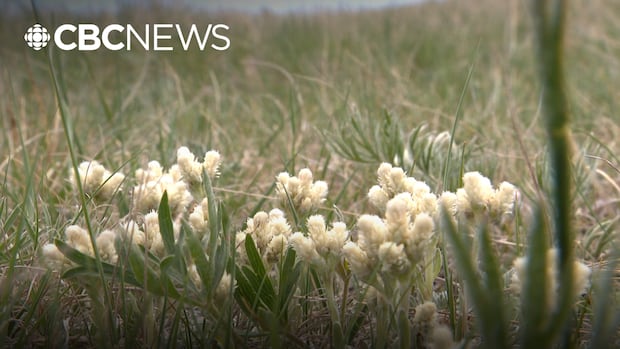
Knowledge keepers exploring private land to create medicinal plant inventory
The Treaty Land Sharing Network connects farmers and other landholders with First Nations and Métis people who need safe access to land to practise their way of life. The group is creating an inventory of medicinal plants found at more than 60 locations in Saskatchewan and Alberta.
MacDonald and his wife are passionate about the preservation of native Prairie grasslands and wanted to help reconnect Indigenous people with those grasslands. He said he has gained vast knowledge about the different plants, and their medicinal properties, from those connections.
“That knowledge set is way larger than I imagined it to be,” he said.
“There’s sort of a hope of ours that we could reconnect with some of that traditional knowledge … because I think it strengthens our understanding of the grasslands that we coexist with, but it also strengthens the overall value and importance of keeping these landscapes intact.”
MacDonald said he has a new appreciation for the diversity of plant life — chokecherries, Saskatoons, hawthorne bushes, snowberries, bread root, sage and more — on his family’s property.
“The different uses from a traditional sense has really, really been fascinating and has really broadened our understanding of the ecology of the landscape and how these plants co-evolved with humans as well as as wildlife.”
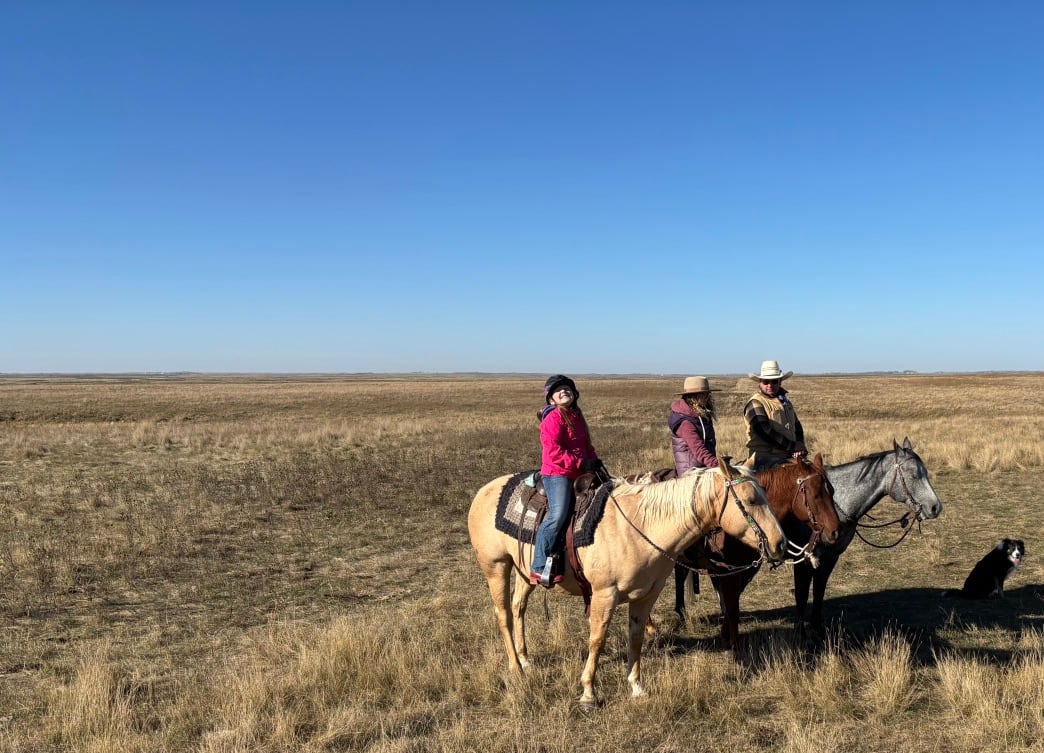 Ross MacDonald, right, with his wife and daughter horseback riding on 98 ranch. (Submitted by Ross MacDonald)
He said he had some some nerves when the project started, but they found the people calling were just as nervous.
“That made us more relaxed to realize that, “OK, we’re all just humans here trying to figure out how we fit with each other,'” he said. “It’s actually been pretty fulfilling for us to know that other people are interested in the same ecosystems that we are, and it’s been really nice to share those spaces.”
Obey-Lavallee said creating an inventory for TLSN and the landowners lets everyone know exactly what is out there.
“Knowing that this plant is out here, it’s more accessible for a lot of people,” she said. “Sometimes somebody who’s really sick and needs it was told in a lodge or ceremony that they need to have this plant and it only grows in this one specific area.”
Obey-Lavallee said working with TLSN for this project is like a mini-vacation, because she is doing what she loves to do — uncovering plants, but also re-tracing the steps of her ancestors.
She said she’s found teepee rings and old settlements. Seeing the different traditional medicines in those areas, she said you can kind of see the way they lived long ago.
“I’m just in awe,” she said. “I’ve read so much research at university of our people roaming from place to place. They didn’t deplete the land. They stayed there only for what they needed and then moved on.
“It gives me goosebumps.”
Barbara Lavallee is also a part of the project. She is a knowledge keeper with a keen eye for finding old sites in rock formations. She said landowners are always interested in finding out more about their properties.
“We’ve covered a lot of area, met some wonderful people, the landholders,” she said. “When we have discussion and inform them of the medicines and the sacred sites, the burial sites, even on their lands, they’re surprised and they’re very welcoming to that information.”
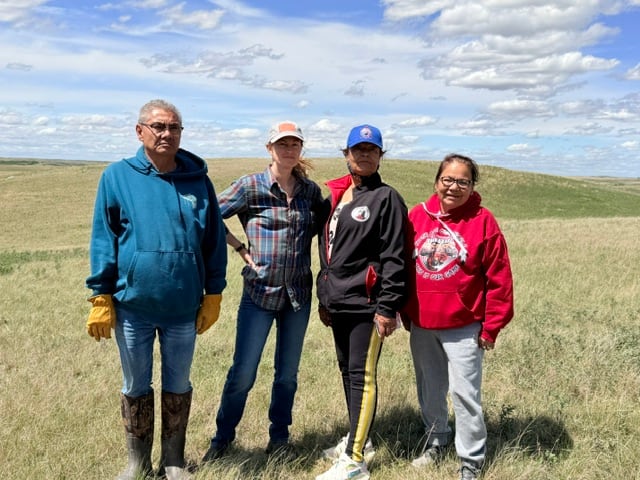 From left, Darryl Obey, Valerie Zink, Linda Obey-Lavallee, and Barbara Lavallee are documenting medicinal plants for the Treaty Land Sharing Network. (Darla Ponace/ CBC)
More knowledge keepers are now working to create an inventory in each area around Saskatchewan and Alberta. Lavallee said she hopes these lands can be used to educate future generations.
She said landowners are open to the hunting and gathering, but also willing to share cultural items Indigenous people need for ceremonies, such as willows, wood and rocks.
“It does get somewhat emotional because the rock formations that we see that have been developed here, our ancestors were here,” she said.
“We’re right where they lived, where they hunted, where they gathered, and now, with the generosity of the landholders within the Treaty Land Sharing Network, we get to experience that again. The fences and the boundaries of the land aren’t pushing us out. We’re welcomed in.”
She said that is the importance of this project. It’s about creating good relations and building positive connections.
“We would really like to see that they would be here in perpetuity,” she said. “There are so many farmers and ranchers that are excellent land stewards.”