
Astronomers intended to analyze the movement of stars in an ancient cluster close to the Earth. But they inadvertently discovered something about the most common stars in the universe.
They noticed something very weird regarding red dwarfs that should have been present.

The absence of these stars could provide some useful information on the internal changes occurring in these stars despite their distance.
A gap in a sea of stars
The finding emerged from observations collected by the European Space Agency’s Euclid space telescope and NASA’s Hubble Space Telescope.
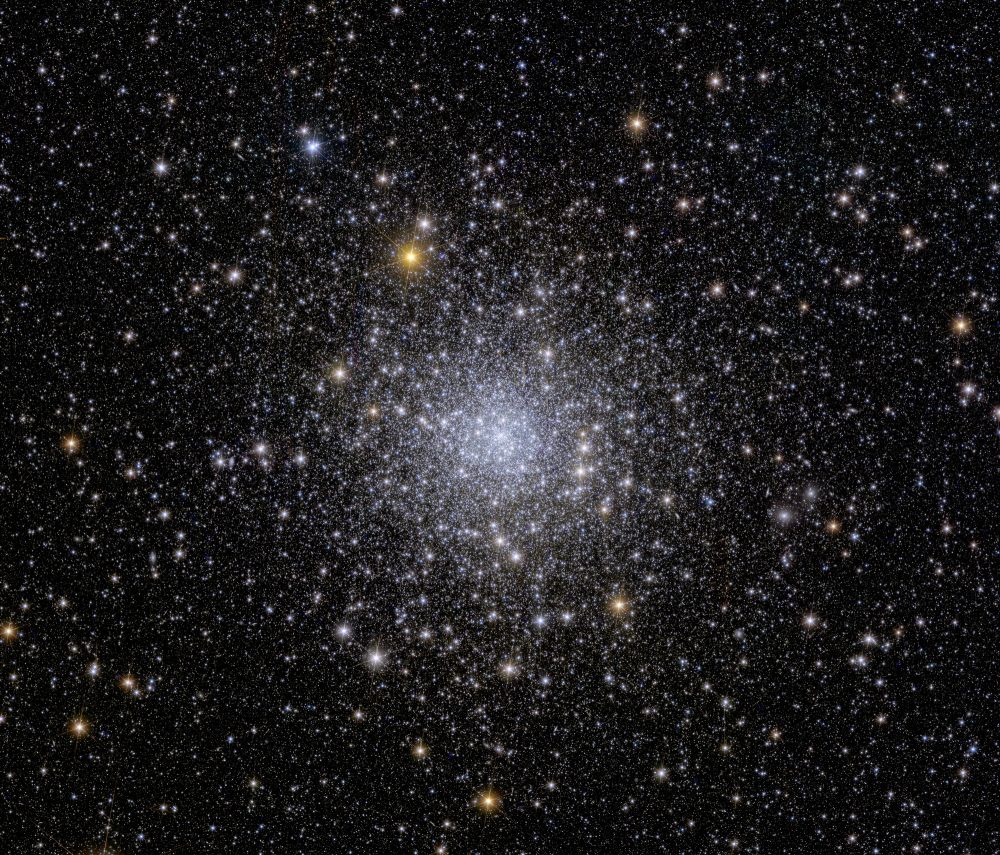
Researchers were studying NGC 6397, an ancient globular cluster located about 8,000 light-years from Earth in the constellation Ara.
When the team sorted the cluster’s stars according to their brightness and color, they noticed a thin gap where a specific group of low-mass red dwarf stars should have appeared.
The study was led by scientists from the Space Telescope Science Institute (STScI) in Baltimore, Maryland.
The team’s discovery marks the first time this feature has been identified inside a globular cluster.
“The discovery was serendipitous,” said study co-author Andrea Bellini. “We were not looking for the gap, but we found it.”
A mystery first spotted closer to home
Astronomers first noticed a similar gap in 2018 while studying data from the European Space Agency’s Gaia observatory.
That research examined nearly 250,000 nearby stars using a Hertzsprung-Russell diagram, a key tool that maps stars according to their brightness and temperature.
The Gaia data revealed a narrow slice cutting through the red dwarf population where relatively few stars appeared.
At the time, researchers suspected the missing stars were linked to changes taking place inside certain red dwarfs.
The new discovery shows the same phenomenon exists in a much older and more distant stellar population.
Instability inside of a star
The stars themselves are not actually disappearing. Instead, they pass through a brief stage that makes them less likely to be observed at particular brightness levels.
Researchers believe the effect occurs in red dwarfs with masses between 0.34 and 0.36 times the mass of the Sun.
In these stars, fuel building up in the core can trigger bursts of energy that create instability inside the star.
Those internal changes slightly alter a star’s size, temperature, and brightness. Because relatively few stars are caught during this transition, a visible gap appears on the chart used by astronomers.
The finding offers a rare glimpse into stellar interiors. Normally, scientists cannot directly observe what happens inside stars.
Instead, they must infer those processes from measurements of light and temperature.
Why globular clusters matter
Globular clusters are among the oldest structures in the Milky Way. They contain hundreds of thousands of stars packed into a relatively small region of space.
Many formed more than 13 billion years ago, not long after the universe itself came into existence. NGC 6397 is estimated to be about 13.4 billion years old.
“Globular clusters are the ideal laboratories to study stellar evolution and stellar populations,” said STScI’s Massimo Griggio, the principal author on the research paper.
“In this globular cluster, the stars are basically at the same distance and have approximately the same age.”
Because the stars formed together, researchers can compare them more easily than stars scattered throughout the galaxy.
Differences seen between stars are therefore more likely to reflect genuine physical processes rather than differences in age or composition.
The discovery could also improve one of astronomy’s most important measurements: distance.
Knowing how far away an object is helps astronomers calculate its true size, brightness, and place in cosmic history.
Measuring those distances accurately remains one of the field’s ongoing challenges.
“Because we can determine the brightness where the gap is with very high precision and know for what stellar masses it occurs, we can use this information to estimate the cluster’s distance,” said study co-author Russell Ryan.
If future observations confirm the method, the red dwarf gap could become another useful benchmark for measuring distances across the galaxy.
Technology built for Hubble
Detecting the feature required extremely precise measurements. The stars inside NGC 6397 are packed so closely together that separating them is difficult.
The team relied on software and analysis techniques developed over more than two decades for the Hubble Space Telescope.
Those tools allowed researchers to identify individual stars within the crowded cluster and measure them with exceptional accuracy.
When combined with Euclid’s much wider view of the sky, the missing-star pattern became clear.
“With these tools, we show that we can push the limits of Euclid, and in the future, the Roman Space Telescope, across a wide field of view,” said team member Mattia Libralato.
“Further investigations with Euclid and, in the future, Roman, will hopefully allow us to better characterize this feature also in other globular clusters.”
The full study was published in the journal Astronomy & Astrophysics.
Image Credit: ESA, NASA, Euclid Consortium
—–
Like what you read? Subscribe to our newsletter for engaging articles, exclusive content, and the latest updates.
Check us out on EarthSnap, a free app brought to you by Eric Ralls and Earth.com.
—–