
GSMArena Team,
8 June 2026.
1. Introduction, specs, unboxing2. Design, build quality, handling3. Our lab tests – display, battery life, charging speed, speakers4. Software, performance5. Camera – photo and video quality6. The competition, our verdict, pros and consInfinix GT 50 Pro specificationUser opinions and reviewsReview comments (3)

Unassuming but ultimately capable dual rear setup, great selfies
The Infinix GT 50 Pro is equipped with a camera system we already saw recently – the hardware is apparently identical to what the Note 60 Pro has. This means a relatively modest dual configuration on the back and what proved to be a pretty well-performing selfie camera.
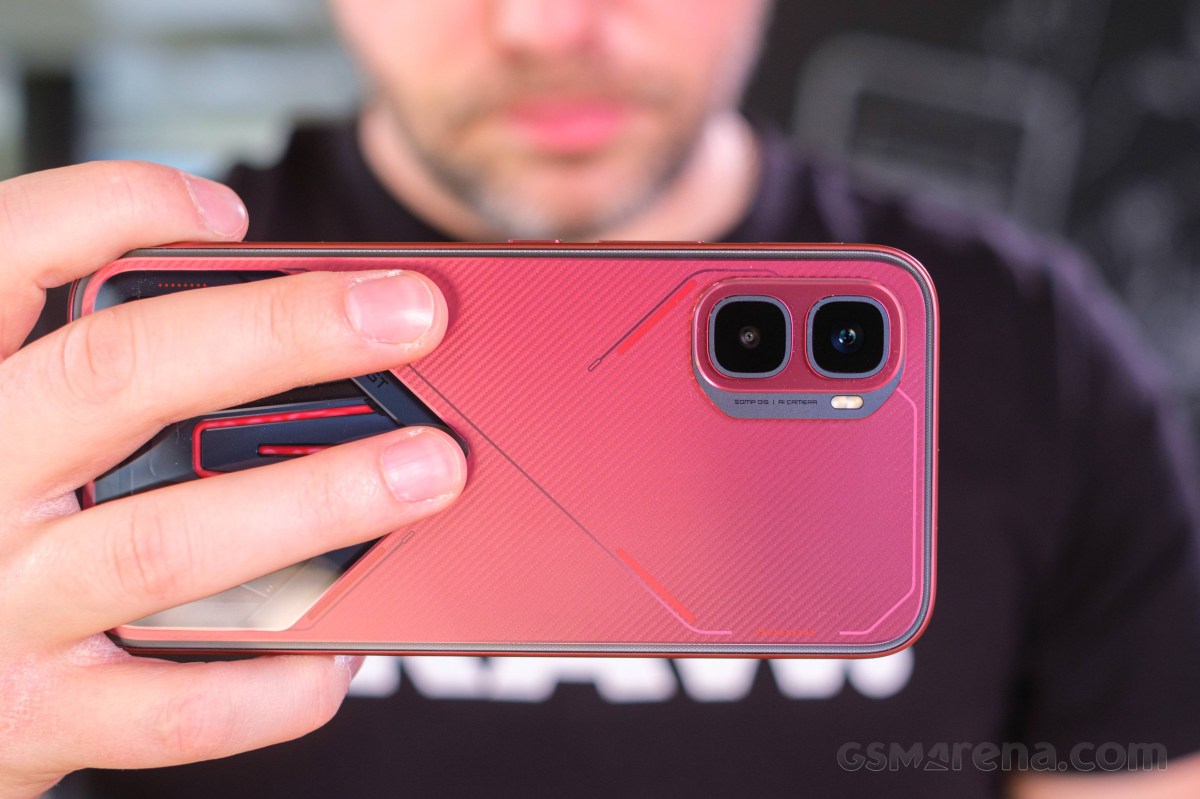
While Infinix doesn’t specify the sensors on their specs pages, some of the key numbers can still be found in official data – that was the case on the Note 60 Pro. The GT 50 Pro just might be a little bit more forthcoming, you’d think, but some of the data it does show is demonstrably untrue (like the 200MP Samsung HPE sensor), so we’ll just go with the numbers and not dwell further on the names.
Just like the Note 60 Pro vs. Note 50 Pro situation, the GT 50 Pro actually brings a downgrade on the main camera – the 108MP 1/1.33″ sensor of the GT 30 Pro is replaced here with a lower-res, smaller imager (50MP, 1/1.95″).
The ultrawide camera has gained autofocus – the one on the GT 30 Pro doesn’t have that – so you can count that as an upgrade. The 13MP selfie camera is quite possibly the same as on the previous generation.
Wide (main): 50MP (1/1.95″, 0.8µm-1.6µm); 27mm, f/1.6, OIS, PDAF (9cm – ∞); 4K60 video recording.
Ultrawide: 8MP (1/4.0″, 1.12µm); 15mm, f/2.2, PDAF; 1440p30.
Front camera: 13MP (1/3.1″, 1.12µm); 24mm, f/2.2, fixed focus; 4K30/1080p60.
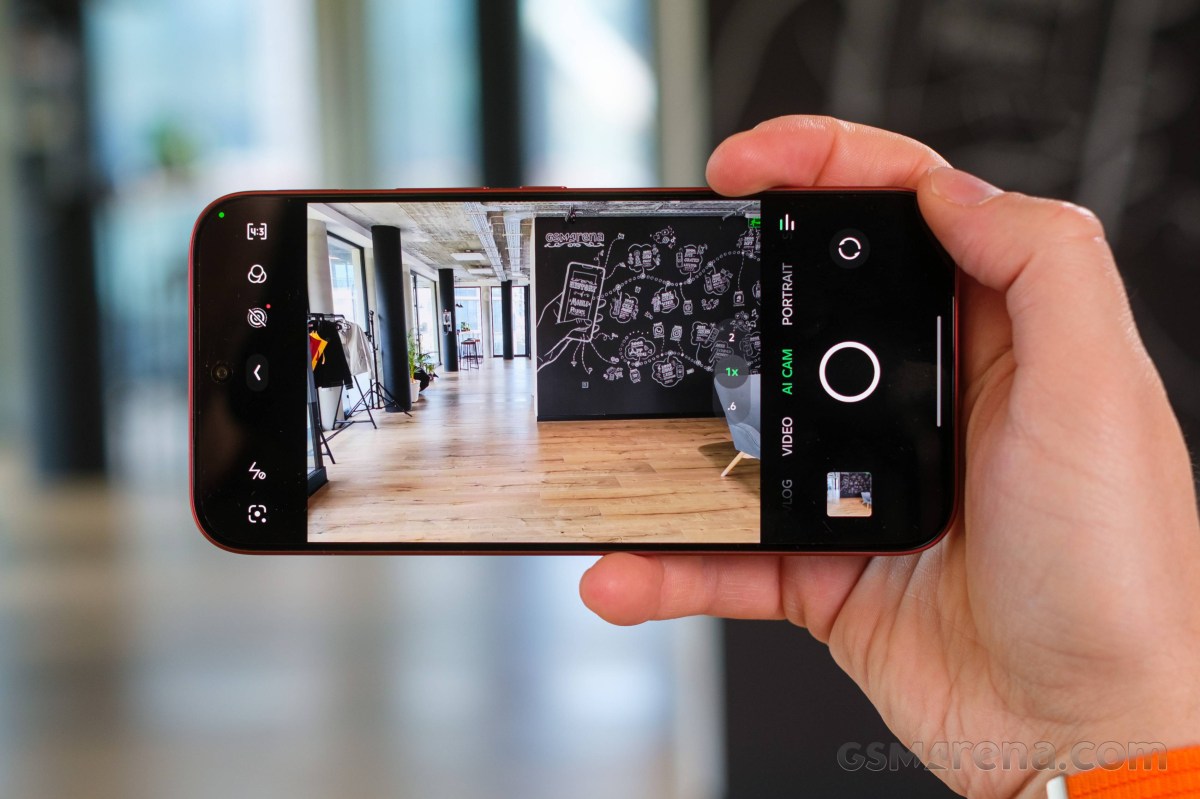
We wouldn’t necessarily call the Infinix camera app the most intuitive – for example, the default regular photo mode is called AI CAM, and in video mode you might not be able to figure out on the very first try that tapping on the resolution in the far corner opens a selection menu on the near end. That said, once you get used to the idiosyncrasies, all should be well.
The GT 50 Pro, being a gaming-focused model, has shoulder triggers, which can also be operational in camera-related scenarios. You can enable a press on either button to act as a shutter release, while long-pressing can do burst shooting. Swiping on the bottom/right trigger can be set to control zoom. We found ourselves with several unintended bursts in the gallery before going into settings to disable the long-press action, but your own mileage with the triggers may vary.
Daylight photo quality
Main camera
On the GT 50 Pro we observed the same field of view peculiarity that we saw on the Note 60 Pro – the main camera’s EXIF data reports a 23mm focal length, but infinix’ own specs say 78 degrees field of view, which corresponds to a 27mm focal length, and that goes well with what we’re seeing in terms of coverage in real life.
While the sensor should be the same, the GT 50 Pro captures sharper shots than the Note 60 Pro, with somewhat nicer detail rendition. Global properties are looking great, with plenty of contrast and wide dynamic range, which walk hand-in-hand with a likable, vibrant color presentation. There’s not a lot more you can ask for, particularly from a phone with a focus outside of camera prowess.








Daylight samples, main camera (1x)
The portraits we got out of the GT 50 Pro are also very good, both in terms of skin tones and facial detail rendition. The Portrait mode’s blur level is a bit more conservative than on the Note 60 Pro, and as such, it’s more believable.








Human subjects, main camera: Photo mode (1x) • Portrait mode (24mm)
Here’s a handful of full-res shots – we wouldn’t say they’re worth it.




Daylight samples, main camera (1x), 50MP
The 2x zoom shots are actually very good for the class, considerably better than the ones from the Note 60 Pro – we won’t be needing to make excuses for fit-to-screen viewing here, as these images stand up well to pixel-level scrutiny.








Daylight samples, main camera (2x)
All that applies to people shots as well – the 2x zoom level will give you very good headshots, with plenty of fine detail on your subject’s face. There’s a hint of subject separation in Photo mode, with a well-judged moderate level of added blur in Portrait mode. Pretty great stuff.








Human subjects, main camera: Photo mode (2x) • Portrait mode (50mm)
Ultrawide camera
We’re not ones to rave about 8MP ultrawides, and the one here is certainly not going to change that, but it still delivers solid photos for what it is. It’s got one of the nicer detail renditions for a camera of this caliber, it’s got a wide dynamic range, and color rendition is pretty great.








Daylight samples, ultrawide camera (0.6x)
Close-ups
You get a couple of options for close-ups. One is the AF-capable ultrawide camera at very close range – it’s uncomfortably close for most applications and prone to casting shadows or disturbing your subject, but it can be the right way to go if you want to exaggerate perspectives. The other option is the main camera, at 2x – more comfortable subject distance, less distortion. Both avenues of action will get you pretty solid pixel-level quality, too.




Close-up samples, ultrawide camera (0.6x)




Close-up samples, main camera (2x)
Low-light photo quality
Main camera
The GT 50 Pro’s main camera is unfazed by the dark and will get you well-exposed shots with wide dynamic range and good development at both ends of the tonal range. The auto white balance is reliable and saturation is on point.Detail is very good too, the inevitable softening in the particularly dark areas not really a dealbreaker. It’s a performance that’s thoroughly superior to that of the Note 60 Pro, despite what’s seemingly the same camera hardware.








Low-light samples, main camera (1x)
The 2x zoom shots are also quite good in absolute terms, and notably better than what you’d get from the GT 50 Pro’s recent Note sibling.








Low-light samples, main camera (2x)
Ultrawide camera
The pattern continues on the ultrawide, where the GT 50 Pro’s unit, modest as it may be, captures generally good photos and ones that are better than on the similarly equipped Note 60 Pro. Exposures are great, dynamic range is wide, colors are looking good, and detail is quite alright, all things considered.








Low-light samples, ultrawide camera (0.6x)
Selfies
We had high praise for the Note 60 Pro’s selfies and that applies to the ones from the GT 50 Pro. They are packed with detail, skin tones are vibrant, dynamic range is nicely wide.








Selfie samples
Photo quality verdict
The Infinix GT 50 Pro does a fine job of squeezing the most out of seemingly unassuming camera hardware and delivers a nicely competent performance in stills. The main camera is very good at both its native focal length and 2x, and does well in daylight, as well as after dark. The ultrawide’s results are also quite good in most conditions – within the limits of the relatively low resolution, of course. The selfie camera won’t leave you wanting either.
Video quality
The GT 50 Pro can record in up to 4K60 on its main camera – that’s one better than the Note 60 Pro, which maxes out at 4K30/1080p60. The ultrawide is still capped at 1440p30 (not enough pixels for 4K and no 60fps mode either).
There’s no Pro video mode and neither is there a 24fps capture option. You do get HDR10+ recording on the main camera at up to 4K30.
There are two tiers of stabilization – the regular Video Steady (as opposed to AI Steady on the Note 60 Pro) is available for all quality settings (including 4K60), while the Ultra Steady mode works at 1080p30 on the ultrawide and 1080p30 or 1080p60 on the main camera at 1x.
You can hit ‘> play’ below and use the ‘>| next’ button to advance through the playlist of all video samples, or you can watch the full playlist on YouTube.
The phone’s main camera videos in daylight are very good. They have good sharpness – they’re not as sharp as the Note 60 Pro’s, but they are more natural looking. Dynamic range is great, contrast is well judged (as opposed to the other model’s excessive contrast levels), white balance leans slightly warm but colors are looking good overall. 2x clips are alright, but again not as sharp as on the Note 60 Pro. The ultrawide’s 1080p clips are usable – not bad but hardly remarkable.



Video screengrabs, daylight: 0.6x • 1x • 2x
In the dark, the main camera likes to expose brightly, giving you lively footage that’s not quite realistic, but not necessarily bad – it’s almost festive. That shadow boost does mean more noise and grain, but things are still pretty sharp and detailed, and highlights remain well contained. It’s certainly a look. 2x is usable too, though predictably soft if you look at it at 1:1. The ultrawide is just barely usable in the dark.



Video screengrabs, low light: 0.6x • 1x • 2x
Stabilization isn’t too confidence-inspiring, unfortunately. While it was, admittedly, unusually windy on one of the shooting days, the walking footage is too shaky, and there’s a fair bit of focus hunting going on as well. The samples shot from a stationary position are better, but there’s a bit of a constant tremor, and pans are insecure as well.
Video quality verdict
The GT 50 Pro’s video recording performance is not quite as proficient as its stills results. We’re least enthusiastic about the stabilization, which isn’t great when walking, but it’s also less than ideal when shooting from a fixed spot. The main camera’s daylight clips are pretty good, and it’s got a specific bright take on low-light shooting that you might enjoy, so there’s that. The ultrawide’s showing is good for a pass mark (if you’re not too demanding).