
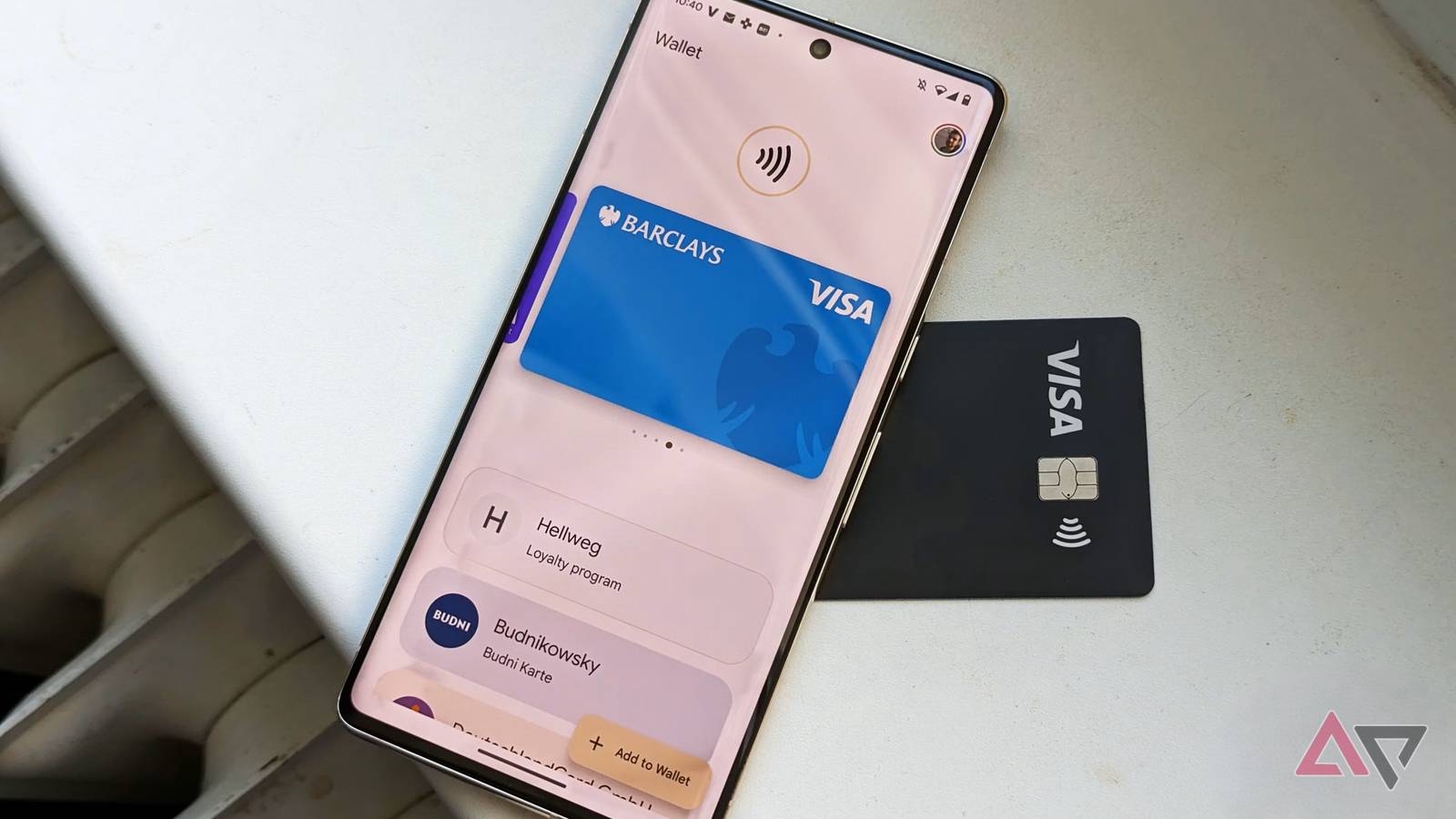
I use two wallet apps, and each has its strengths and weaknesses. I use the Samsung Wallet app for everything related to payments and IDs, while Google Wallet is irreplaceable for its automated ticketing feature.
However, for anyone without a Samsung Galaxy handset, Google Wallet is perhaps their best bet. It wouldn’t be a big deal to many, but I absolutely hate to see that my Motorola Edge 50 Neo can’t run the Samsung Wallet app.
In many instances when I use the Edge 50 Neo as my primary handset, I am forced to carry my Galaxy S21 because I need both Samsung Wallet and Google Wallet.
But I did something bold a few days ago by not carrying the Galaxy S21 and relying solely on my Edge 50 Neo.
This automatically meant I had access only to Google’s wallet app, not both. I thought it’d be a fun experiment, so I tried to survive a week using only Google Wallet, but one missing feature almost ruined it.

Quiz
8 Questions · Test Your KnowledgeGoogle Wallet app
Trivia challenge
From tap-to-pay to digital passes — how well do you really know Google Wallet?
PaymentsFeaturesHistorySecurityCompatibility
Begin
In what year was the original Google Wallet first launched?
A2010B2011C2013D2015
Correct! Google Wallet launched in 2011, making it one of the earliest mainstream mobile payment apps. It initially worked with select Citi Mastercard and Google Prepaid Cards on supported Android devices.
Not quite — Google Wallet actually launched in 2011. It was a pioneering move into mobile payments, though it took years and a rebrand before it truly gained widespread adoption.
Continue
What was the name of Google’s payment service that replaced Google Wallet before the Wallet brand was revived?
AGoogle CashBAndroid PayCGoogle PayDGPay Plus
Correct! Google Pay was the unified payment brand Google introduced in 2018, merging Android Pay and the original Google Wallet. The Wallet name and app were later revived in 2022 with an expanded feature set.
The answer is Google Pay. Google unified its payment services under the Google Pay brand in 2018, combining Android Pay and the original Wallet. The Wallet app was then relaunched separately in 2022.
Continue
Which technology does Google Wallet primarily use to enable contactless payments at terminals?
ABluetooth Low EnergyBQR codesCNFCDUltrasound
Correct! Google Wallet uses NFC (Near Field Communication) to enable tap-to-pay at contactless terminals. NFC allows devices to exchange data over very short distances, typically a few centimeters.
The correct answer is NFC (Near Field Communication). While QR codes are used in some payment systems, Google Wallet’s tap-to-pay functionality relies on NFC chips built into Android devices to communicate with payment terminals.
Continue
Besides payment cards, which of the following can you store in Google Wallet?
ACryptocurrency walletsBBoarding passes and loyalty cardsCSocial media profilesDWi-Fi passwords
Correct! Google Wallet supports a wide range of passes beyond payment cards, including boarding passes, loyalty cards, event tickets, hotel keys, and even COVID-19 vaccination records in supported regions.
The right answer is boarding passes and loyalty cards. Google Wallet has evolved into a broad digital wallet for many types of passes and credentials, though cryptocurrency storage is not a native Google Wallet feature.
Continue
What security feature does Google Wallet use to protect your card details during a contactless payment transaction?
AYour actual card number is transmitted each timeBA one-time virtual account number (tokenization)CEnd-to-end SMS verificationDA static encrypted PIN shared with the merchant
Correct! Google Wallet uses tokenization, which means a one-time virtual account number is generated for each transaction instead of sharing your real card number. This significantly reduces the risk of fraud and card data theft.
The answer is tokenization — a one-time virtual account number. Your real card number is never shared with the merchant during a Google Wallet transaction, making it more secure than swiping a physical card.
Continue
Which operating system is required to use Google Wallet’s tap-to-pay feature on a smartphone?
AAndroid 5.0 or higherBAndroid 9.0 or higherCAndroid 6.0 or higherDAndroid 8.0 or higher
Correct! Google Wallet requires Android 6.0 (Marshmallow) or higher to use tap-to-pay functionality. The device also needs an NFC chip, which is standard on most mid-range and flagship Android phones.
The correct minimum version is Android 6.0 (Marshmallow). In addition to the OS requirement, the device must also have an NFC chip to enable contactless payments through Google Wallet.
Continue
What is the name of the feature in Google Wallet that allows users to store and use digital versions of their government-issued ID in supported US states?
AGoogle ID VaultBDigital IDCVerified MeDGovPass
Correct! Google Wallet’s Digital ID feature lets users in select US states store a digital version of their driver’s license or state ID. It’s accepted at certain TSA checkpoints and partner locations, representing a major step toward digital identity.
The feature is simply called Digital ID within Google Wallet. Rolled out in partnership with select US states, it allows users to present a verified digital driver’s license or state ID at TSA checkpoints and other supported venues.
Continue
When using Google Wallet to pay, what must you typically do on your device before holding it near a payment terminal?
AOpen the Google Wallet app manually every timeBUnlock your device or authenticate with biometricsCEnable airplane mode firstDConnect to a Wi-Fi network
Correct! For security, Google Wallet requires you to unlock your device or verify your identity via fingerprint, face unlock, or PIN before a payment can be made. This ensures that only the authorized user can complete a transaction.
The correct answer is unlocking your device or authenticating with biometrics. This is a deliberate security measure — Google Wallet won’t transmit payment data to a terminal unless the device owner has been verified first.
See My Score
Challenge CompleteYour Score
/ 8
Thanks for playing!
Try Again
Google Wallet made the experiment easier than I expected
I knew it would be difficult before I started relying solely on Google Wallet. I wouldn’t mind a surprise, but I was spot on in my assumption that it would be difficult to survive.
However, I expected the hardship to be more pronounced than it actually felt.
As a Samsung Galaxy user, I never thought I would be able to adjust to any payment solution other than Samsung Wallet.
I thought making payments quickly would be the hardest part of the experiment, as Google Wallet doesn’t have a Quick access feature similar to Samsung Wallet.
After a week of experimentation, it turned out that I wasn’t entirely wrong.
However, it wasn’t as hard as I thought. Google Wallet doesn’t have a feature similar to the swipe-up gesture support in Samsung Wallet, but you can launch Google’s wallet app by adding a quick-launch shortcut.
I added Google Wallet as a Quick Settings toggle to launch the app quickly on my Motorola Edge 50 Neo.
I could also make my preferred card the default in the Google Wallet app for tap to pay.
However, in my region, Google Wallet opens Google Pay to complete the payment. This isn’t convenient, but half a loaf is better than none.
Related
Google Wallet vs. Samsung Wallet: Which is better?
Which digital wallet should you be using?
The missing feature that almost ruined it for me

Credit: Lucas Gouveia / Android Police
Wallet apps try to project themselves as replacements for physical wallets, but none of them, including Google Wallet, are quite there yet.
The biggest challenge it faces is consistency. Google Wallet behaves and functions differently in different parts of the world.
In my region, I can’t use Google Wallet to store all my important government IDs. While digital ID support in Google Wallet is slightly better in the USA, state IDs aren’t available in all parts of the country.
A month ago, Google partnered with the Unique Identification Authority of India (UIDAI) to allow its Wallet users to store Aadhaar, which is India’s unique identification number.
The announcement gave me hope that Google Wallet will support more IDs in the future in my region.
Only time will tell how much Google Wallet gets better at supporting IDs across different parts of the world, but for now, it feels frustrating that it can’t store something simple, like a driving license, which I need more often than Aadhaar.
The lack of support for digital IDs is a major reason I rely more on Samsung Wallet than Google Wallet.
In addition to a driving license, Samsung Wallet allows me to store documents like a Vehicle Insurance Certificate, marksheets, a unique identifier from the Income Tax Department, and more.
In my region, none of this is possible with Google Wallet, whereas Samsung Wallet supports IDs from both the Central and State governments.
Samsung Wallet isn’t a truly paperless wallet, but Google Wallet is way worse than that, at least in my region.
I can’t go back to using a digital wallet that’s only good at making payments and storing boarding passes, loyalty cards, event tickets, and more.
The lack of digital ID support ruined what would have been a wonderful one week with Google Wallet.
Google Wallet isn’t my default wallet app, but I can’t give it up
The flaws in Google Wallet are hard to ignore. Still, I keep coming back to it for its excellent integration with Gmail, which is one of the most overlooked features in Google Wallet.
It can automatically import items like boarding passes, event tickets, loyalty cards, and receipts from Gmail.
So, no matter which phone I carry, I keep the Google Wallet app installed specifically for this reason. I wish I could do this on Samsung Wallet, which is a testament to how much I like the integration.
This may be an undue advantage to Google Wallet, but it keeps me coming back to the app every few weeks. I can’t give it up, but I don’t want to rely on it alone, either.