
A handful of deep-space signals have puzzled astronomers for years. Known as long-period radio transients, they pulse, fall dark, then return about an hour later – yet no one knew the cause.
New observations have now confirmed a very different source for one of them.

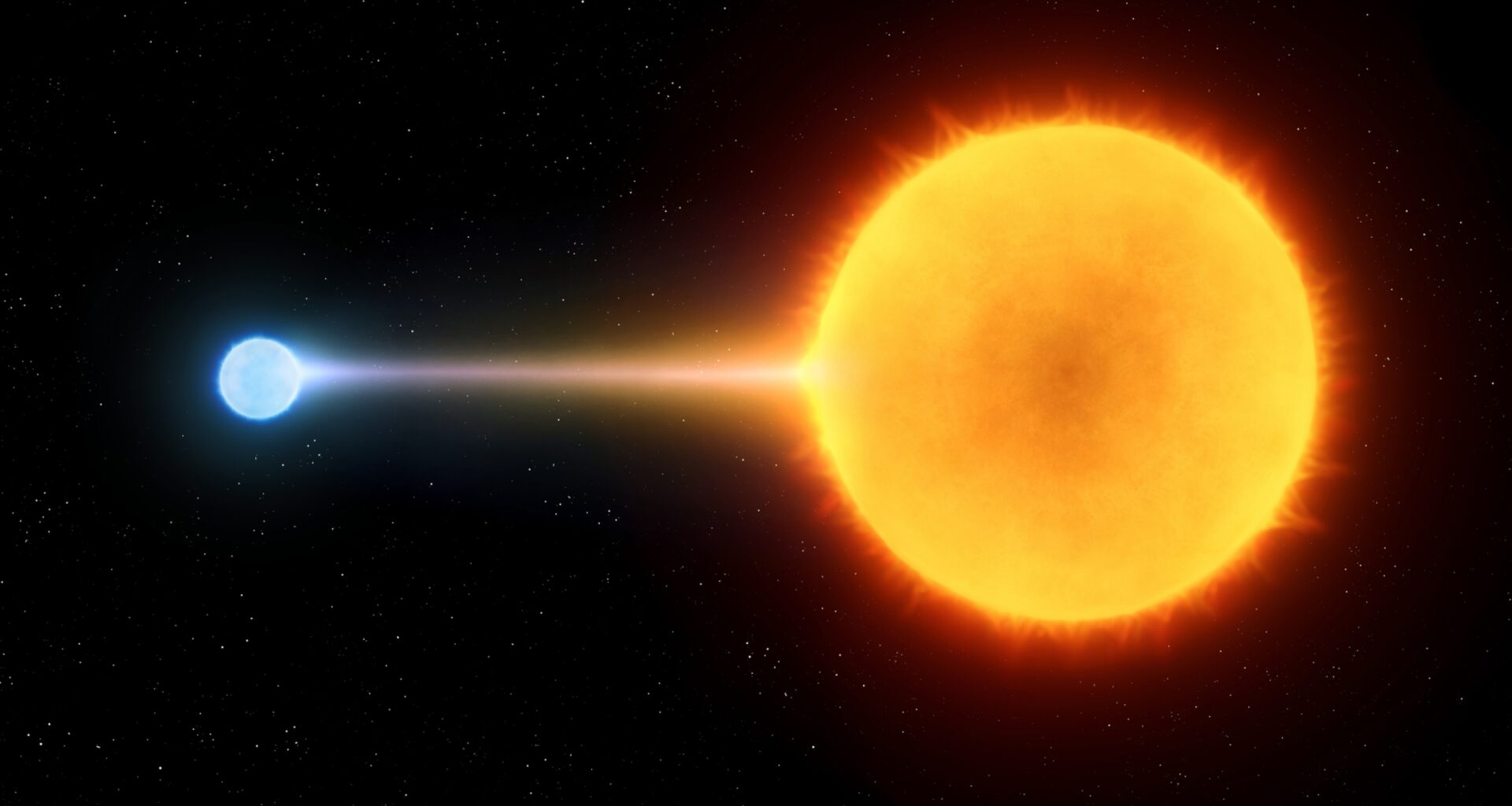
It’s not a single spinning star, but two stars bound in a tight orbit, with one pulling gas off the other.
Long-period radio transients
These long-period radio transients brighten in radio waves, fall quiet, then return minutes or hours later. Only about a dozen have ever turned up.
A signal that slow is hard to explain. The favored idea blamed a spinning dead star, yet a star turning that lazily should produce no radio pulse at all.
Without the true source, no one could tell whether all these signals shared one origin or many. The field needed a single system clear enough to take apart.
Catching the culprit
Kovi Rose, a doctoral physics researcher at the University of Sydney, was combing a radio survey for a twisted, magnetic kind of light. One source matched nothing on record.
The survey ran on CSIRO’s ASKAP radio telescope in Australia, which was built to flag oddities others miss. A closer look revealed not one star but two, now cataloged as ASKAP J1745-5051.
Their combined light marked the pair as a cataclysmic variable – a dead star stripping gas from a living companion. That star is a white dwarf, near Earth’s size yet almost as heavy as the Sun.
Two stars, one orbit
Its companion is a red dwarf, a small, cool star with a tenth of the Sun’s mass. The two sit so close that a single orbit takes about 1.4 hours.
Astronomers timed that orbit by watching the starlight. Lines in the spectrum slid back and forth as the stars swung toward Earth and away again, matching the beat of the radio pulses.
Gravity drives the rest. Gas torn from the red dwarf spirals toward its heavier partner and slams onto the white dwarf, a process called accretion that heats the gas until it glows.
X-rays and radio bursts
That falling gas runs hot, and its heat escapes as X-rays. Space telescopes watched the glow swing more than tenfold – a sign of gas piling onto the white dwarf.
The radio bursts come from elsewhere – most likely where the two stars’ magnetic fields collide and grab the gas between them. They peak at a different point in the orbit than the X-rays.
The X-rays also keep time with the orbit, a link no one had pinned down for one of these systems before. Only a couple have ever been caught in X-rays at all.
Stripes like Jupiter’s
These radio bursts hold details never seen in such signals before. They drift up and down in frequency over a longer cycle, and a fine striped pattern runs through each one.
One feature had no precedent in any star pair. Across the sky, that striped pattern of bright and dark bands appeared in only one other place – the radio glow from Jupiter and its moon Io.
Stripes like those appear when a radio beam shines out through a cloud of charged gas. Here, that gas most likely streams off the companion feeding the white dwarf.
The signal also shuts off for hours at a time. That stop-start behavior fits accreting white dwarfs, which an earlier study showed switch on and off.
Not a dead pulsar
Early on, the obvious suspect was a neutron star – a dense stellar remnant that spins fast and beams radio waves out. Such pulsars are the textbook source of steady pulses.
There was a catch. A neutron star spinning slowly enough for these long beats should make no pulse at all. A recent paper showed how a white dwarf and a companion could produce them.
Similar pairs had been linked to these signals before, but never one caught feeding in plain sight.
“Now, we’ve been able to show that the source for one of these transients comes from a white dwarf actively pulling material from a companion star,” said Rose.
A stellar Rosetta stone
Because this system is finally understood, it anchors the whole class of long-period radio transients. Astronomers can now test the next slow pulse against it.
“It could help us determine whether other long-period transients are more like pulsars or like white dwarf systems, acting like a stellar Rosetta stone,” said Rose.
The discovery reaches beyond a single pair – it also offers a rare look at physics no laboratory can recreate.
The slow radio pulse is the work of a dead star feeding on its neighbor – confirmed by the paired stars, their shared orbital beat, and the X-rays that rise and fall with it.
With one case cracked, astronomers can begin sorting this strange class.
The study is published in the journal Nature Astronomy.
—–
Like what you read? Subscribe to our newsletter for engaging articles, exclusive content, and the latest updates.
Check us out on EarthSnap, a free app brought to you by Eric Ralls and Earth.com.
—–