
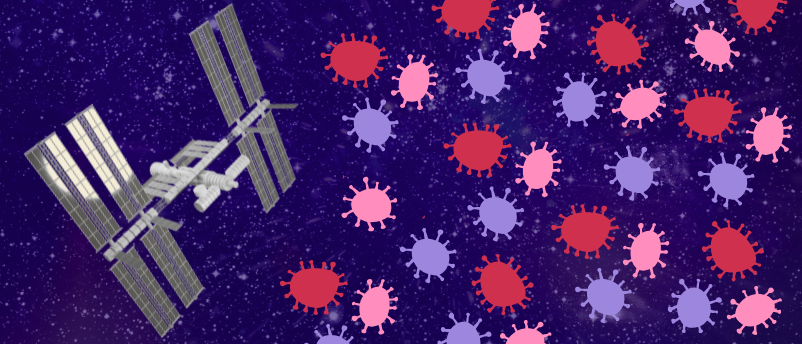
How do bacteria fare in space? A new study examines the effects of microgravity on melanin biosynthesis in Escherichia coli (E. coli) aboard the International Space Station (ISS), offering crucial clues for improving space biomanufacturing.
Some 400 km above our heads, the ISS conducts essential research in microgravity. Alongside the astronauts and state-of-the-art science facilities lurks a legion of microorganisms, providing insights into processes such as microbial metabolism beyond Earth’s atmosphere. Adding to this horde, scientists at the US Naval Research Laboratory (DC, USA) recently launched engineered E. coli to study melanin biosynthesis in extraterrestrial environments. Although the bacteria could still produce melanin in space, microgravity significantly disrupted the process – information that we can use to optimize off-planet biomanufacturing in future.
Harnessing microbes for manufacturing in space offers a scalable and adaptive approach to producing biomaterials, pharmaceuticals and metabolites – and it is vital for enhancing the sustainability of long-duration space missions, particularly when resupply missions are impractical, such as during deep-space exploration. Unfortunately, microgravity can wreak havoc on microorganisms, altering their metabolism and biosynthetic efficiency; hence the need to do some more digging if we are to make this dream of microbial bioproduction in space a reality.
Melanin – the molecule responsible for hair, eye and skin pigmentation – has emerged as a promising candidate for space applications. It can act as a protective shield against radiation and exhibits antioxidant activity, thermal stability and metal chelation, all of which may help organisms survive beyond Earth.
To find out if melanin was a viable option to help protect organisms in space, the team, led by Zheng Wang, engineered E. coli to express tyrosinase – an enzyme required for melanin synthesis – and investigated its production when cultured under microgravity conditions aboard the ISS and in ground controls.
Once samples returned Earthside, melanin production of the bacterial strains flown on the ISS, as well as the ground controls, was characterized. ISS-grown E. coli exhibited significantly lower melanin production than ground controls, as visualized by the contrast in color of the cultures. Sequencing did not reveal any mutations in the tyrosinase gene (tyr1) in either sample, indicating that the enzyme was not responsible for this drop in production.
 Defying gravity: musculoskeletal aging models in space
What happens to our muscles on a cellular level as we age? Anne McArdle, a Professor of Musculoskeletal Aging, explores this question in this interview.
To investigate further, the researchers performed differential pulse voltammetry experiments, which revealed high extracellular tyrosine in ISS samples. “Without gravity,” Wang explained, “nutrient transport just didn’t work the same way.”
Next, the team collaborated with scientists at Arizona State University (AZ, USA), using a Rotating Wall Vessel bioreactor to recreate the space-based microgravity environment on Earth. Low Shear Modeled Microgravity experiments using this system, again, demonstrated that the bacteria produced less melanin, had altered metabolism and lower cell survival.
Meanwhile, proteomic profiling of melanin-producing bacteria grown on the ISS identified increased expression of membrane, transport and stress-related proteins, while metabolomic analysis showed elevated trehalose and decreased glutathione, indicating oxidative stress and disturbed redox homeostasis.
Taken together, these findings suggest that the reduced melanin production observed in ISS-grown E. coli is the result of a combination of disrupted substrate transport, altered redox homeostasis, oxygen limitation and increased metabolic burden under microgravity.
“The biggest takeaway is that if we want to manufacture materials using microbes in space, we have to solve the issue of how nutrients get into cells,” added Wang. “Without that, the cells become stressed and stop functioning in the way we expect.”
If they can achieve that, then microbial biomanufacturing in space could finally be on the cards.