
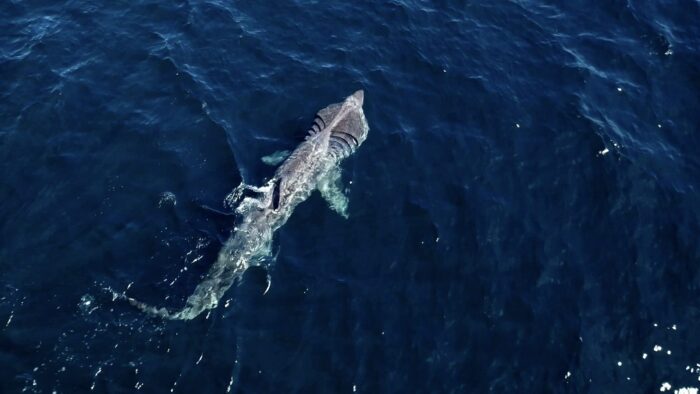
Researchers have found that basking sharks do not fast during their long migrations.
The findings are the result of new research from the Woods Hole Oceanographic Institution (WHOI) and reveal that endangered basking sharks are not fasting during long-distance migrations. The scientists found that the sharks appear to forage en route and dive far deeper than previously recognized.
The team made their findings after analyzing more than 8,000 days of tracking data from 37 basking sharks tagged near Cape Cod between 2004 and 2011.
Commenting on the findings, Jaida Elcock, a doctoral candidate in the MIT WHOI Joint Program and lead author of the paper, stated:
“Reaching depths of 800 to 1,000 meters is physiologically demanding. It’s cold, dark, and low oxygen. Yet these sharks repeatedly dive into the secondary deep scattering layer, a resource that most large pelagic predators cannot exploit.”
Discussing the sharks’ mating habits, Elcock added:
“One of the biggest mysteries is their reproduction. We still don’t know where basking sharks mate or give birth, and these long-distance migrations may be tied to mating behavior happening far offshore and deep underwater, where we can’t observe it directly…There have also been records of basking sharks moving from the Cape Cod region to the Northeast Atlantic, towards Scotland and Ireland, which raises questions about how much genetic exchange may be happening between seemingly distinct populations.”
While co-author Camrin Braun, an oceanographer and ecologist at WHOI, added:
“We don’t yet know what basking sharks are feeding on at these depths. One interesting idea is filter feeding on swarms of tiny twilight zone fish that are too small for most other predators to target. A key question is what would the impacts be if we started harvesting the tiny fish and squid that live in the twilight zone on an industrial scale? Would this negatively impact basking sharks and other top predators? We need to figure that out.”