
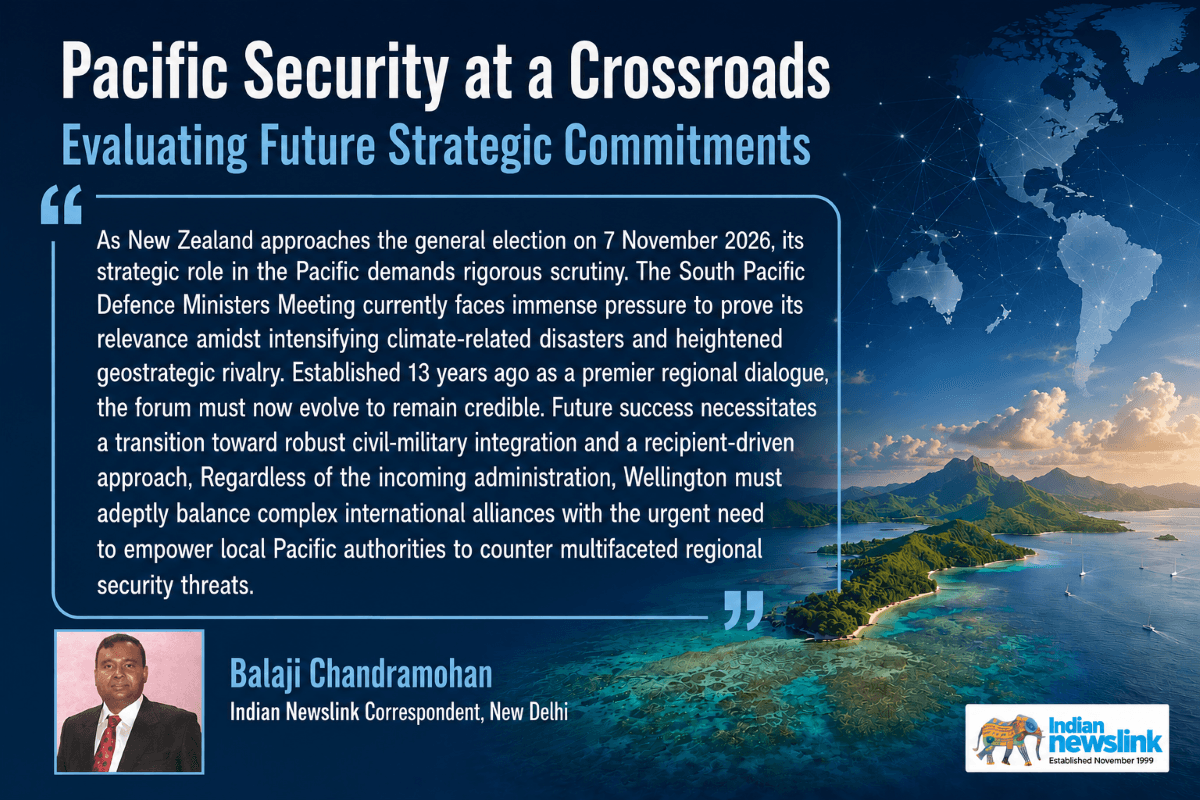
Balaji Chandramohan
New Delhi, June 13, 2026
As New Zealand moves towards its general election on November 7, 2026, the Nation finds itself at a critical juncture regarding its future role and strategic posture within the Pacific Islands.
There is significant interest in how Wellington will navigate its long-standing commitments and evolving security partnerships.
Central to this discourse is the South Pacific Defence Ministers Meeting, an institution currently under pressure to demonstrate its relevance amidst intensifying climate-related disasters and heightened geostrategic competition.
The next government, regardless of political affiliation, must confront these challenges while balancing complex international alliances and regional expectations for security.
The Evolution of the Defence Ministers’ Meeting
Since its inception 13 years ago, the South Pacific Defence Ministers Meeting has served as the premier ministerial dialogue for the region, acting as a catalyst for cooperative, Pacific-led responses to security concerns.
However, the institution is currently facing a dual challenge: the increasing vulnerability of Pacific nations to extreme weather events driven by climate change, and a surge in geostrategic rivalry marked by competitive military posturing. To remain effective and maintain its legitimacy, the forum must evolve. This necessitates a transition toward a stronger civil-military integration and a more recipient-driven approach that prioritises the empowerment of local authorities over external interventions.
Enhancing Regional Operational Synergy
The future efficacy of the South Pacific Defence Ministers Meeting hinges on its capacity to harmonise operational collaboration with broader regional security architectures.
A significant step forward occurred in 2024, when the forum hosted the Pacific Islands Forum for the first time with observer status. This alignment is essential to avoid the duplication of efforts and to streamline humanitarian and disaster relief responses. Furthermore, initiatives such as the Pacific Response Group and the deployment of the Pacific Special Advisory Team have demonstrated the value of multinational coordination during high-risk weather seasons.
These collaborative exercises are vital for building the interoperability necessary to manage the complex, multifaceted threats facing the region today.
France as a Pillar of Regional Stability
France continues to play a pivotal, and often understated, role in the Pacific security landscape. Through its military presence in New Caledonia and French Polynesia, France provides critical logistical support for humanitarian operations and aids Pacific Island nations in the monitoring of their exclusive economic zones.
The expansion of the Pacific Academy in Noumea represents a strategic investment in human capital, offering advanced training in civil-military crisis planning.
By formalising ship-riding agreements that allow partner nation inspectors to operate aboard French vessels, France has significantly bolstered the collective capacity of the region to enforce maritime security and manage resources effectively.
This framework exemplifies the practical, technical cooperation required to ensure the Pacific remains a region governed by established maritime law.
The Geopolitical Stakes in New Caledonia
The upcoming elections in New Caledonia carry profound strategic connotations for the wider Pacific. As an essential French overseas territory, the political stability of New Caledonia directly influences the dynamics of the Melanesian region. The interaction between the Melanesian Spearhead Group and external powers highlights the tension between regional autonomy and the influence of larger global actors.
As Pacific Island countries increasingly resist the militarisation of their waters, the demand for a balanced, transparent, and consultative security architecture grows. Any diplomatic misstep in this territory could ripple across the Pacific, complicating the delicate balancing act required of nations such as New Zealand. New Caledonia stands as a test case for how a territory can reconcile its internal political aspirations with the broader regional necessity for security, transparency, and collaborative governance.
New Zealand’s Shifting Diplomatic Landscape
As Wellington evaluates its foreign policy trajectory, the interplay between domestic political shifts and international expectations becomes paramount.
Historical frameworks, such as the Wellington Declaration and the Washington Declaration, have cemented the strategic partnership between New Zealand and the United States.
While the Labour Party may advocate for a different emphasis on intelligence sharing or public alignment within the Five Eyes partnership, the necessity of maintaining robust defence relations remains constant.
The warming of United States-New Zealand defence relations over recent years confirms the importance of working with like-minded countries in the wider region.
If a new administration emerges, it will likely be called upon to provide clear confirmation of these security commitments to reassure strategic partners such as India, Australia, and Indonesia. This is vital to maintain the credibility of New Zealand as a reliable security actor in the Indo-Pacific.
Future Projections and Strategic Continuity
Ultimately, the choice facing New Zealand voters transcends simple party lines. Whether the next administration is led by the Labour Party or the National Party, the imperative to engage constructively with regional partners is absolute.
While specific policies regarding maritime deployments or intelligence prioritisation may undergo refinement, the overarching requirement for strategic continuity is clear.
Strengthening the existing security architecture, deepening partnerships with both traditional allies and emerging regional powers and addressing the root causes of regional instability through cooperative development will define the next chapter of New Zealand’s engagement with the Pacific Islands.
Furthermore, the commitment to open Sea Lanes of Communication remains a cornerstone of regional prosperity. By maintaining these standards and fostering a spirit of mutual respect, Wellington can ensure that it remains a central and trusted architect of Pacific security for years to come.
Balaji Chandramohan is an Indian Newslink Correspondent based in New Delhi.