
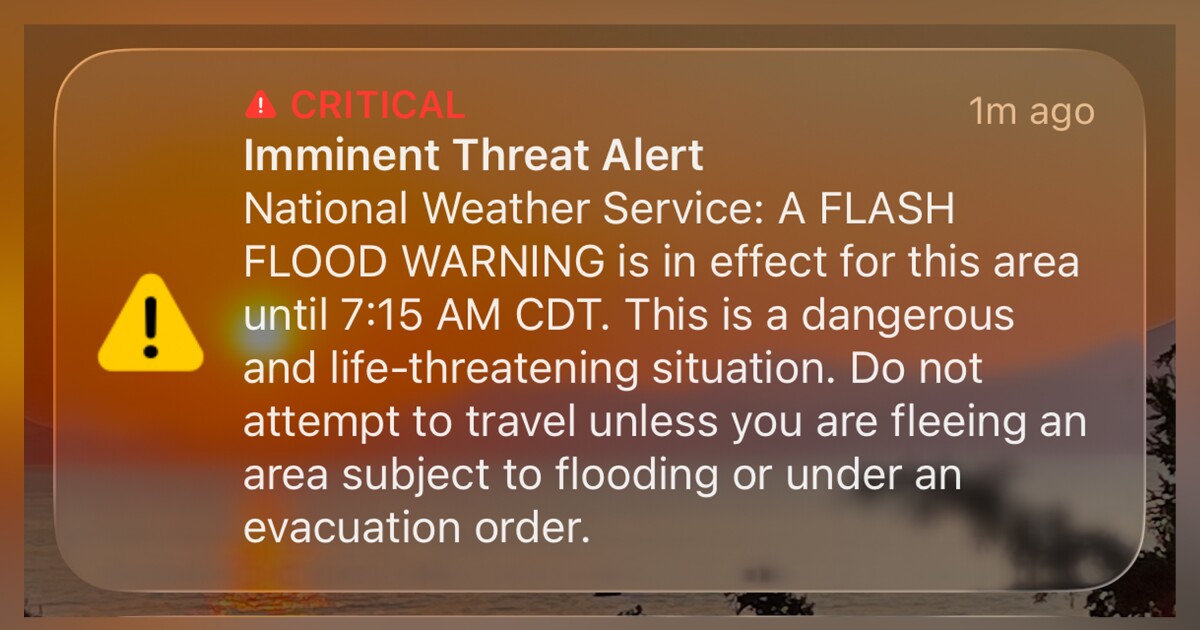
Flash flood warnings from the National Weather Service woke people up across Austin early Monday morning. A new type of emergency notification, which appeared on the screens of iPhone users as an “imminent threat alert,” startled and confused many.
One person posted on the Austin page of the social media platform Reddit, saying, “So are we all awake now?” In the comments, people complained about the multiple alarms going off and the loss of sleep between the ringing of phones and the storm.
Another user posted instructions on how people can turn off the weather alerts, while others pointed to last July’s floods as a reason to keep alerts on.
KUT News reached out to emergency management and weather officials for answers.
What are ‘imminent threat’ alerts?
“CRITICAL,” the alert read at the top of the screen in red letters. “Imminent threat alert.”
Many people saw the above message for the first time this week due to an updated Apple iOS feature that includes “Enhanced Safety Alerts.” It provides more information about threats, such as maps, links and different audio tones, according to Pat Vesper, the meteorologist in charge at the Austin-San Antonio National Weather Service office.
“Hopefully this will be remedied,” Vesper wrote in an email in response to the Apple update. “It affects more than just our office.”
The National Weather Service sends out notifications through the Integrated Public Alert & Warning System, according to Martin Ritchey, the director of Homeland Security for the Capital Area Council of Governments.
The message is sent to local cell towers, which broadcast it to phones in the area, Ritchey said. Each time the flood warning is extended, another alert is sent out, according to Vesper.
There have been no recent changes to the procedures for the flash flood warnings, Vesper said.
How do I turn off the new alerts?
You can turn the enhanced safety alerts feature on or off by going into the Apple settings → Notifications → Enhanced Safety Alerts and toggling the buttons to customize your preferences.
“If Government Alerts are enabled and issued by your local authorities via carrier networks, your iPhone might receive them in addition to Enhanced Safety Alerts,” Apple said on its website. The company says that another toggle option on iPhones — “Improve Alert Delivery” — can even result in messages being delivered faster than government alerts.
Should I keep the alerts on?
The messages are sent out by human forecasters, according to Cory Van Pelt, a meteorologist and hydrologist at the National Weather Service. Van Pelt said the office is focused on getting the message out, regardless of whether it wakes people up or not.
But there is a social science behind the messaging and how people respond. Ritchey said there is a concern that people are turning off the alerts.
“We do have conversations with our stakeholders and everybody about message fatigue … and so does the National Weather Service,” Ritchey said.
Still, he said that communicating with people through their phones is the most effective way.
“I’m very proud of the first responders that were out there doing their job, and I think the community should respect that by keeping that switch on,” Ritchey said. “I apologize on behalf of the whole way we approach this stuff for the inconvenience, but I do want people to know it’s essential that we can reach you.”
Storm chances return to the Austin area this Friday.