
 image: ©Rene Notenbomer | iStock
An eight-year field experiment has challenged the belief that biochar acts as a permanent, one-time agricultural fix. The study suggests that biochar should instead be managed as a medium-term soil amendment whose agronomic benefits degrade over time under intensive farming
Researchers tracked the long-term impact of varying biochar application rates across two contrasting soil types in Guizhou Province, China, from 2018 to 2025.
Strong initial gains, rapid decline
In the initial years of the trial, the material performed well. High application rates sharply boosted soil organic carbon, soil pH, and key available nutrients like potassium, phosphorus, calcium, and magnesium. At the highest application rate, soil organic carbon peaked at 83.59 grams per kilogram within the clay loam soil.
However, these distinct agronomic advantages did not last indefinitely. The strongest positive soil effects lasted only 3 to 5 years. By the final years of the study, between 6 and 8 years, the nutrient profiles of soils treated with biochar gradually weakened, ultimately becoming statistically similar to untreated control plots. Crop nutrient uptake, leaching, fertilisation effects, and biochar ageing appeared to reduce the differences among treatments over time.
Structural equation modelling revealed that soil pH played a central role in regulating nutrient availability, especially for base cations like calcium and magnesium. As biochar’s early liming effect naturally weakened over time, its nutrient advantages declined alongside it.
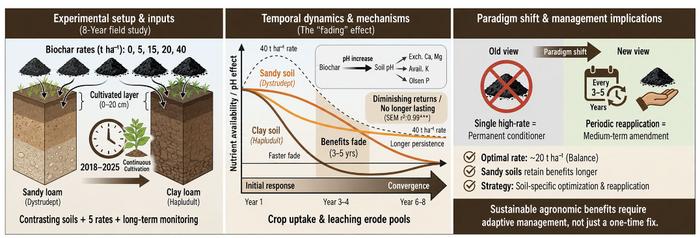 Biochar application rates regulate soil nutrient availability: evidence from an 8-year field study across two soils
Credit Jiuquan Zhang, Caibin Li, Minggang Xu, Jianxin Dong, Shuai Wang, Pengzhi Li & Heqing Cai
Testing soil textures and application thresholds
The experiment evaluated five different application rates—0, 5, 15, 20, and 40 tons per hectare—across a sandy loam Dystrudept soil and a clay loam Hapludult soil under continuous tobacco cultivation.
Surprisingly, the sandy loam soil retained biochar effects longer than the clay loam soil, even though clay-rich soils are traditionally expected to hold nutrients more effectively. Researchers note that under intensive cultivation, crop demand and nutrient movement can override simple predictions based purely on soil texture or cation exchange capacity.
The study also identified an important threshold for the application rate. A moderate rate of 20 tons per hectare offered the best balance between effectiveness and persistence. The highest rate of 40 tons per hectare produced the largest short-term response but did not extend the duration of the benefits, meaning adding more biochar may raise costs without providing longer-lasting improvements.
Implications for future agriculture
The findings suggest that farmers may benefit more from optimised or periodic biochar applications than from a single high-dose application. Future biochar strategies should focus on when, where, and how much to apply, rather than assuming that one application will work forever.
The authors note that the study used one type of biochar made from tobacco stems and focused on continuous tobacco cultivation, so results may differ for other biochars, crops, and management systems. Still, the 8-year dataset provides rare long-term field evidence that highlights a practical shift in biochar management: biochar can improve soils, but its agronomic benefits under intensive farming may need renewal over time.