
Danger in the ocean does not always arrive in plain sight. Sometimes it spreads as an invisible chemical signal, drifting through the water and warning nearby animals that trouble is near.
Bony fish have relied on this signal for ages. A startled individual releases a warning compound into the water, and nearby fish read the message and react.

Sharks, rays, and their relatives were thought to sit outside this conversation. But now, a study has revealed that bat rays use chemical signals to warn about nearby predators.
Bat rays send a chemical warning
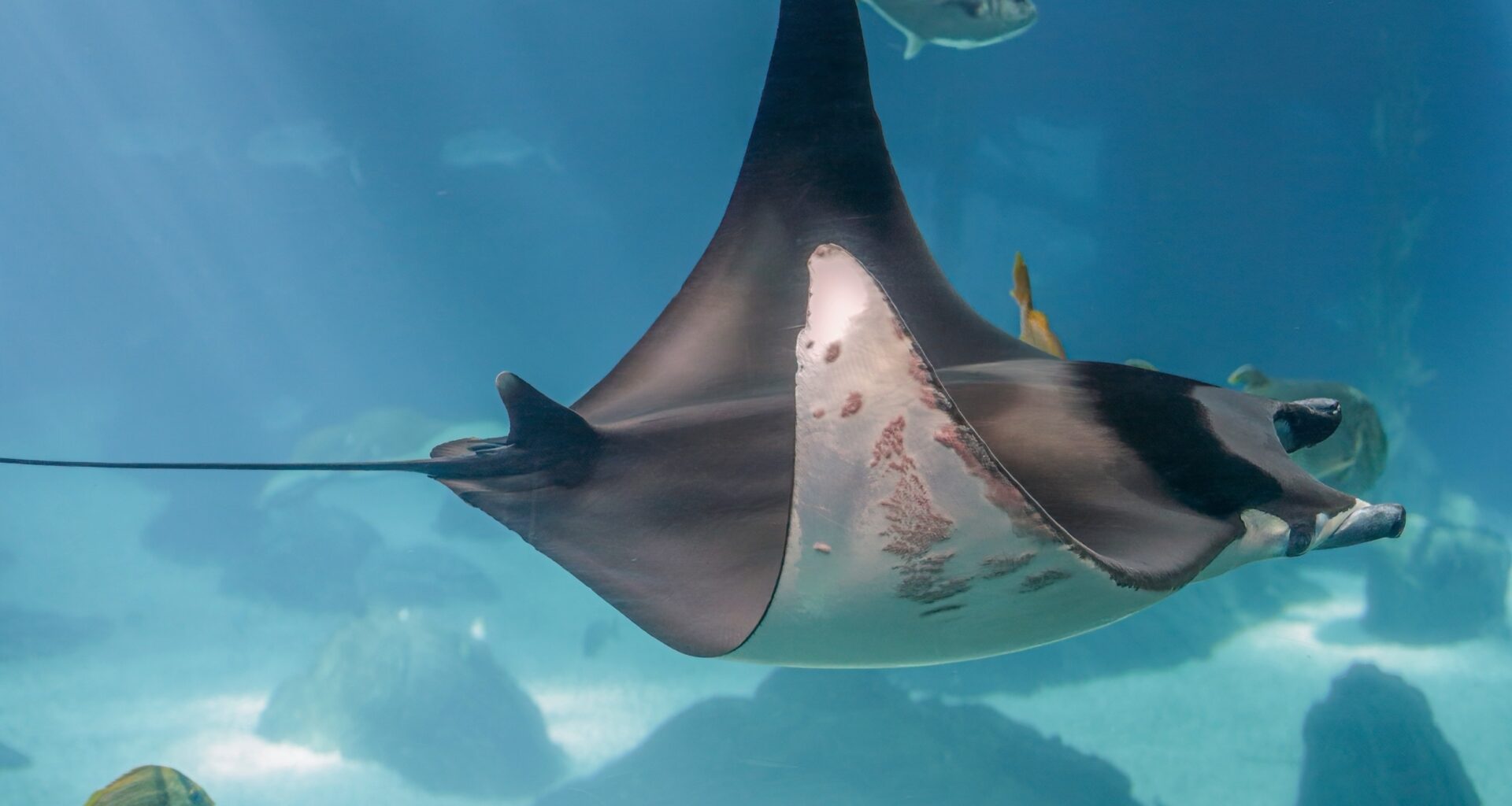
Researchers at Oregon State University have shown that a scared bat ray (Myliobatis californica) appears to release a chemical that alerts other rays to trouble.
The signal moved from one tank to another and changed how the receiving animals behaved.
This anti-predator strategy was well known in bony fish. It had never been documented in cartilaginous fish before now.
“The animals could not see each other, and they were acoustically isolated, so our work shows the response was induced by a chemical alert from the frightened ray,” said Joshua Bowman, the study’s lead author.
Why sharks flee orcas
Bowman began with a larger question about white sharks. These ocean giants sometimes abandon their hunting grounds, and nobody was sure how the warning spread.
“People don’t necessarily think of sharks as prey, but even white sharks – the largest predatory sharks in the ocean – can be prey to orcas,” Bowman said.
“Past research has documented sharks fleeing when orcas are present, and they’re probably not all seeing an orca and saying ‘ok, time to leave.’ That suggests there’s probably some other signal they are responding to.”
Rays stand in for sharks
White sharks are difficult to keep and study. Bat rays offered a practical alternative, since they are smaller and easier to house in a laboratory.
The team borrowed juvenile rays from the Oregon Coast Aquarium in Newport. Rays and sharks share an evolutionary branch, so lessons from one can inform about the other.
Study co-author Taylor Chapple is an associate professor and co-director of the Big Fish Lab at Oregon State University.
“Rays are closely related to sharks, so studying their communication pathways can provide insights into sharks as well,” said Chapple.
“Disturbance cues have never been described in sharks or rays, so these findings provide new insights into the communication pathways and behavioral complexities of these critically important marine species.”
A simple, three-tank test
The setup was simple in design. One signaler tank fed water into two downstream receiver tanks, each holding a single ray.
Thick foam, opaque barriers and falling water blocked sound, sight and vibration between the tanks. Anything the receivers picked up had to arrive dissolved in the water itself.
Once the rays had settled in, Bowman chased the signaler with a stick for 30 seconds. He never touched or harmed the animal, which kept the cue free of blood or injured tissue.
The rays reacted fast
Overhead cameras recorded each ray for 15 minutes before and after the chase. The receivers responded within seconds of the disturbed water reaching their tanks.
Receiver rays sped up, while control rays in a parallel setup did not. They also switched from resting on the bottom to circling the walls of their tanks.
The receiving rays raised their average speed by about three centimeters per second, a jump of roughly 21 percent. Control animals, which received water from an empty tank, showed no real change.
That faster, wall-hugging movement matches a classic escape response. In the wild, extra speed helps prey put distance between themselves and a hunter.
No stress in the blood
A racing animal might be expected to show signs of physical stress. The researchers checked blood for glucose, lactate, pH and a ketone called 3-HB.
None of these markers differed between the alarmed receivers and the calm controls. The behavior shifted, yet the body chemistry held steady.
That steady chemistry suggests the rays handled the burst of activity with ease. Bat rays carry oxygen well and recover fast, so a short sprint stays within their aerobic budget.
Daily feeding may also have smoothed over any metabolic signal. The animals had plenty of fuel on hand, so they did not need to tap deeper energy reserves.
Why this matters for ecosystems
These signals matter well beyond a single startled animal. When a predator like a white shark leaves an area, the prey it leaves behind can multiply and reshape the local food web.
A chemical that spreads alarm could therefore move predators around in ways that touch whole ecosystems.
The work hints that this kind of chemical risk assessment is more common among sharks and rays than anyone realized.
The chemical itself is still a mystery. Bowman hopes future research can pin down what the rays are actually releasing.
“This behavior evolved to help the animals survive in the wild,” Bowman said.
“But it also serves as a reminder to people that if they disturb these animals, in the wild or in controlled settings, they may be impacting more animals than just the one in front of them.”
The study is published in the Journal of Experimental Zoology.
—–
Like what you read? Subscribe to our newsletter for engaging articles, exclusive content, and the latest updates.
Check us out on EarthSnap, a free app brought to you by Eric Ralls and Earth.com.
—–