
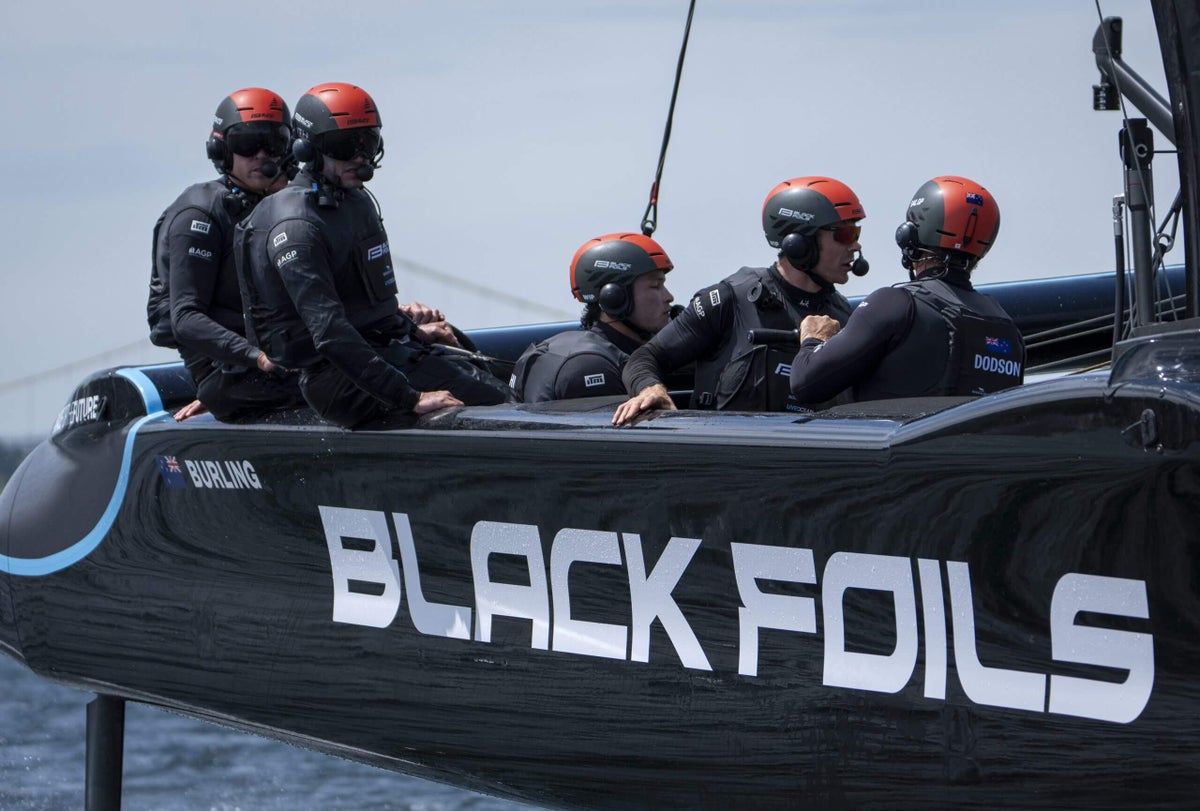
Four months after crashing out of the SailGP Championship in front of their home crowd in New Zealand, Peter Burling and the Black Foils are set to return to competition this weekend for the Canada Sail Grand Prix.
February’s high-speed collision between New Zealand and France in front of the Auckland crowd had catastrophic consequences for both teams, as well as for Burling’s quest to win his first championship. One crew member from each team was taken to hospital after the New Zealand boat nosedived and immediately corkscrewed 90 degrees, directly into the path of the French boat just a few metres behind.
Black Foils grinder Louis Sinclair, who suffered fractures to both legs, continues his recovery at home. Stewart Dodson has joined the Black Foils as a replacement for the remainder of the season, which concludes in Abu Dhabi this November.
With no boat, the Black Foils were unable to compete but the team’s new F50 catamaran, built in the UK, has been delivered in time for Halifax, Nova Scotia, a competition which marks the halfway point of the 13-event season.
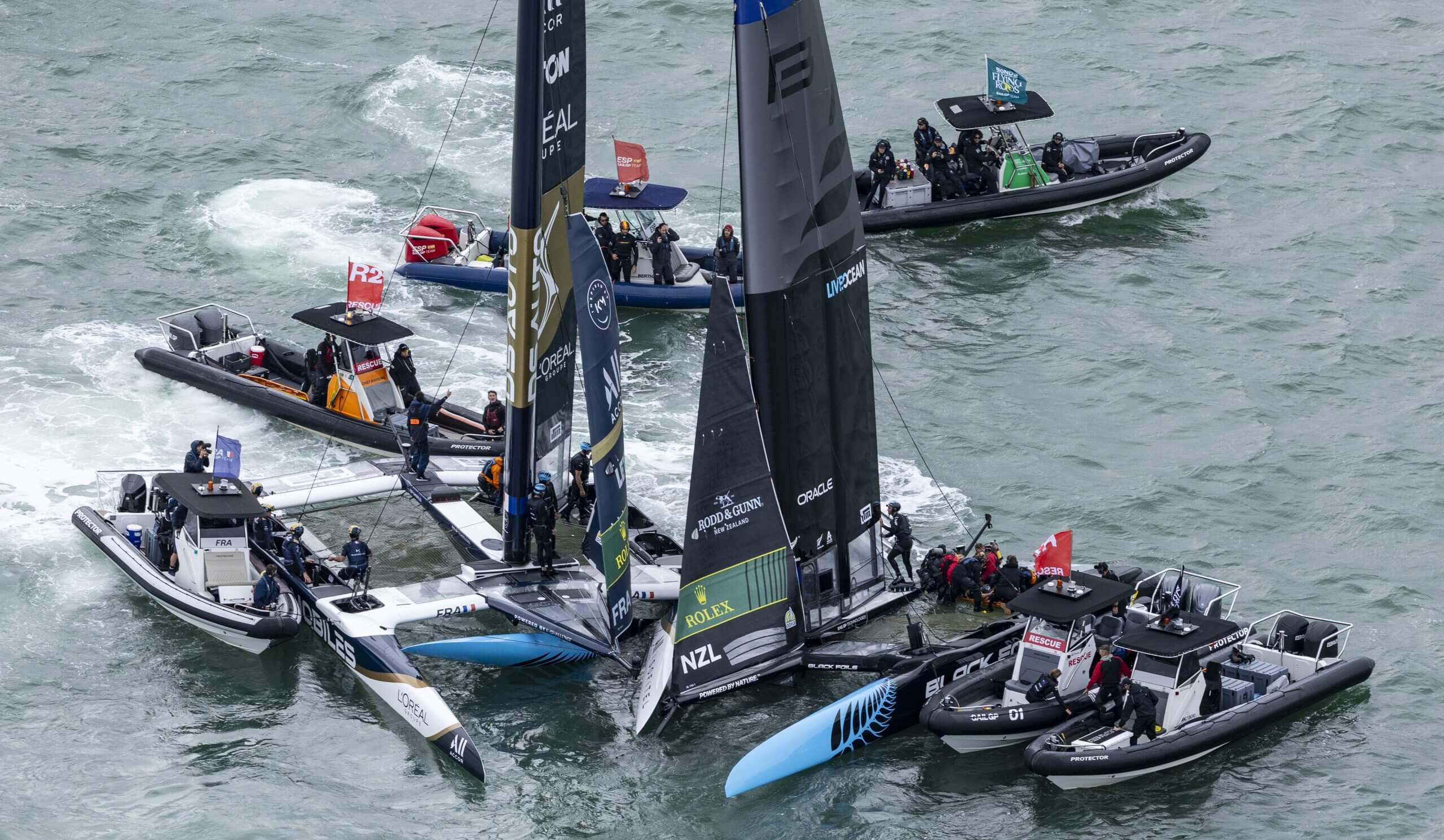
The aftermath of the collision between New Zealand and France earlier this year. (Simon Bruty for SailGP)
The Black Foils still have a mathematical chance of qualifying for the three-boat season-deciding final race in Abu Dhabi, although it is a long shot — even for a team of the Kiwis’ caliber.
Blair Tuke, Black Foils Co-CEO and wing trimmer (the sailor who constantly adjusts the wing sail for maximum speed), said he has been struggling with the enforced period away from competition.
“It’s been a tough few months, but we are full focus ahead now,” he told The Athletic. “The team is motivated just to get back out there and start putting some good performances back on the board.”
Burling and Tuke have won so much together: three Olympic medals in the 49er skiff class and three America’s Cup victories with Team New Zealand, a competition regarded as the most prestigious in sailing. Yet, the one that has yet eluded this power duo is overall victory in SailGP.
“Before the accident, we were sailing really well,” he said. “We’d put two good races on the board. Pre-Perth [the opening event of the season in Australia], we were sailing well in the warm-ups, the best we’ve sailed as a group. So, yeah, it’s been tough to sit out these events now knowing that we’ve got those performances already.”
While Tuke has been taking time away from the sport back home in New Zealand, other members of the team have remained closely involved in the league in one way or another.
Burling has visited a number of events, sitting in the coaches’ booth watching the action closely through the multiple camera angles and constant data flow pouring off the boats during racing. Strategist Liv Mackay has been standing in as France’s strategist while Manon Audinet recovers from the injuries she suffered from that Auckland crash. And grinder Marcus Hansen has served a stint with the Danish team at the Bermuda Sail Grand Prix last month.
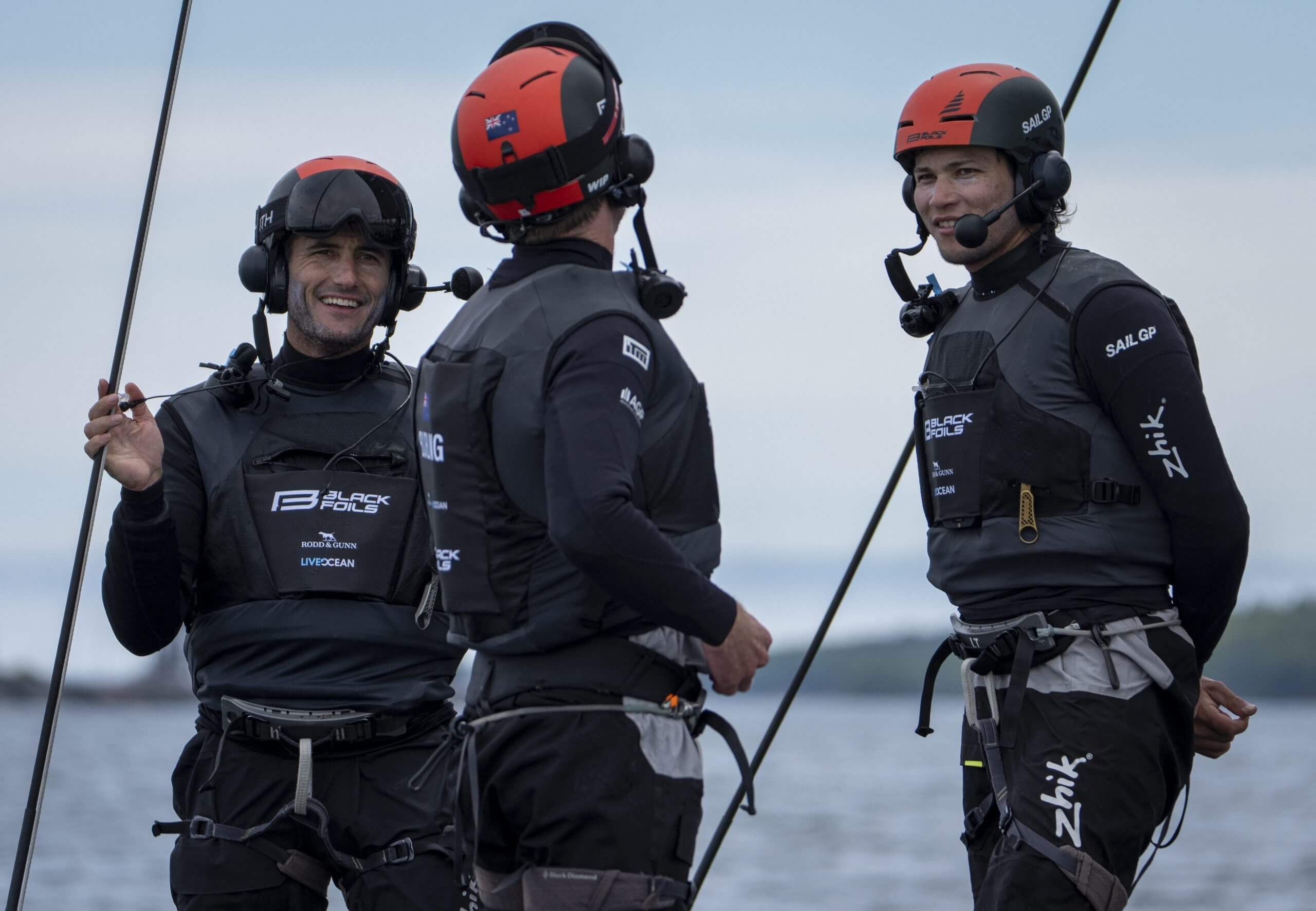
Blair Tuke, Peter Burling, and Leo Takahashi, flight controller, onboard their F50 ahead of the Canada Sail Grand Prix. (Jason Ludlow for SailGP)
Getting the team back together and working as a cohesive unit again is another matter, although Australian skipper Tom Slingsby — winner of the last three events, in Rio, Bermuda and New York — expected New Zealand to be instantly competitive again. “They’re going to come in for the second half of the season with nothing to lose,” he told The Athletic. “They’re going to be trying to get event wins, get prize money, and have a good year. I expect to see them come back in at the top.”
But Tuke is playing down expectations, saying it would be a mistake to expect too much too soon.
“After a few months away, we have to take that on board, and make sure we account for that [the lack of racing]; don’t try and do it all at once when we get back,” he said. “It’ll just be about getting out and putting some solid starts together, make sure the boat’s going fast, and sail smart. That’s the kind of ingredients for having a good race and a good weekend.”

“These are complicated boats and they don’t always come together totally smoothly,” said Tuke. “But the team’s done a great job in Southampton. This is probably the most complete that a boat’s come out of the yard facility so far.”
On Thursday, the Black Foils successfully blessed in a ceremony in Halifax and launched their new F50, which is named Manawatītī. Burling told SailGP it was “special” to be back on the water.
There has been plenty of boatbuilding going on more locally in Nova Scotia, too, as five local experts have joined forces with a SailGP team of 35 across the UK and Canada. Between them, the boatbuilding crew have put in almost 3,500 project hours to complete repairs across all three F50s caught up in that New York start-line pile-up between Italy, Brazil and the USA.
This means that there will be a full complement of 13 boats lining up to start racing in Halifax. However, such has been the rate of attrition, the league has yet to see all 13 boats make it through to the end of a race weekend. After the trials and tribulations of New York, SailGP CEO Russell Coutts will be keen to see the fleet emerge unscathed from Halifax.
On Instagram, Coutts countered criticisms of the high-speed reaching start format, or that there was any need to alter the fundamental Racing Rules of Sailing, which govern the rules of the road for all forms of sailboat and yacht racing. Instead, he put it back on the sailors to be more aware of changing situations developing around them.
One of the proposals being mooted is that there be someone occupying the strategist’s role at all times, even when the usual crew count of six is reduced in lighter winds. This could most affect the make-up of Taylor Canfield’s crew on the U.S. boat, as the Americans are the only team to have their female sailor, Anna Weis, operating in the grinder’s role at the front of the cockpit, where visibility is severely restricted by the wingsail.
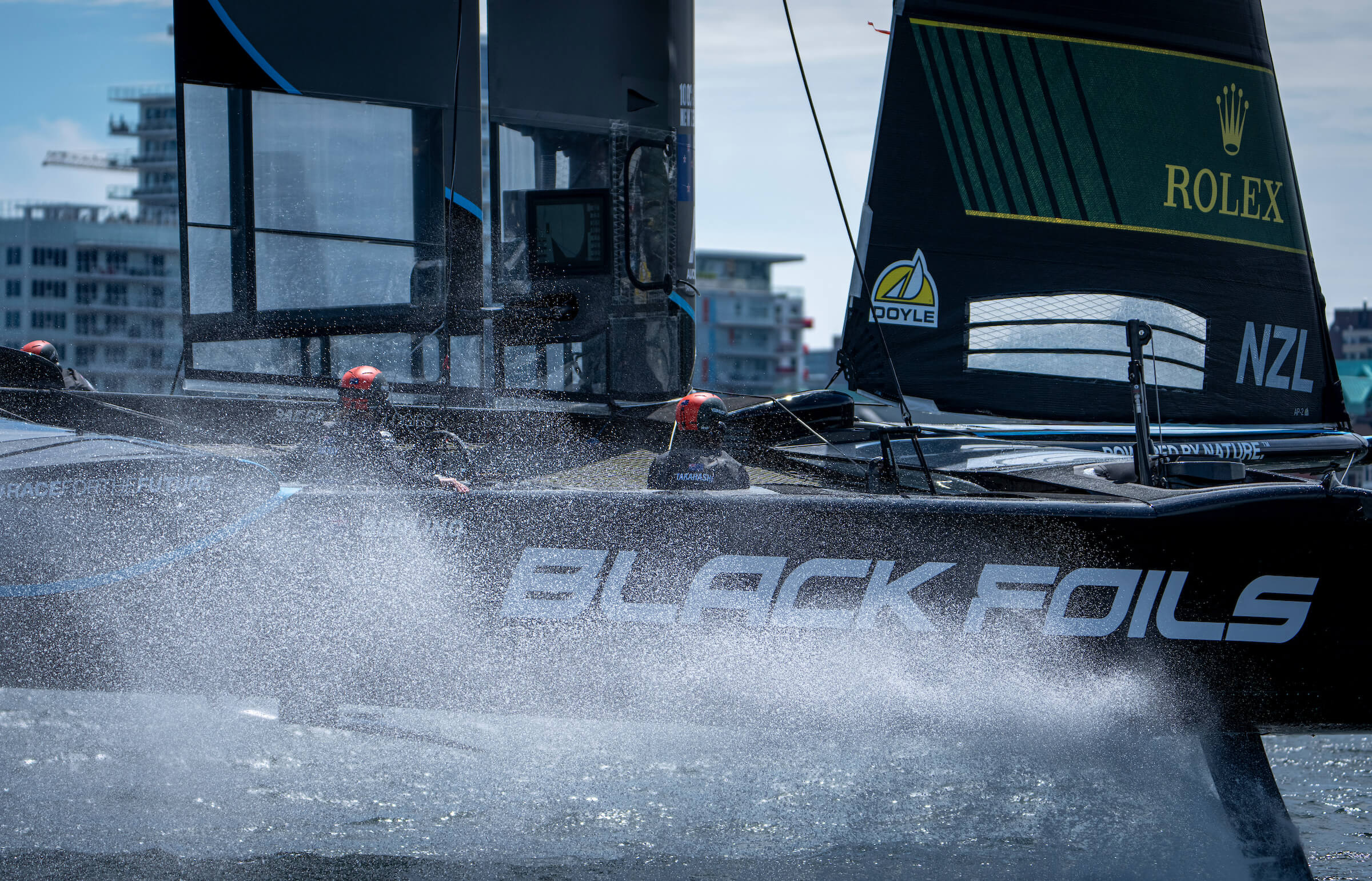
The Black Foils practice on the water on June 18. (Jason Ludlow for SailGP)
The unusual American setup — with no strategist in place — was deemed to be one of the reasons why Canfield and his crew failed to spot the impending collision with the Italian boat, which had changed course significantly in the last 10 seconds before the start of the race in question.
So changes may be foisted on the American setup, just as Canfield and crew have been hitting their stride this season.
Changes are also afoot on the underperforming Brazilian F50, which sits in 12th place in the season standings, ahead of only the New Zealand team.
Brazilian driver Martine Grael — the only female driver in the league — and British strategist Paul Goodison are switching roles this weekend. They will hope the swap will bring much-needed improvements on the race course, particularly out of the starts, which have been a weak spot. Now it’s up to Goodison, an Olympic gold medalist from Beijing 2008, to take the wheel and get the boat off the start line while Grael steps into the decision-making strategy role.
SailGP’s first visit to Halifax two years ago was full of drama and unpredictability. On that occasion, the Australians were caught out by an electronic malfunction to the wingsail controls that caused Slingsby’s F50 to capsize. The way things have played out so far this season, and with a gusty forecast on the cards, the league’s second visit to Halifax could be every bit as dramatic.
How to watch
Racing takes place in Halifax on June 21 and 22 from 3 p.m. ET. Viewers in the UK can watch on TNT Sports, while in the U.S. highlights and a full delayed broadcast will be on CBS Sports Network. For more details on how to watch wherever you are in the world, click here.