
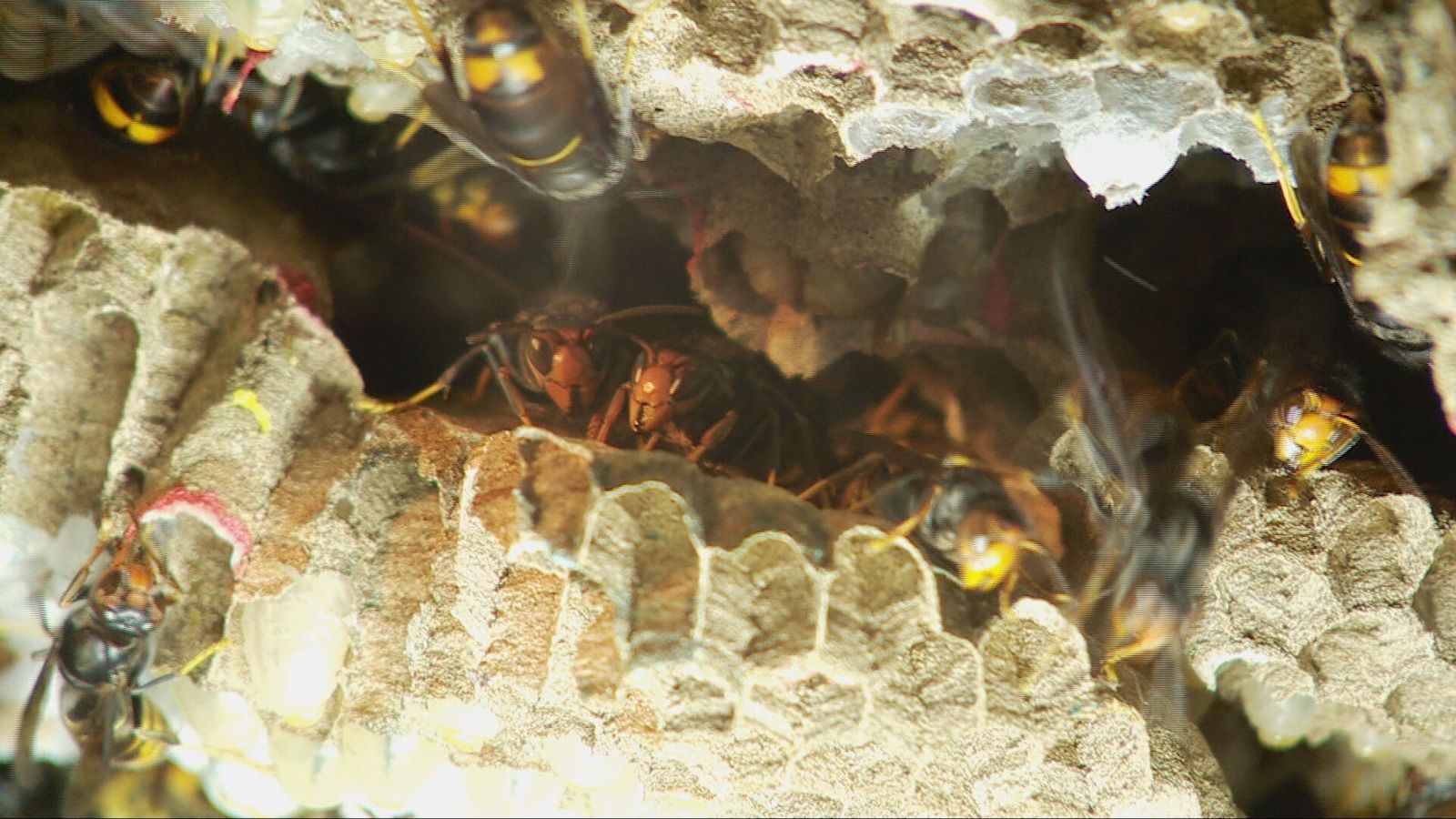
Nearly 3,000 Asian hornet queens have been captured in Jersey so far this year, with nearly 200 caught in Guernsey and Herm over the last 10 weeks alone.
Asian hornets are an invasive species which prey on other native insects, including honey bees and wasps, which can have a devastating effect on biodiversity.
People in both Bailiwicks are being encouraged to track rather than trap the hornets so local authorities can learn more about their behaviour and how to prevent them from building nests.
Now figures from the islands’ Asian Hornet organisations have revealed that they are already seeing hundreds of nests across the Channel Islands.
The Jersey Asian Hornet Group says this time last year (2025), they had 1,374 reported queens and 152 nests.
It means that reported queens are now at double last year’s rate.
Figures from the Jersey Asian Hornet Group for 2026 as of Friday 19 June:
2,996
Asian hornet queens reported
*Of these, 2,715 have been caught and killed.
253
Asian hornet nests reported
Figures from the Asian Hornet Team – Guernsey for the 10 weeks leading up to Monday 15 June:
197
Asian hornet queens captured
In 2025, 694 nests were discovered in Jersey, with 71 found in Guernsey.
In Guernsey, islanders are being asked to report the location of any hornets they see, the direction it is flying, and to take a photo if it is safe to do so.
Government advice in Jersey also suggests that anyone working outside should be wary of Asian hornet nests, which can start out being the size of a tennis ball but grow to be the size of a football by late July.
It is advised that islanders stay at least 10 metres away from any nests they find and should not touch, disturb or cause vibrations around nests.
Nests are usually found high in trees but may also be uncovered in brambles, hedges, garden sheds, roof spaces, cliffs and even in the ground.
Asian hornets can sometimes be mistaken for European hornets, which are native to the Channel Islands.
European hornets – which are native to the Channel Islands – are often confused with Asian hornets. Credit: ITV Channel
Anne Lotte, from the Guernsey Asian Hornet Team, says: “Asian hornets have a black body with a large orange stripe on the back and two smaller yellow bands.
“Their legs are half yellow and half black, and they have a very distinctive orange face.”
Anne says that Jersey usually sees more hornets each year because it’s closer to France, explaining: “We know the Asian hornet is very well established [in France], so there will be yearly occurrences of Asian hornets flying into Jersey.
“Another reason is that last year, Jersey had more nests, meaning they had more Asian hornets as well, and it is possible that they’ve missed more nests and that these queens hibernate in the island and then create new nests.
Anne says they are “very confident” that Guernsey is on top of dealing with the island’s invasive hornet population.
“We have a very good strategy, which has two distinct phases. One is the spring queening, where we trap all the queens, and this stops them from making their nests.
“Then, our second phase is to track down and trample, which is the phase we’re going into now. That’s where we actively try to find these Asian hornets and see where they’re flying to, find their direction, their flight lines and then locate their nests.
“Once we’ve found a nest, we do everything we can for a rapid removal of the nest.”
Jersey has gone to the polls, and ITV Channel has broken down the key election results. Listen to Jersey Votes wherever you get your podcasts or watch on ITVX and YouTube below: