
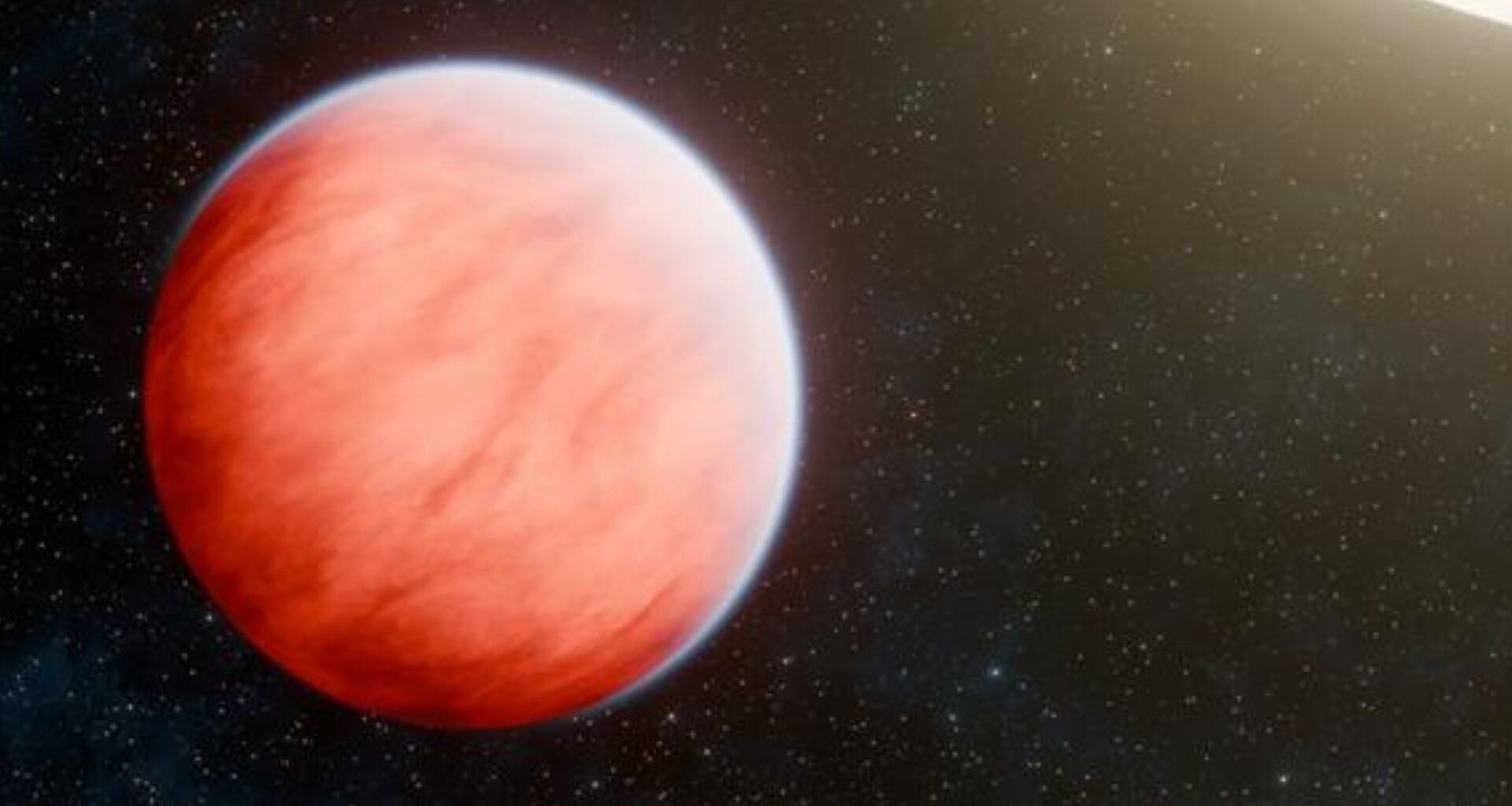
Astronomers have spent years studying giant planets known as hot Jupiters because they offer a rare chance to watch extreme worlds up close.
These massive gas giants orbit so close to their stars that a year can last only a few days.

Their scorching temperatures and rapid orbits make them some of the most unusual planets ever discovered.
How hot Jupiters behave
Most hot Jupiters seem to behave in a predictable way. One side constantly faces the star, creating a blazing dayside and a cooler nightside.
Strong winds move heat around the planet, creating a hot spot that is usually shifted slightly in the direction of the planet’s orbit.
But one world has been puzzling scientists for years because its hot spot appears in the wrong place.
New research has now identified the most likely explanation. The planet, called CoRoT-2 b, may not be tidally locked at all.
A strange world under scrutiny
The study was led by Aurora Kesseli in the NASA Exoplanet Science Institute at IPAC, a science and data center at Caltech.
Using new spectroscopic observations from the European Southern Observatory’s Very Large Telescope, Kesseli and her collaborators revisited a mystery that has challenged planetary scientists since 2018.
“I really like looking at the weird ones – finding planets that don’t fit the standard picture – and doing some mystery solving,” said Kesseli.
CoRoT-2 b stands out because its hottest region appears opposite the direction seen on other hot Jupiters.
Earlier research proposed three possible explanations. Clouds might be hiding part of the atmosphere. Magnetic fields might be affecting how heat moves around the planet.
Or, the planet might be rotating more slowly than expected. The new findings point strongly toward that third possibility.
Why tidal locking matters
Tidal locking happens when a planet’s rotation becomes synchronized with its orbit.
Earth’s Moon is a familiar example. We always see the same side because the Moon rotates once during each trip around Earth.
Scientists have long assumed hot Jupiters become tidally locked because they orbit so close to their stars.
Powerful gravitational forces should gradually slow their rotation until the same side always faces the star.
Planets that are potentially habitable
For gas giants, tidal locking creates a complicated weather system. Their thick atmospheres constantly move heat around the planet.
Even so, most hot Jupiters show a similar pattern, with their hottest region shifted slightly in the direction of motion.
“The conditions for tidal locking are important for astronomers to understand because the habitable zone for planets around M dwarfs is within the tidal locking zone, where we expect tidal locking to happen pretty quickly,” said Kesseli.
Low-mass M dwarf stars are the most common type of star in the universe.
Many of the potentially habitable planets discovered in the future may orbit these stars, making tidal locking an important factor in understanding alien climates.
“The way that a planet rotates greatly affects how the planet distributes its heat, and therefore affects its habitability, so for a planet that is tidally locked, the temperatures, winds, and climates are going to look completely different than those of a planet that is not tidally locked,” noted Kesseli.
A day longer than a year
To test the competing ideas, Kesseli measured the planet’s velocity and estimated its rotation rate.
The results were surprising. One day on CoRoT-2 b lasts about three Earth days, while its year lasts only 1.5 days.
In other words, the planet circles its star twice before completing one full spin.
“I was very pleasantly surprised when I tried a bunch of methods, and I was like, ‘Aha! This is actually like one of the three hypotheses!’ Seeing the data pretty clearly pointing towards one of them was just really exciting,” said Kesseli.
If confirmed, the finding would challenge a long-standing assumption that all hot Jupiters eventually become tidally locked. Instead, some may have more complex rotational histories than astronomers realized.
The future of hot Jupiter studies
Researchers still do not know why CoRoT-2 b rotates so slowly.
Interactions with its star, internal planetary processes, or other factors may be involved. More observations will be needed to uncover the cause.
The discovery highlights a broader lesson in exoplanet science. More than 5,000 planets have been confirmed beyond our solar system, and each new observation reveals just how diverse these worlds can be.
Patterns that seem universal often turn out to have exceptions.
“Now we can see that a one-size-fits-all model does not work, even for planets that we’ve been studying for a long time,” said Kesseli.
“Every time we look at another hot Jupiter, we learn something new to help refine our models, which are useful for understanding not only hot Jupiters, but for all types of exoplanets.”
The next generation of telescopes
Astronomers are optimistic that upcoming observatories will provide clearer answers.
Future instruments will be able to study exoplanet atmospheres in greater detail. They will measure winds and temperatures more precisely.
The instruments will also examine worlds that may be far more Earth-like than the giant gas planets currently dominating the field.
“Hot Jupiters are the first type of planet where we have been able to really explore and refine our models of their climates,” said Kesseli.
“With the next generation of telescopes like the Habitable Worlds Observatory and the Extremely Large Telescope, we’ll be able to do more in depth measurements across more planets, maybe even potentially habitable ones.”
The research was presented at the 248th meeting of the American Astronomical Society (AAS).
Image Credit: Keith Miller (Caltech/IPAC – SELab)
—–
Like what you read? Subscribe to our newsletter for engaging articles, exclusive content, and the latest updates.
Check us out on EarthSnap, a free app brought to you by Eric Ralls and Earth.com.
—–