
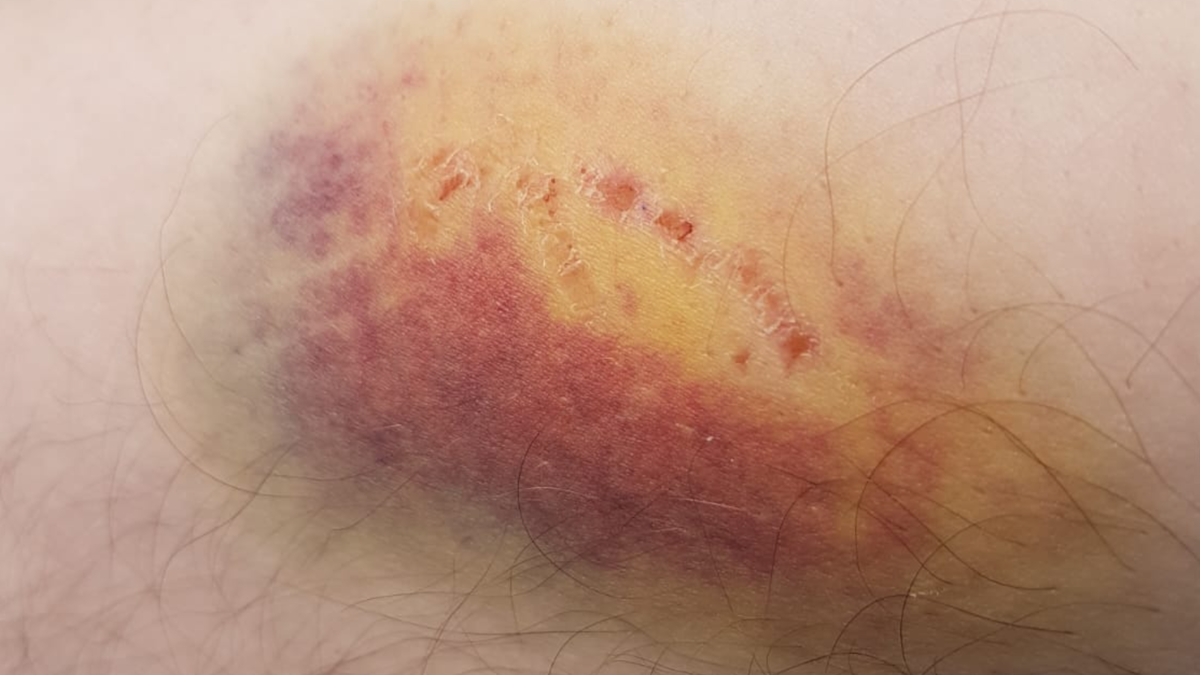
Exclusive: For three days after a violent assault at work, Sarah* urinated blood every time she went to the bathroom.
The ICU nurse, based in NSW, had turned for a brief moment to hang a life-saving drug infusion when the patient lashed out – driving a foot into her lower back with enough force to leave her bleeding internally.
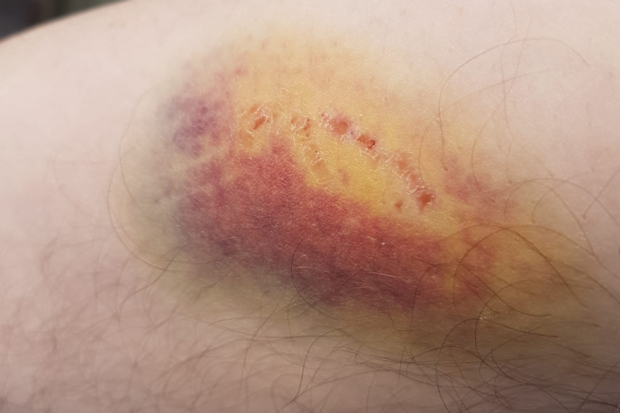
A bite mark left on an NSWNMA member after being injured by a patient during a shift. NSWNMA
“Obviously clocked me right on a kidney,” she told nine.com.au.
For Sarah, whose name has been changed to protect her privacy, her experience is far from an isolated incident.
Healthcare workers are among the most assaulted employees in Australia, according to Safe Work Australia data.
They’re 6.5 times more likely to experience a serious workers’ compensation claim related to assault compared to the national average.
Figures released by the NSW Nurses and Midwives’ Association (NSWNMA) also paint a grim picture of what it can be like on the job.
A survey of more than 1300 frontline workers found that 88 per cent had either experienced or witnessed workplace violence and aggression over a six-month period in 2025.
What stayed with the ICU nurse was not anger toward the patient, but the realisation that incidents like this had become almost routine.
After 21 years on the wards, she said many healthcare workers had become conditioned to accepting threats, abuse, and assaults as part of the job.
The spectrum of violence felt by staff nationwide ranges from verbal abuse and intimidation to severe physical attacks.
One emergency department nurse, who works in rural and remote hospitals, said she needed almost a year off work after an intoxicated patient pushed her to the ground.
Months later, scans revealed the muscles and tendons in her shoulder had almost snapped in half.
She underwent major surgery, and her recovery took 11 months, complicated by frozen shoulder and nerve problems.
“I suffered nightmares, especially during my recovery,” she said.
“I was very depressed due to not working.”
The psychological toll is driving staff out of the profession.
Deepak, a registered nurse formerly based in regional Queensland, left the hospital system and now owns a cosmetic clinic franchise in Brisbane.

Deepak has since left hospital nursing and now owns a cosmetic clinic franchise in Brisbane. Supplied
He said repeated patient aggression forced him to leave hospital nursing altogether.
During one shift in an acute medical ward, he said a patient experiencing withdrawals became agitated as he attempted to administer medication.
“The patient grabbed my arm and pushed me against the medication trolley.
“Security was required to attend … the incident left me feeling shaken and anxious.”
A senior Victorian nurse said repeatedly responding to “code greys” – emergency calls for violent or aggressive incidents – fundamentally changed the way she experienced her workplace.
“The heightened anxiety, the hypervigilance and the inability to do any other work became my norm,” she said.
On the other side of the country, a nurse based in Western Australia highlights the tactical and emotional tightrope frontline hospital staff must walk.
While emergency protocols like a “code black” exist for personal threats, she notes that a heavier security presence doesn’t always guarantee safety.
“Security presence does not always de-escalate the situation,” the nurse said.
“Sometimes it can make an already distressed or aggressive patient more heightened.
“So, you are constantly trying to balance patient safety, your own safety, and the safety of everyone else on the ward.”
This constant balancing act leads to exhaustion, forcing many to question the viability of their careers.
“There have definitely been times when I have thought, ‘Is this really worth it?’” the WA nurse said.
“I love being a nurse … but no one should have to come to work and be threatened, abused, or physically assaulted while trying to help someone.”
Despite the trauma, nurses interviewed for this story repeatedly stressed that compassion for patients remained central to their work.

In April, NSW nurses and midwives were granted a major pay rise – 16 per cent for registered nurses and 18 per cent for enrolled nurses over three years. LightRocket
Sarah, the ICU nurse, said many violent patients genuinely believed they were fighting for their lives.
“So these people don’t upset me, or make me want to leave nursing,” she said.
Yet, more and more believe that compassion is weaponised against them.
The regional WA nurse said that staff are often expected to be “endlessly understanding” simply because a patient is unwell.
“Being unwell does not make abuse or violence acceptable,” they said, adding that the psychological burden of pushing through a shift after an assault is unsustainable.
“We still have a duty of care, but employers also have a duty to provide a safe workplace.
“It should not just fall on individual nurses to tolerate repeated violence and then continue with the rest of the shift as if it is normal.”
Sarah explained that a more insidious boundary is crossed when the aggression comes from those who are cognisant.
She recalled an instance where an aggressive family visitor became so physically intimidating that she contemplated leaving the profession.
Even harder to process, she said, is the sexual harassment.
“The sexual harassment from the sane, or even visitors … that has made me want to leave,” she said, revealing the issue escalated to the point where she had to take legal action to bar an abusive individual from her unit.
Australian Institute of Health and Safety chief executive Julia Whitford said violence and aggression should never be accepted as routine parts of nursing.
“There has been a longstanding risk in healthcare that violence, abuse and aggression are seen as an unavoidable part of the job, rather than as workplace health and safety risks that can and must be managed,” she said, adding that employers must treat psychological harm with the same seriousness as physical injury.
NSWNMA general secretary Michael Whaites agreed that occupational violence is leaving a trail of trauma across the sector.
Worse still, the union’s report found that official statistics represent only a fraction of the true scale of the crisis.
Only one in four workers said they reported every violent incident, meaning a staggering 75 per cent of offences go unrecorded.
Nurses cited excessive workloads, convoluted reporting systems, and a lack of confidence that hospital management would act on the complaint.

The NSW Government will introduce a one-nurse-to-four-patients ratio on day shifts in public hospital wards. Getty
This sentiment is echoed by NSWNMA members, who have decided to remain anonymous.
One registered nurse with a decade of experience in a busy Sydney ED said clinicians often do not have time to document incidents.
In a statement to nine.com.au, NSW Health Minister Ryan Park said violence against frontline health workers is not on.
“I am pleased that we are already undertaking a number of initiatives which already go some way to the recommendations made in the report, including more staff, training, and more security staff.
“But I also recognise there is always more to do. I want us to be engaging closely and constructively with the NSW Nurses and Midwives’ Association on this matter.”
To address workload pressures and improve care safety, the NSW government has announced the next stage of its Safe Staffing Levels rollout.
This includes a minimum staffing level of one nurse per four patients during morning and afternoon shifts and one nurse per seven patients overnight across medical, surgical, and specialty wards in public hospitals.
The new ratios will initially apply to main hospital floors, including assessment units, general wards, and specialties such as cardiac, cancer and stroke care.
The union’s report found that staffing levels heavily influence frontline safety. It said chronic understaffing is placing health facilities under strain, limiting their ability to manage high-risk situations and prevent violent incidents.
Occupational safety experts also warn that depleted staffing rosters leave nurses vulnerable. With fewer workers on the floor, staff are often left working alone, without nearby colleagues to spot escalating behaviour or help defuse volatile situations.
While these specific ratio reforms are currently localised to NSW, frontline staff across state borders argue that the core issue remains the same.
For the senior Victorian nurse, better staffing, stronger leadership, and follow-through from management after violent incidents are universal requirements.
“We shouldn’t wait for injuries to happen before we do something about them,” she said.
Nurse & Midwife Support provides a free, national 24/7 telephone helpline for all Australian nurses, midwives, and students. Call 1800 667 877 or visit nmsupport.org.au
If you or someone you know needs support, contact Lifeline on 13 11 14 or Beyond Blue.