
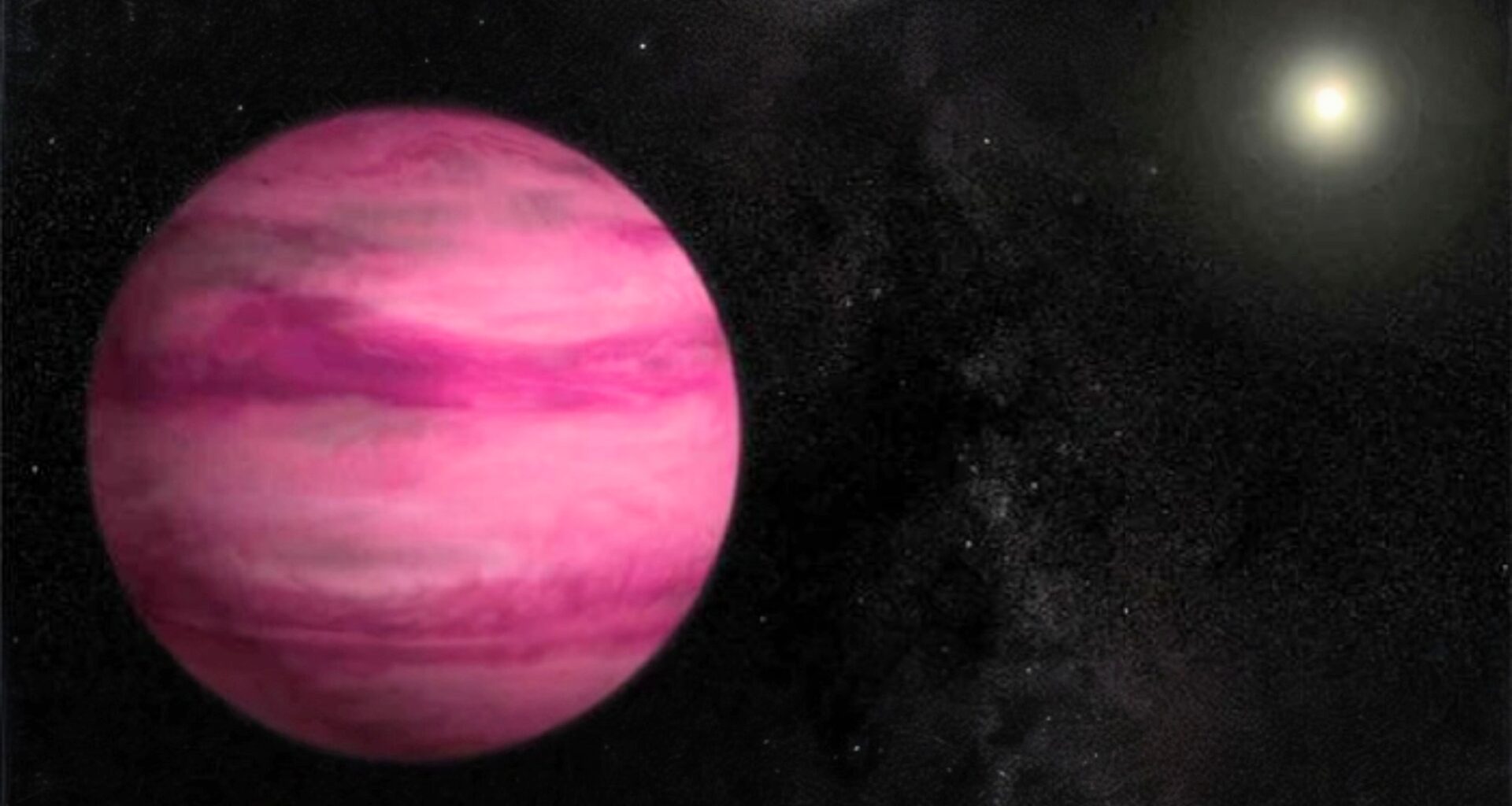
Some planets refuse to make life easy for astronomers. GJ504b is one of them.
The planet glows faintly beside a much brighter star, sits 57 light-years from Earth, and has kept scientists guessing since its discovery in 2013.

People call it the Pink Planet because early images showed a rosy haze. The nickname is only the beginning of the mystery.
This cold, dim object may not even be a true planet.
At about 25 times the mass of Jupiter, it sits near the blurry line between giant planets and brown dwarfs.
Old, cold, and hard to study
Most directly imaged exoplanets are hot, often around 1,000 to 2,000 degrees Fahrenheit.
GJ504b is much cooler, about 550 degrees Fahrenheit, roughly the heat of a bread-baking oven. That may sound hot, but for this kind of object, it is chilly.
“The Pink Planet is the coldest companion ever discovered using ground-based instruments,” said Northwestern University’s Aneesh Baburaj, who led the study.
“Many teams all around the world performed follow-up observations to study its light, but it was too faint for ground-based instruments. That made it a perfect target for JWST.”
“When we finally obtained its spectrum, it immediately looked interesting. But once we started digging deeper into the data, we realized it was not like anything we have analyzed before.”
Webb sees what Earth could not
For years, even some of the world’s largest telescopes could not pull out enough detail from GJ504b’s light. The object was simply too faint, and its host star was too bright.
“In the past, other astronomers observed the companion for an entire night with some of the biggest telescopes in the world to obtain a spectrum,” Baburaj said.
“And they could not see the object. With JWST, our entire observation took around two hours, and we were successful.”
The team captured the object’s spectrum, which breaks light into colors. Those colors carry chemical fingerprints.
In GJ504b’s atmosphere, the researchers found water vapor, methane, carbon dioxide, ammonia, and other molecules.
The clue was in the clouds
The first models did not make sense. The atmosphere looked as if it needed odd features that should not physically exist.
“We ran simulations with clouds, and the results aligned with what we know about cold planets,” Baburaj said.
“We tried three different types of clouds, and salt clouds fit best.”
“When we accounted for salt clouds, it subdued the signature of molecules hidden deeper in the companion’s atmosphere. Then, the results became physically possible.”
Scientists had predicted salt clouds in cold atmospheres more than 15 years ago. Webb has now provided some of the first direct evidence for them.
Looking beyond hot exoplanets
For years, astronomers have learned the most about large, hot exoplanets because they are easier to detect and study.
Cooler worlds present a much bigger challenge because they emit less light.
The James Webb Space Telescope is changing that. Its sensitivity allows researchers to examine objects that were once out of reach, opening a new window into the atmospheres of older and colder planetary bodies.
A strange object with a cloudy future
GJ504b is likely between 2.5 billion and 4 billion years old. Giant planets start hot and cool over time, which helps explain its low temperature.
Its spectrum also suggests that GJ504b is unusually rich in heavy elements, often called metals in astronomy.
Still, no one knows exactly how it formed. It may have formed like a planet – building up from material around a young star. Or, it may have formed more like a small star.
“This is the first time we’ve found that salt clouds are critical to explaining the spectrum of an object,” Baburaj said. “It’s a good reminder to account for clouds in our models.”
Cold, faint worlds are hard to study, but they may hold some of the most useful clues about how planets age, cool, and change over time.
The full study was published in the journal The Astronomical Journal.
Image Credit: NASA/ Goddard Space Flight Center
—–
Like what you read? Subscribe to our newsletter for engaging articles, exclusive content, and the latest updates.
Check us out on EarthSnap, a free app brought to you by Eric Ralls and Earth.com.
—–