

Listen to this article
Estimated 4 minutes
The audio version of this article is generated by AI-based technology. Mispronunciations can occur. We are working with our partners to continually review and improve the results.
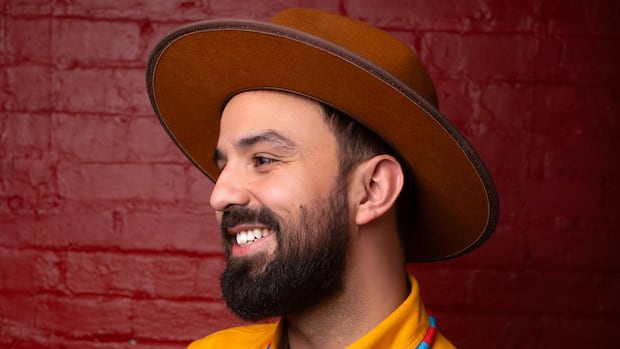
The 2024 Sobey Art Award winner Nico Williams’ art practice was inspired by his great-grandmother, a basket-maker from the Kettle and Stony Point First Nation located in Southwestern Ontario. Williams tried his own hand at traditional basket-weaving, “to really connect to that part of myself,” he says.
Williams, who is based in Montreal and a member of the Aamjiwnaang First Nation, says his great-grandmother would pull roots from the beach shoreline of Lake Huron, turning them into fibres for baskets. Unfortunately, roots from beachside plants were in short supply in Montreal. Another traditional basket material is birch bark — and while Williams did manage to find a birch tree in Montreal, it was not enough material to make baskets.. Instead, he turned to weaving geometric forms and beading them. “It was a happy accident that started this career,” he says.
That ‘accident’ became the foundation of a multidisciplinary arts practice. Williams’ first-ever basket-and-bead-work art piece was Indian’s Frozen Computer, inspired by his own experiences getting trapped in an online bid for a beaded bag when his computer froze. The piece currently sits in the Canadian Crown Collection; made up of around 4,000 artifacts, these pieces are placed in official residences’ households.
His geometric beadwork even drew the attention of the Geometric Beadwork Research Team at MIT, where he was invited to meet with one of their artists and researchers. “At first I thought it was the Met, but then it turned out that it was that school down in the U.S. that was doing all these things with mathematics,” Williams laughs.
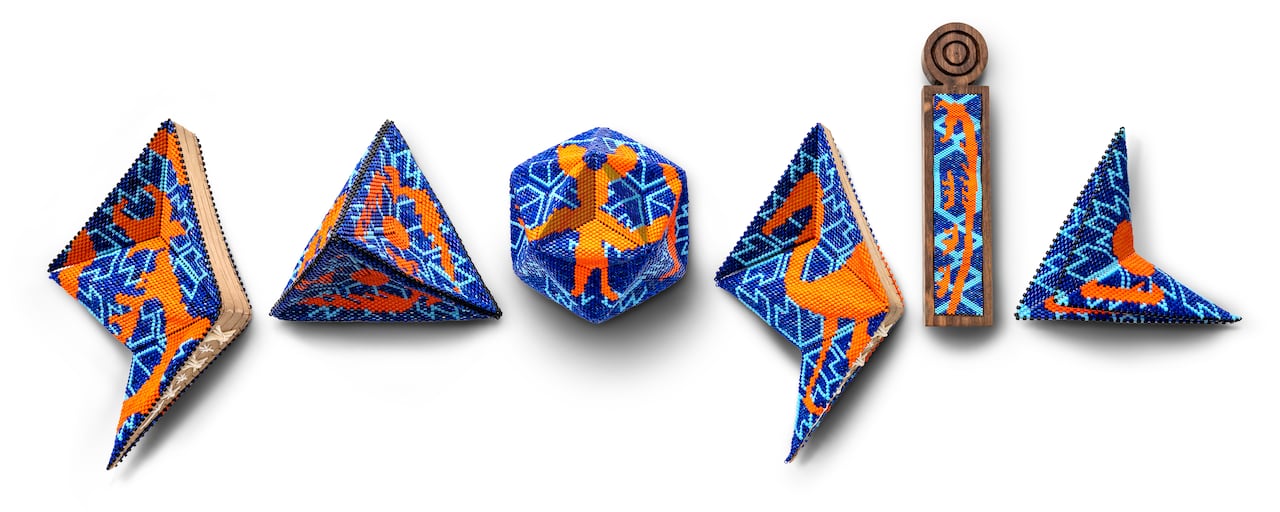 Nico Williams Google Doodle for National Indigenous People’s Day 2026. (Courtesy Google Canada)
Since then, Williams has beaded all kinds of everyday objects including grocery flyers, lottery tickets, camping chairs, caution tape and more. His works are on display at places like the Royal Bank of Canada Art Collection to The Montreal Museum of Fine Arts; he has also run workshops at the Museum of Modern Art in New York.
For this year’s National Indigenous People’s Day, which takes place on June 21, Google asked Williams to create their Google Doodle. When Google reached out to Williams, he was in disbelief. “It felt too good to be true,” he says — but with a tight turn-around of only three months in-studio before the public release, he dove right in.
For the design, Williams chose deep blues to evoke the bodies of fresh water found across Anishinaabe and other Indigenous territories, with a background pattern showing reindeer antlers. Within the word “Google”, the bright orange beads represent the Great Lakes cliffs, with different images depicted. For example, the first letter ‘G’ shows the mythological being Mishipizheu, a powerful water spirit, while one of the ‘O’s shows a crane, or Ajijiak — an important clan symbol representing leadership, according to Williams.
Typically when creating his artwork, Williams would pour all the beads onto a mat and begin threading them together. In this instance, working with around 28,000 Japanese glass cylinder beads, Williams had a team of five people in his studio, using the same geometric form-weaving techniques he’d first used 10 years ago. “People in the studio got to learn new weaving techniques as we’re all beading together,” he says.
Through his Google Doodle, Williams hopes to highlight the works of Indigenous peoples that have lasted for thousands of years. “I think the most important thing about this work is really telling stories that have been passed down, and appreciating the world around us,” he says.
Last year, Williams had his first-ever large-scale exhibition mounted at Montreal’s PHI gallery — a life-long dream, he says, and one that placed his works in a space that has shown internationally-renowned artists such as Yayoi Kusama. Starting this fall, Williams’ same exhibit, titled Bingo, will be travelling across Canada. “People [can] really share that love and joy with these wonderful creations that our studio has created,” Williams says.
His next dream is to host an exhibit in Venice, famous for its hand-crafted glass beads. “I hope that people just get into beadwork and get to geek out with me and get excited about it,” he says.