
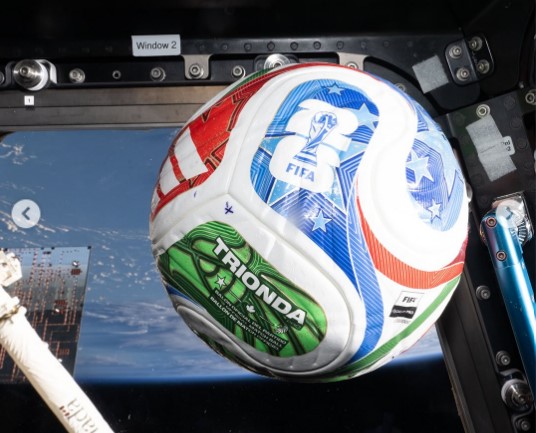
The official ball of the 2026 FIFA World Cup has completed an unusual warm‑up: a test session in microgravity aboard the International Space Station. NASA astronauts used Adidas’s Trionda match ball to study how footballs move and balance when there is no gravity to pull them down.
World Cup Tech In Zero-G
In videos shared on NASA’s social media, crew members float inside the ISS while passing and spinning the Trionda in weightlessness. The experiment revisits a study first run in 2019, this time using the new World Cup ball. The goal is to see how the ball’s centre of mass and internal balance affect its motion when it is not rolling or flying through the air in the usual way.
Engineers tune modern match balls very carefully so they behave consistently during games. On the station, astronauts can isolate that behaviour from friction and gravity. By watching how the ball tumbles, stabilises or wobbles in microgravity, researchers gain clues about how weight distribution and embedded electronics influence its flight back on Earth. NASA says the work could help scientists better understand how smart technologies inside footballs change their performance.
Trionda: Symbol Of Three Hosts
Trionda will be the official ball for the 2026 FIFA World Cup, jointly hosted by the United States, Canada and Mexico. Its name comes from a Spanish phrase meaning “three waves”, a nod to the first World Cup spread across three nations. The design uses red, green and blue panels, with details like a maple leaf for Canada, an eagle for Mexico and a star for the US.
The ball also carries a 500 Hz motion sensor that sends data to the Video Assistant Referee system in real time, helping officials with tight offside and goal decisions. Deep seams and a textured surface are meant to keep the ball stable in flight and easier to control in wet conditions.
For NASA, flying the Trionda is a way to connect orbital science with a global sport. As the agency notes, helping to improve “the beautiful game” is one more example of how experiments on the ISS can feed back into everyday life on Earth.