
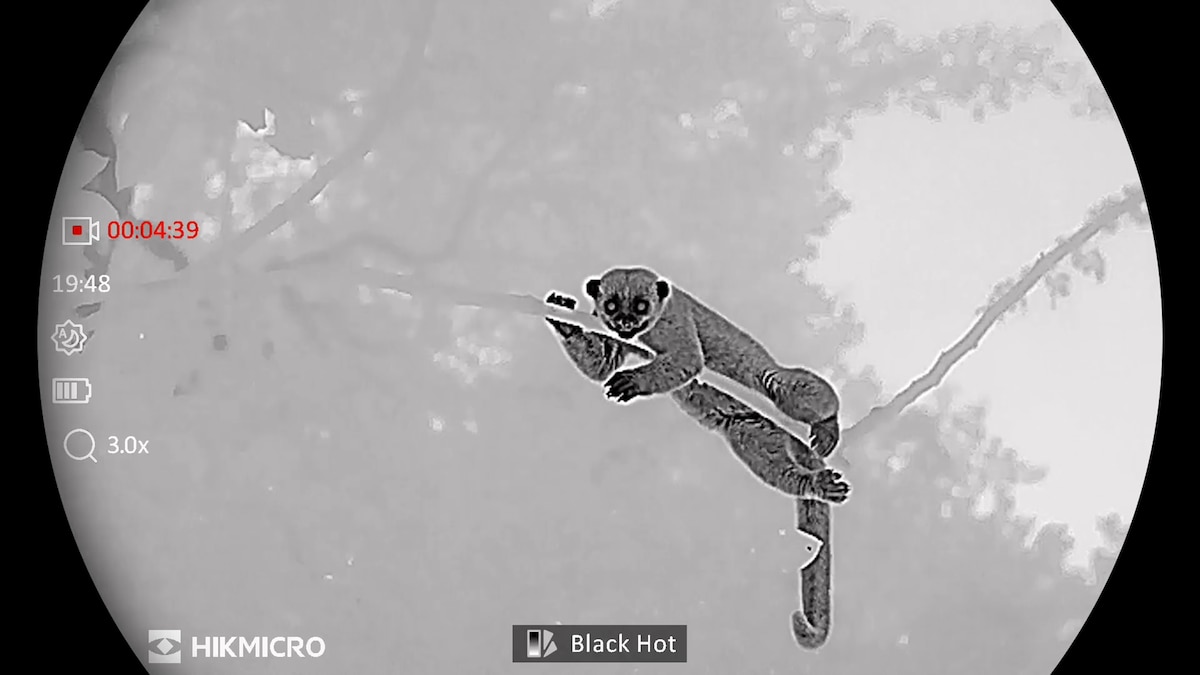
It’s a rare and surprising encounter. Andean porcupines, who weigh about 4 pounds and only move at night through rainforest canopies, are so rarely spotted that scientists haven’t been able to determine how endangered they are, and the International Union for Conservation of Nature lists the species as “data deficient.” Scientists previously thought these porcupines were largely solitary animals, but Hughes now concludes, “They’re more social than we knew.”
In fact, many nocturnal rainforest critters are data-deficient because it’s rare to observe them in the wild. But Hughes and other scientists hope to change that. By foisting themselves into the canopy at night to observe the animals at eye level through thermal binoculars, the team has recorded the first up-close, extended video of certain elusive small nocturnal rainforest animals moving in the wild. These include the Andean porcupine and the Panamanian night monkey (Aotus zonalis), a species that is near threatened with extinction. They also tracked kinkajou, margays, olingos, and other nocturnal critters. A study detailing their method, which they’ve tested in Panama and Peru, was published recently in the Journal of Tropical Ecology.
The footage raises the curtain on “a largely unseen world,” says Wilderson Medina, a Colombia-based researcher for the nonprofit Saving Nature, who was not involved in the work. “Because it’s very difficult to study, we don’t know much about life within the rainforest canopy; at night, it’s even more mysterious.”
And tracking data-deficient species is especially important, says Duke University ecologist Stuart Pimm, who was not involved in the research. “Scientists set conservation priorities based on how endangered species are,” he says. Without that information, many species get neglected. “Almost certainly, the fact that they’re data-deficient means they’re very rare and may be in deep trouble already.”
Peering into hidden worlds
After her three-hour observation shift ends, Hughes checks her climbing harness, then rappels down the tree in darkness, clutching a rope in her hands. All around her, insects are buzzing loudly, and the air smells sweetly of flowers that open overnight for nocturnal pollinators. As she goes to sleep in a hammock at base camp, her research partner and husband, ecologist Trevor Hughes, ascends the tree for his three-hour shift.