
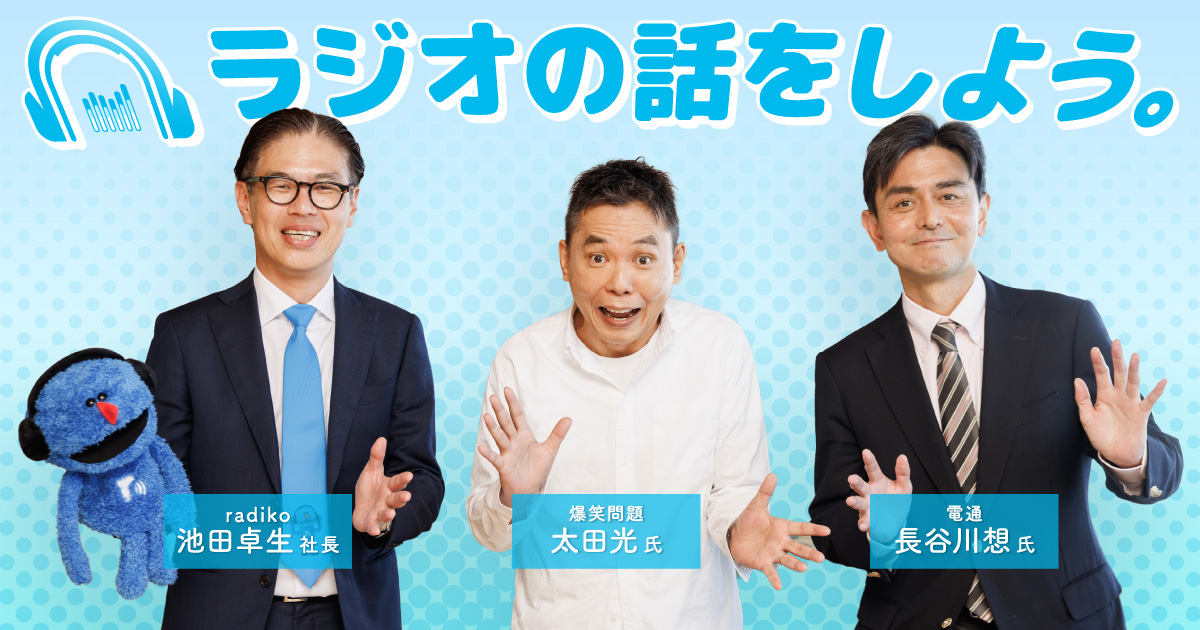
▼Howradiko and podcasts have changed the way radio programs “reach”listeners
▼We want to expand the “radio experience”—where audio sparks the imagination—through radiko
▼Radio fosters deep engagement between hosts and listeners!
▼Ensuring the public continues to recognize radio as a source of cutting-edge disaster information
How radiko and podcasts have changed the way radio programs reach listenersHikaru Ota
At the same time, I have mixed feelings—I’m glad to see that services like radiko (which, as a digital medium, is classified as internet advertising in Japan’s advertising expenditure categories) are gaining attention.
Being able to listen to regional station programs with crystal-clear sound thanks to “Area-Free” felt like a dream from back then had come true, so I listened to everything I could get my hands on. I was so happy and thought, “What a great era we’re living in.”
radiko 15th Anniversary Special Site
https://15th.radiko.jp/
I’m currently hosting a special interview series called “radiko 15th Anniversary Podcast: Hikaru Ota and 15 Radio Hosts,” where I talk all about radio with 15 popular personalities, and I’m really enjoying this project too. It was the first time I’d ever had such a long, one-on-one conversation with Takashi Okamura of Nainai (Ninety-Nine), someone I don’t usually get to talk to much.
After that, we moved to radiko, which allowed for area-free listening. That’s how the reach of radio programs has expanded in various ways. As audio media has grown, even though what we’re doing hasn’t changed, I really feel that the way our shows reach the world has changed.
Back then, the radio and TV industries were terrified of new media like social media and YouTube, but I feel like radio was the first to realize that we could coexist with them—even before television did.
Later, social media emerged, and at first, there were people in the industry who opposed its use. These days, everyone reads comments from X aloud, but I think radio has adapted to all these shifts in society.
And then, when it comes to features like radiko’s “Time Free,” from a broadcaster’s perspective, there’s definitely some resistance—or rather, there are definitely times when you think, “Please don’t leave that comment up.”
We want to expand the “radio experience”—where listeners let their imaginations run wild through audio—via radikoTakuo Ikeda, President of radiko
But I could also understand TaiTan’s point. He explained that, in order to grab people’s attention, there’s been an “entertainment inflation” across all forms of content, and conversely, the value of more laid-back, relaxed content is rising. He believes radio is the medium best suited to handle that.
Radio features deep engagement between hosts and listeners!So Hasegawa, Dentsu Inc.
I think there are many young people who find solace in radio because they learn that even if they make all kinds of mistakes, they can turn them into funny stories, so I’m happy that young people struggling with anxiety are tuning in.
Furthermore, one of radio’s inherent characteristics is the deep engagement between hosts and listeners. As a result, the environment where hosts can introduce products and drive sales remains strong. As proof of this deep engagement, when radio programs host events, they attract large crowds of listeners.When I talk to people at local stations, I often hear them say, “Even when we held paid events, a huge number of people showed up.” I feel this is precisely because the hosts are effectively conveying their messages to the local community. It really drives home the point that these traditional values of radio are still very much alive today.
Related Article:
“How to Create a Podcast”: An Interview with the Producer of “OVER THE SUN”
TV is often called “old media” these days, but it’s unique to TV that it can connect live feeds from network stations across the country—something individual YouTubers can’t do—and go live immediately when something happens.
We need to ensure advertisers don’t come to believe that advertising on TV today is ineffective, and I believe we should preserve the benefits of free TV made possible by sponsors. While Netflix certainly has the production budget and is creating amazing content, I do hope that TV will be reevaluated a bit more.
To ensure that the general public continues to recognize that radio provides the most up-to-date disaster information
Since I know the staff members’ names and the pen names of regular listeners, I find myself wondering, “I hope everyone’s okay.” It’s not just something happening somewhere else—listeners take it personally. It’s precisely because of that value that when I hear local stations are struggling right now, I truly hope people will support them from the bottom of my heart.
After the Interview (Hasegawa)
This interview really conveyed the long-standing relationship between Mr. Ikeda, who has been on the front lines adapting to changes in the media landscape, and Mr. Ota, who has been delivering the values he hopes will never change—a relationship built on overcoming both the good and the bad together over many years. While radio and radiko aren’t enjoyed by as many people as television, I strongly felt that I hope they continue to be a presence with a passionate community that welcomes newcomers without turning them away.
Was this article helpful?
 19Author
Born in Saitama Prefecture in 1965. Formed the comedy duo Bakushō Mondai in 1988 with his college classmate Yuji Tanaka. Their manzai comedy, which takes a sharp look at various social phenomena ranging from politics to the entertainment industry, is popular not only among young people but also across a wide range of age groups.Currently, in addition to appearing on regular TV and radio programs, he is also active as an author, with many of his publications becoming bestsellers. In particular, *Bakusho Mondai’s Theory of Japan* (Takarajimasha), published in January 1997, became a bestseller with over 500,000 copies sold. He also appears at every “Titan Live” event, which has been held every two months since 1996.
 Takao Ikeda
radiko, Inc.
President and CEO
Born in 1969 in Osaka Prefecture. After graduating from Meiji University’s School of Political Science and Economics, he worked at a radio program production company before joining TBS Radio & Communications in 2001. He worked on late-night programs such as “JUNK.” He has served as an Executive Officer at TBS Radio since 2022. On June 19, 2025, he assumed the position of President and CEO of radiko, Inc.
 Hasegawa So
Dentsu Inc.
Dentsu Inc. Media Innovation Lab
Director of Media Innovation Research
After working in the development and operation of information media services at a domestic telecommunications carrier, he joined Dentsu Inc. Following roles primarily in media planning and digital marketing, he assumed his current position. His interests include information behavior, media business, advertising medium development, and local media. He holds a Master’s degree in Interdisciplinary Information Studies and is a Marketing Meister certified by the Japan Marketing Association.