
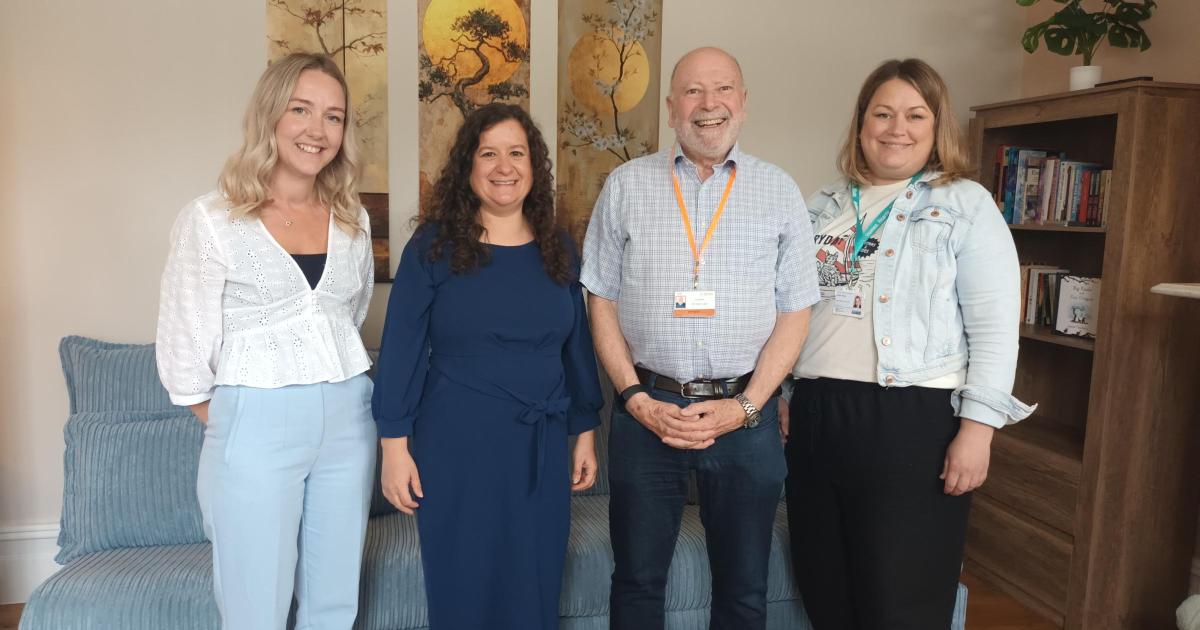
Oriana House is owned by AWP, with day-to-day services operated by Missing Link and ALABARÉ, as part of the BaNES, Swindon and Wiltshire Mental Health and Wellbeing Partnership.
It currently has four bedspaces for women to stay for up to 10 days, offering a safe space for person-centred and trauma-informed support within the community.
The non-clinical, residential support is an alternative to a hospital admission which aims to give women more choice and autonomy over the support they need.
Sarah O’Leary, the chief Executive of Missing Link, who specialise in providing support for women who are struggling with their mental health, said: “We know that mental health is not always, but often, intertwined with experiences of trauma.
“Male violence and domestic abuse can be an example, and for many women, it’s just not an appropriate environment to go into a mixed gender setting, because of their experiences.
“There are a lot of women that we work with where hormone-related issues like the menopause or gynaecological concerns are coupled with their mental health, so they might not feel comfortable talking about their experiences with men.
“It’s also critical because women may have religious or cultural reasons that prevent them from going into that environment, so opening Oriana House gives women that choice to go into the right places for them to help with their recovery.”
Each bedroom within the house has been individually decorated, with guests able to personalise them with items from home during their stay.
The property also includes a communal lounge and kitchen, sensory room, large garden and an outbuilding for craft activities, one-to-one support meetings and office space.
ALABARÉ, Missing Link and AWP have been co-producing with former clients who have lived experience of mental health services on every aspect of the creation of Oriana House.
They also chose the name, Oriana, which is rooted in the Latin word for ‘sunrise’ or ‘new dawn’.
Samantha Hanks has spent time in a crisis house during her own recovery from mental health issues and has been part of the design process.
She said: “It’s so important that people who have used the services have a say in how they’re shaped for the future.
“I jumped at the chance to be involved. There are small details that someone who might not have spent time in a crisis house might miss.
“For me, coming out of hospital, it was great to walk into a room that felt like a bedroom, because it had a duvet, a pillow, a chair in the corner, a lamp.
“It felt so different to a hospital environment that you immediately let a bit of your guard down and have that breathing space.
“It’s vital that when you walk through that door, you’re entering a supportive, safe, comfortable and welcoming space that’s giving you the room to be who you need to be in that moment.”
Helen Brian, Head of Mental Health Services at ALABARÉ, said: “This house will belong to every woman who walks through the door, and when designing the property, we very much took the experience of women who’ve used ALABARÉ’s other mixed crisis homes, Hope and Elm Houses, and Missing Link’s women’s crisis house based in Bristol, and their thoughts on what would work here.
“The best people to hear from when creating a space like this are the people who will use and have used these services.
“This is the first women-only crisis house for Wiltshire and the BSW region. We’re setting the standard for these kinds of services, and we’re really excited to start welcoming guests.”
The crisis houses are one part of the overall support offering from the BSW Mental Health Partnership, which also includes the charities Second Step and Nilaari.
The collaboration, which has been in place since April 2025, has been working closely with AWP throughout to ensure all aspects of mental health care are more joined-up for the benefit of patients and clients.
Mathew Page, Deputy Chief Executive of AWP, said: “Most of the best things in life are born through collaboration and cooperation.
“Great orchestras and symphonies are beautiful because everyone’s working together, and I think mental health care should be exactly like that. “What we’re demonstrating here is that it’s much better when we collaborate, as each partner provides a different range of services.
“At AWP, we’re really mindful of the impact on women in particular coming into hospital, but having a women-only environment like this really enables them to feel safer and have their needs met in a way that mixed-sex environments just aren’t able to do.”
Referrals to Oriana House will come from across the BSW region via the NHS, in collaboration with the partner charities of the Mental Health and Wellbeing Partnership and AWP.