INTRODUCTION
Initially dismissed as a cosmetic concern, a young woman’s hyperpigmentation was eventually identified as the first sign of Addison’s disease, which can be fatal if undiagnosed as it may progress to life-threatening adrenal crisis.
CASE REPORT
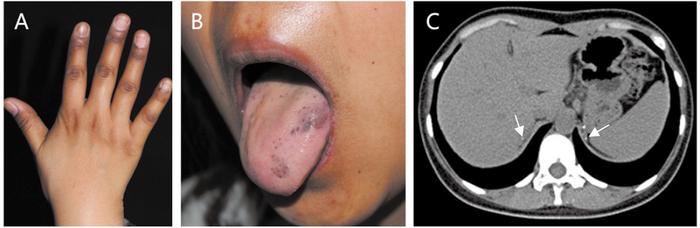
A 24-year-old woman presented with two years of unexplained darkening of her hands, feet, gums, and tongue. The patient also reported fatigue, irritability, poor appetite, and 2.5 kg of weight loss over six months. Laboratory tests revealed abnormally low cortisol levels and drastically elevated adrenocorticotropic hormone (ACTH). A positive tuberculosis test and adrenal calcification on CT scan confirmed the diagnosis of Addison’s disease caused by adrenal tuberculosis.
TREATMENT AND OUTCOME
After treatment with prednisone and anti-tuberculosis medications, the patient’s symptoms resolved completely, and her skin pigmentation faded significantly within six months.
DISCUSSION
This case underscores the vital role of dermatologists in recognizing systemic diseases through their skin manifestations. Addison’s disease can be fatal if undiagnosed, as it may progress to life-threatening adrenal crisis.
The case report appears on Skin.
PHOTO CAPTION: Addison’s disease.(A) Hyperpigmentation on overpressured areas of the hands. (B) Hyperpigmentation on the tongue. (C) Abdominal computed tomography (CT) showing adrenal calcification.
PHOTO CREDIT: HIGHER EDUCATION PRESS