
CLIMATE INDICATOR:
Leading and coincident indicators rose last month, signaling that economic momentum had remained broad despite pockets of moderation
By Crystal Hsu
/ Staff reporter
Taiwan’s economy remained firmly in expansion mode last month, with broad-based strength in investment, exports and domestic demand keeping the government’s business climate indicator at its highest “red” signal, the National Development Council (NDC) said yesterday.
The NDC’s composite monitoring indicator edged down to 39 from a revised 40 in April, but it flashed “red” for the sixth consecutive month.
The council uses a five-color system to track the economy. Red (38-45) signals overheating; yellow-red (32-37) indicates a warming economy; green (23-31) suggests stable growth; yellow-blue (17-22) reflects sluggishness; and blue (9-16) points to contraction.
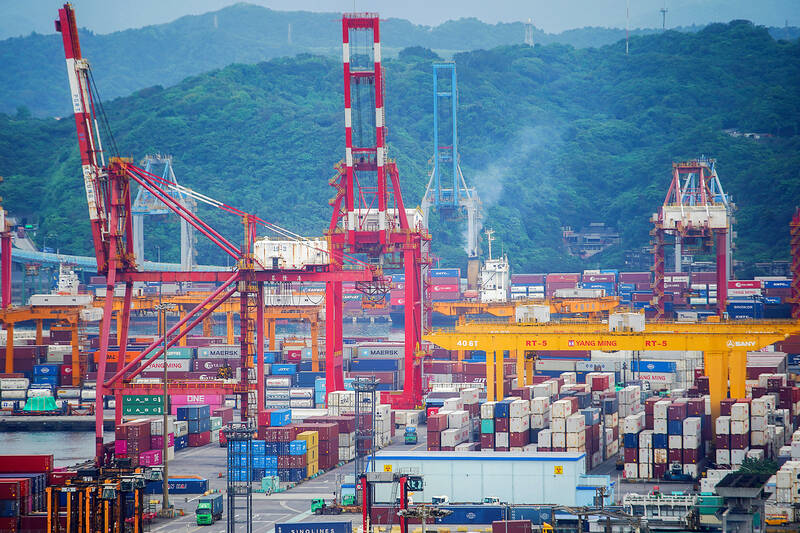
Photo: CNA
The fall in last month’s score came after the subindex for overtime working hours in the industrial and service sectors and manufacturing-sector revenue fell 1 point each, while the money supply subindex rose by 1 point.
The subindices for six other factors — stock prices, industrial production, merchandise exports, imports of machinery and electrical equipment, sales posted by the retail, wholesale and food-and-beverage sector and business sentiment among manufacturers — stayed unchanged last month, the council’s data showed.
“Taiwan continues to benefit from strong investment and export demand, though growth momentum is expected to moderate in the second half compared with the first, partly due to a high base in the first six months,” NDC Department of Economic Development Director Chen Mei-chu (陳美菊) said at a news conference in Taipei.
The Directorate-General of Budget, Accounting and Statistics last month that forecast GDP would grow 6.9 percent in the second half of the year, slowing from double-digit expansion in the first half, Chen said.
The NDC expects the monitoring indicator to ease toward “yellow-red,” but the economy remains robust, she said.
The council also said the index of leading indicators, which seeks to forecast economic scenes in the next six months, rose 0.55 percent to 103.81 last month, driven by gains in stock prices, semiconductor equipment imports, manufacturing sentiment and export orders, despite declines in construction starts and employment measures.
The index of coincident indicators, which tracks current economic conditions, climbed 1 percent to 108.11, supported by stronger retail, wholesale and food-and-beverage sales, higher industrial production, increased electricity consumption and rising capital goods imports, even as export values and overtime hours showed some slowdown, it said.
The council said stronger corporate earnings among listed companies are supporting wage growth and dividend payouts, helping sustain consumption momentum and boost domestic demand.
Wealth effects from record-high equity markets, alongside major entertainment and sporting events and government domestic travel subsidy programs, are also boosting private consumption, it said.
Investment momentum is expected to remain solid as semiconductor and AI supply-chain firms continue to expand capital spending, while multinational companies increase investment activity in Taiwan, which is favorable for private-sector growth, Chen said.
The council said Taiwan’s outlook remains anchored in AI-driven demand, including higher capital expenditures by major US cloud service providers, ongoing upgrades in AI server specifications, and continued expansion across semiconductor and AI-related supply chains.
However, the council cautioned that developments in Iran-US negotiations, global inflation and monetary policy paths in major economies, as well as the trajectory of US tariff policy, still warrant close monitoring.
Additional reporting by CNA