
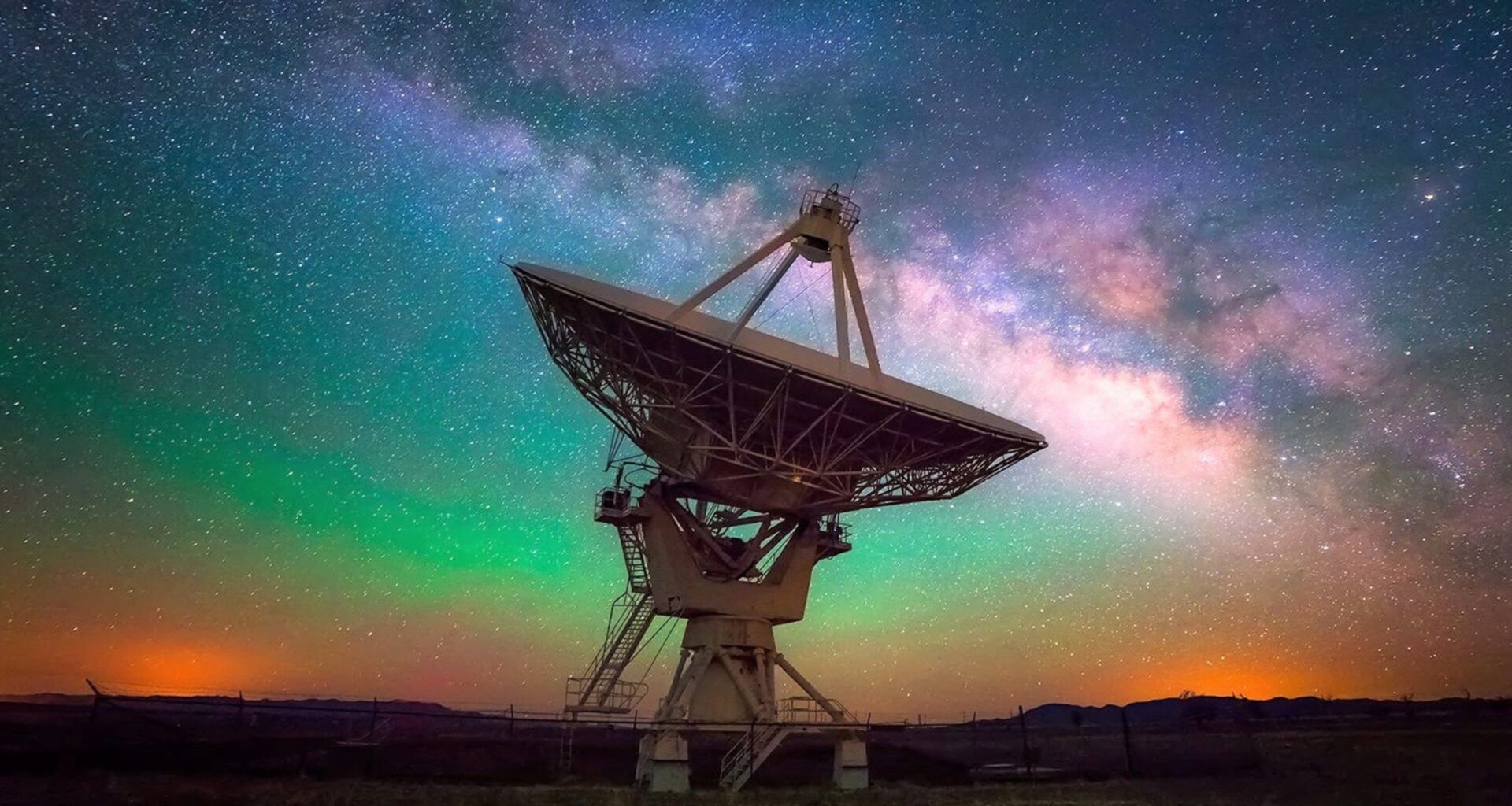
Radio telescopes catch plenty of repeating signals from deep space, and astronomers can usually say what produces them.
A fast-spinning, collapsed star – the dense leftover of a dead sun – drives most of the steady, clocklike pulses they record.

Some signals refuse to fit. They repeat far too slowly, with minutes or even whole hours between beats, and for years nobody could agree on what produced them. Now one has finally been traced to its source.
Signals that refused to make sense
These oddballs are called long-period radio transients, and only about a dozen are known. Each sends out bursts of radio waves that repeat on a schedule, from a few minutes to more than an hour apart.
That slow timing creates a challenge. Most radio sources flash for seconds or less, so a beat measured in minutes leaves astronomers searching for something unusual.
Two suspects dominated the argument. One is a magnetar – a city-sized, fiercely magnetic neutron star turning unusually slowly.
The other is a white dwarf locked in a tight orbit with a second star, the two whirling around fast enough to set the rhythm.
Following the signal to its source
The break came from a sky survey on CSIRO’s ASKAP radio telescope in Western Australia, built to flag sources that look out of place. One blip in the data matched nothing on record.
Kovi Rose, a PhD researcher at the University of Sydney and CSIRO, had been combing the survey for a twisted, magnetic kind of radio light when this one stood out.
Follow-up observations with several telescopes turned a single dot into two stars.
Splitting the system’s light into its colors revealed sharp bands of hydrogen and helium. Those signatures point to a cataclysmic variable – a white dwarf actively pulling gas off a partner star.
The ultraviolet and X-ray data told the same story.
White dwarf in a tight embrace
The dense star at the center is a white dwarf, about the size of Earth but nearly the mass of the Sun. Its partner is a red dwarf – a small, cool star with roughly a tenth of the Sun’s mass.
They sit so close that a single loop around each other takes only about 1.3 hours. Earlier white-dwarf examples of these transients circled every 2 to 4 hours.
This one runs under 90 minutes – close to the limit where two such stars can still orbit.
Gravity from the white dwarf drags gas off the red dwarf. The stripped material spirals inward, crowds together, and heats to hundreds of thousands of degrees Fahrenheit.
Other accreting white dwarfs behave the same way in an earlier study, though rarely in a pair wound this tight.
X-rays reveal the feeding white dwarf
On their own, the radio pulses only hinted at the answer. The X-rays made it hard to argue with, because gas heated to those temperatures glows in X-ray light as it crashes down onto the white dwarf.
Those X-rays brighten and fade on the same 1.3-hour cycle as the radio bursts, and their strength rises and falls more than tenfold.
That jumpiness likely comes from gas landing on the star in uneven spurts, not a steady stream.
Until this system, no slow radio transient had been tied so cleanly to feeding of this kind. It is only the third ever caught giving off X-rays, a detection managed just twice before, noted in an earlier paper.
The radio and X-ray bursts never peak together. This is a clue that the two kinds of light come from separate corners of the system.
Echoes of Jupiter
The signal hides a stranger detail still. Watch the radio bursts closely and their brightness breaks into fine, evenly spaced stripes running through the radio waves – a pattern seen in just one other place, the planet Jupiter and its moon Io.
Nobody had spotted those stripes beyond Jupiter until now. Their presence here suggests clouds of charged gas sitting between us and the source, scattering the radio light on its way out.
The bursts also slide up and down in frequency and switch off for hours at a stretch. And the whole system glows brighter in radio than about 99 percent of known radio stars – far too bright for the small companion to produce alone.
Finally decoding a cosmic mystery
A guessing game now has one firm answer. For the first time, astronomers have traced one of these repeating signals to a white dwarf feeding on a small companion star in a 1.3-hour orbit.
The evidence was confirmed across radio, X-ray, and optical observations.
With one system fully mapped, researchers can compare other long-period radio transients against it and sort out which are white-dwarf pairs and which are spinning neutron stars.
“This system gives us a way to decode these signals,” said Rose.
She called the system a stellar Rosetta stone that could help decode the rest of the class.
Systems like this also serve as natural laboratories for extreme magnetic fields and superheated gas that no experiment on Earth can reproduce.
The study is published in the journal Nature Astronomy.
—–
Like what you read? Subscribe to our newsletter for engaging articles, exclusive content, and the latest updates.
Check us out on EarthSnap, a free app brought to you by Eric Ralls and Earth.com.
—–