
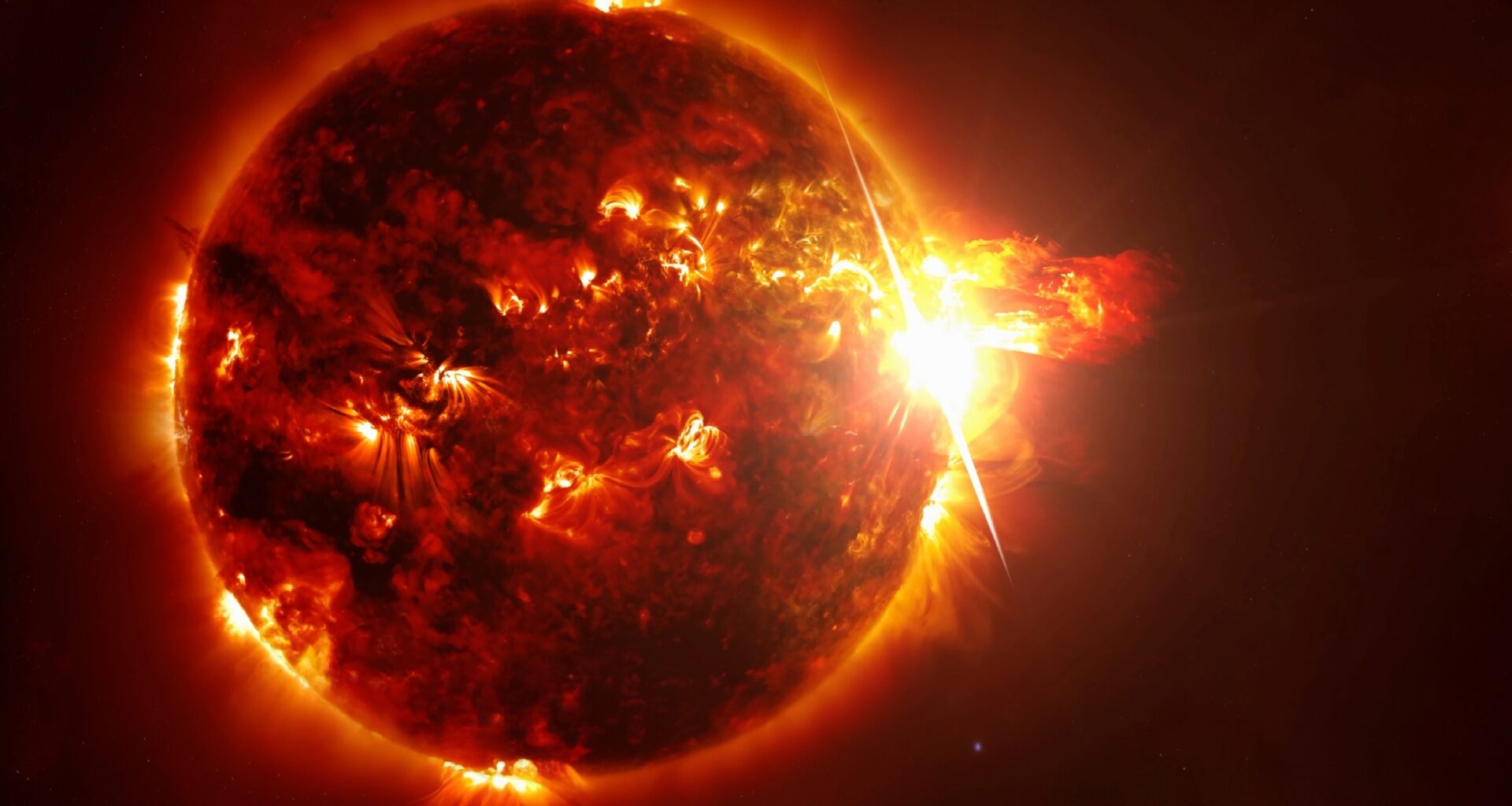
The sun throws clouds of hot, magnetized gas into space on a regular basis. For years, scientists figured these clouds swell in a steady, predictable way as they drift outward toward Earth.
One cloud refused to behave. As it swept past two spacecraft on its way here, it ballooned far more than anyone expected across a short stretch that should have barely touched it.
A lucky alignment

The story starts with a coronal mass ejection, a giant eruption that hurls magnetized plasma off the sun’s surface.
In November 2021, one of these blasts sent a magnetic cloud toward Earth, slipping past two probes lined up almost perfectly along the sun-Earth path.
Catching the same cloud with two craft on one line is extraordinary. One probe, the spacecraft Solar Orbiter, sat about 78 million miles from the sun. NASA’s Wind drifted farther out, near Earth.
Shirsh Lata Soni, a postdoctoral research fellow in the Department of Physics and Astronomy at the University of Iowa, led the team that pieced the event together. Soni studies solar outbursts and saw the lineup as a rare gift.
Two spacecraft almost never align on the sun-Earth line during a passing solar storm, and no one had tracked a single cloud this closely before.
This one had already triggered a powerful magnetic storm of the kind a study ranks among the strongest these eruptions cause.
What the spacecraft saw
Between the two probes lay roughly 13 million miles, a hair’s breadth by the standards of space.
A cloud crossing that gap should look nearly identical at both ends, but it did not.
By the time the cloud reached the second spacecraft, its width had grown by about a fifth, swelling roughly 21 percent over a distance that usually leaves these clouds looking much the same.
Growth like that over so little ground caught the team off guard.
The researchers named the behavior “super expansion,” a tag for a cloud that balloons far faster than the standard version.
A cloud heats up
The size was only half the surprise. As the cloud expanded, the gas inside grew about three times hotter, the reverse of what physics predicts for something spreading into the cold of space.
Gas that spreads out is supposed to cool as it thins. This cloud did the opposite. Hotter, not colder, even while it grew.
What pumped in that heat is still an open question. The researchers suspect the cloud drew energy from inside itself, or from its run-in with the gusty solar wind off the sun, but the true source stays unsettled.
The heat showed up in the readings as a sharp climb in pressure inside the cloud.
Standard models expect that pressure to fade as a cloud ages, not rise, and that mismatch is much of what made the event stand out.
A solar storm that expanded
Speed told the same story. The cloud’s edges pushed outward at roughly 119 miles per second, while a typical cloud expands closer to 30 to 60 miles per second.
The expansion was not picking up pace, though. Between the two probes it slowed a little, dragged down by the slower gas already filling the space around it, the kind of drag a paper on cloud motion describes.
That combination is the odd part, since the growth rate eased off while the cloud kept getting bigger.
Solar storms usually speed up or slow down when they hit the surrounding gas – but this time, it expanded.
Where models fall short
As the cloud spread, its magnetic field weakened, which lines up with what the math predicts.
By the time it reached the outer probe, that field had dropped by more than 40 percent. No surprise there.
The pressure inside told a murkier story. The usual models say it should ease off steadily as the cloud expands, but here it behaved in ways they did not see coming, pushed around by the heating and squeezing within.
Earlier studies leaned heavily on computer simulations to describe how these clouds change.
Tracked by two real probes instead of one, this event exposed cracks in that picture and gave researchers hard numbers to test their assumptions against.
Implications for space weather
Knowing how a cloud changes on its way to Earth feeds straight into space weather forecasting. The sharper that warning, the more lead time power companies and satellite operators get.
A strong storm can scramble GPS signals and knock satellites offline. At its worst, it can damage the transformers that keep electricity flowing, a danger one report spells out across several historical cases.
What this event makes plain is that not every solar cloud follows the same script. Some swell and heat far faster than the models assumed, and this one hands researchers a concrete case to rebuild their predictions around.
“In this study, we show the magnetic cloud can expand dramatically in a short period of time and space, which could have impacts to Earth that we wouldn’t have known about,” said Soni.
The team sees a wider lesson about surprises tucked inside familiar events.
The study is published in Monthly Notices of the Royal Astronomical Society.
—–
Like what you read? Subscribe to our newsletter for engaging articles, exclusive content, and the latest updates.
Check us out on EarthSnap, a free app brought to you by Eric Ralls and Earth.com.
—–