
This is a guest post by Darren Davis. It originally appeared on his excellent blog, Adventures in Transitland, which we encourage you to check out. It is shared by kind permission.
It’s been 25 years since the Bay of Plenty has had a regular passenger service in the form of the Kaimai Express. And May 2026’s Glenbrook Vintage Railway excursion train was apparently the first passenger train to enter the Bay of Plenty in over a decade. And it sold out in record time – less than two days – with minimal publicity. Which kinda shows some sort of latent demand for interregional passenger rail in Aotearoa.
What shouldn’t be a once in a decade plus shot – a passenger train boarding actual passengers at the east facing platform at Hamilton Frankton Station. Photo credit: Darren Davis
This absence of regular passenger rail service is in spite of the fact that the Bay of Plenty forms one leg of the Upper North Island’s Golden Triangle, home to 40 per cent of Aotearoa’s population, whose rail network carries 30 per cent of Aotearoa’s rail freight.
And as a reminder that such a thing actually existed back in the day, below is the timetable of the dear departed Kaimai Express, which ran until 2001.
Kaimai Express timetable up to its enforced demise in 2001
I have previously written about the case for restoring passenger rail to Toi Moana/ Bay of Plenty here. So worth having a read of this for my views on the case for rail to the Bay of Plenty and a possible Te Huia based option.
So what would it take to get passenger rail back to the Bay of Plenty? Quite a lot in fact. The elephant in the room is the constraint presented by the Kaimai Tunnel as well as the cost of addressing decades of underinvestment in passenger rail in Aotearoa.
But that doesn’t mean that it’s impossible, just difficult and likely expensive. As I see it, there are two basic options:
Extending the current Auckland to Hamilton Te Huia service to TaurangaNew battery electric multiple unit service
Both options would require work on the Kaimai Tunnel to make it safer for train passengers and rail crew. So let’s dive into the options.
I have covered this in my earlier piece so in case this content looks familiar, it is as it paraphrased from my previous blog post on the subject.
Extending Te Huia to Tauranga is the (multi) million dollar question, and we shouldn’t kid ourselves that this will come cheap. The five-year trial of Te Huia between Hamilton and Auckland – now extended for a sixth year – ended up costing $98 million. But it also set a solid basis for building on this investment and extending its benefits to Tauranga and the Bay of Plenty, assuming of course that the service becomes permanent in 2027.
So the logical way to go is to build on what we’ve got and take it further – to Tauranga. And this means an extension of Te Huia to the Bay of Plenty.
Let’s assume for the sake of argument that the current 9:30am Te Huia departure on Thursdays and Fridays become Monday to Friday services (i.e. adding in Monday to Wednesday trips), then an extended service could start in Tauranga at 8:00am and get to Auckland Strand at 11:54am. The return trip could be an extension of the current weekday 5:45pm departure from Auckland Strand would arrive in Tauranga around 9:50pm.
My hypothetical Te Huia to Tauranga timetable
At weekends, based on extending current services in the Te Huia timetable, this could be a 7:30am departure from Tauranga on Saturdays and a 1:15pm departure on Sundays and public holidays. Return trips would leave Auckland at 5:30pm on Saturday and 6:15pm on Sundays and public holidays with late evening arrivals into Tauranga.
These are not absolutely ideal times, especially the late arrivals into Tauranga, but we need to be careful not to make perfect the enemy of good. But to make this work, we would need to address the 8.879 kilometre long elephant in the room – the Kaimai Tunnel. At the moment, a combination of a large number of daily trains from the Port of Tauranga to Metroport in Southdown in Auckland and the time required to clear the tunnel of diesel exhaust emissions severely constrains the potential slots available to operate passenger trains through the tunnel. More on this later.
The simple logic of this option is that Aotearoa is investing $900 million in battery electric trains to run improved, and hopefully faster, services on the Wairarapa and Manawatū lines in the Lower North Island. There is a narrow window of opportunity for the Upper North Island to add its requirements to this order, to achieve some economies of scale in terms of the size of the train order.
Render of interior of Tūhono Lower North Island battery electric trains. Image source: Horizons Regional Council
There are some technical differences to address, such as differences in platform heights between stations in the lower and upper North Island (why a country as small as Aotearoa can’t standardise platform heights is quite beyond me), but I have been advised by people with rail technical know-how that this is far from an unresolvable issues.
But the biggest technical difficulty is that the current battery range of around 80 kilometres would require the approximately 76 kilometre gap in North Island Main Trunk electrification between Pukekohe and Hamilton to be closed first, and probably extended as far as Morrinsville on the East Coast Main Trunk from Hamilton along with the ability to fully charge up the train battery overnight in Tauranga.
KiwiRail has done a lot of work on the electrification of the Golden Triangle rail network in the Upper North Island which I have previously covered in this blog post which I recommend reading.
In a presentation to the Waikato Regional Transport Committee on 9th March 2026, KiwiRail outlined the following updates to this work.
Currently completing the Detailed Business Case to identify the best and preferred electric solution plus the staged delivery pathway.After this it is expected that further work on the funding options will be discussed with key stakeholders. This will include exploring funding options for the delivery stages from within KiwiRail and potential Government budget bids.It is also likely that further technical work will be recommended on the preferred option to further increase confidence in the programme estimates and help narrow the risk contingency range.
It’s clear from this that Golden Triangle electrification does not seem to be anyone’s fast track. And as this electrification is a precursor to a battery electric train option to Tauranga (which notably is a viable option for replacing Te Huia between Auckland and Hamilton as the electrification gap is around 76 kilometres, within battery range), extending the current Te Huia diesel train service to Tauranga seems to be the only viable shorter term option.
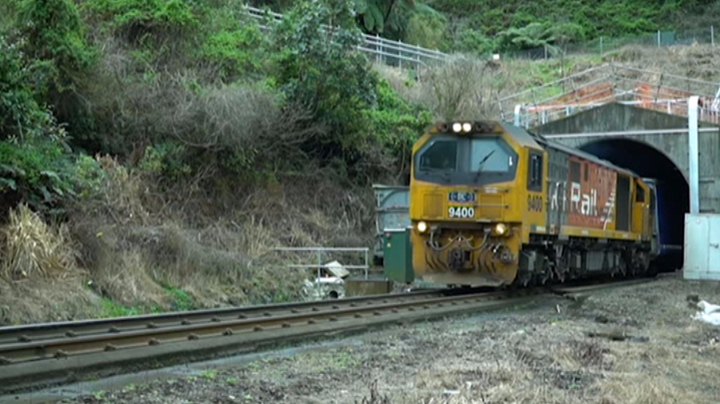
The elephant in the room is the Kaimai Tunnel. While passenger trains do run through similar length tunnels around 9 kilometres long (Remutaka Tunnel for the Wairarapa Line and the Otira Tunnel for the Tranz Alpine train) with a range of precautionary safety measures in place, the issues with ventilating the Kaimai Tunnel requires lengthy gaps between trains to clear out the exhaust emissions in the tunnel. These lengthy gaps were in play for the recent Glenbrook Vintage Railway excursion, requiring a late departure from Tauranga to fit in with an available tunnel slot.
Freight train emerging from the Kaimai Tunnel.
Given that the ventilation issues in the Kaimai Tunnel are a clear and present health and safety risk for the KiwiRail locomotive engineers and maintenance staff whose work involves the tunnel, it would seem that addressing those issues would deliver a win-win for both KiwiRail’s freight operation, which would have more slots available and equally a win for slots for passenger rail, not contingent on waiting for an available gap around a busy schedule of freight trains.
While advocacy groups such as Future is Rail and Tauranga Connect have been energetic in their advocacy for passenger rail in the Bay of Plenty, elected members at all tiers of government have been rather less energetic in their advocacy. Without this political drive and momentum, noting a forthcoming national election in early November 2026, it is hard to see much action forthcoming unless it becomes an election issue.
It took the Waikato a decade of solid and highly energetic political advocacy to get Te Huia off the ground between Hamilton and Auckland. And it’s going to take solid and highly energetic political advocacy in the Bay of Plenty to get passenger rail restored east of the Kaimai Ranges in the Bay of Plenty.
Greater Auckland’s work is made possible by generous donations from our readers and fans. We’re now a registered charity, so your donations are tax-deductible. If you’d like to support our work you can join our circle of supporters here.
Make sure to check out Darren’s blog here.
Share this