
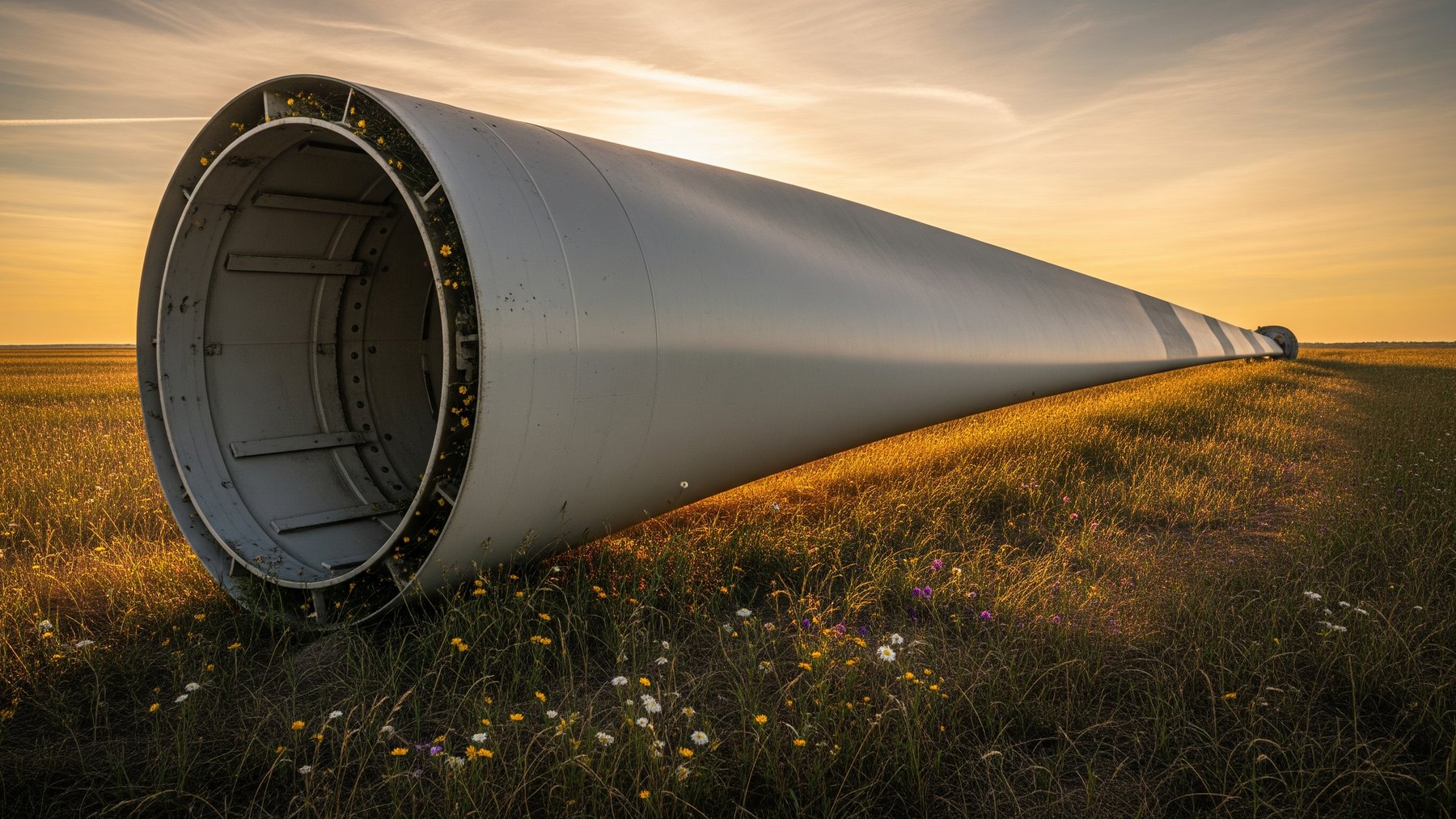
Drive past a wind farm on an open stretch of American highway and the turbines look like the cleanest thing in the world.
Each blade cuts through the air, making power for thousands of homes without burning a drop of fuel.
But inside that long white arm turning overhead, there is a material puzzle the industry has been putting off for decades.
The clock has now run out, and the first big wave of retired blades is already here.
The blades are bigger than almost anything you have ever seen
Blades on modern utility scale turbines usually measure around 200 feet long, and the largest offshore blades stretch to 351 feet.
The GE Haliade-X has a rotor 220 meters across, with blades running about 107 meters each.
That is just over the length of a football field, and for the biggest models, roughly one and a half times a Boeing 747.
Longer blades sweep more sky, catch more wind, and push the cost of each unit of electricity down.
Moving a single blade along a public road takes a convoy of special vehicles, closed intersections, and sometimes the removal of road signs.
That same size is exactly what makes the end of a blade’s life so hard to solve.
What a wind turbine blade is actually made of
Steel, copper and electronics make up most of a turbine, and about 85 percent of those materials can already be recycled or reused.
The blades are the exception.
They are built from fiberglass, a composite made light but tough enough to survive decades of storms.
Inside sit layers of balsa wood, foam and adhesives, all cured together until everything fuses into one piece.
Think of it as a layered loaf baked in a kiln.
That fusion is what gives the blade its strength, and it is also what makes pulling it apart so brutally hard.
A growing mountain with nowhere easy to go
For years, most retired blades ended up in one place, the ground.
Crews cut them into sections short enough to haul, then buried the pieces in lined pits at licensed landfills.
By 2050, the United States is expected to face about 2.2 million tons of blade waste, according to the National Renewable Energy Laboratory.
Picture rows of 200 foot white arms stacked in fields across the country, each one built to outlast the turbine it powered.
The reckoning is arriving fast, because the United States now has more than 70,000 land based turbines, and thousands of them have already passed 20 years of service.
A wave of repowering, swapping old machines for bigger ones, is bringing those first blades down right now.
The hidden material inside a blade that scientists are unlocking
Here is the wonder hiding inside the problem.
Glass fibers make up roughly half of a blade’s weight, and that fiberglass is not trash.
A company called Carbon Rivers heats old blades without oxygen to break down the resin and free the glass fiber beneath, recovering fiber it says is up to 99.9 percent pure and scaling toward 50,000 tons a year.
Even bigger news came in 2026, when the Danish maker Vestas and the recycler Stena moved a new chemical process out of the lab and into an industrial test bed in Halmstad, Sweden.
It dissolves the epoxy that glues a blade together and pulls back the building blocks, so that blades sitting in landfills today could become raw material for new ones.
Others turn blade scraps into pellets for construction, playground gear and bike shelters, the same inventive spirit you can see at the wind farm in Patagonia that drew wild animals because engineers kept finding new ways to share the land.
Why the next few years decide how clean wind power really is
The turbines going up today are the largest ever built, and the ones raised in the early 2000s are retiring all at once.
The gap between waste arriving and recycling being ready is closing fast.
On January 1, 2026, the European wind industry’s own landfill ban on retired blades took effect, and several US states already restrict dumping old wind parts.
Vestas has set a goal of zero waste turbines by 2040, and the pressure of millions of incoming tons is exactly the kind of forcing function that tends to produce real breakthroughs.
The chemistry is proven, the policy has arrived, and the industry is finally being pushed toward the solutions researchers spent years building.
The same ambition that made a single blade longer than a jumbo jet is now turning to the question of what to do when it comes down.
Clean energy built the blade.
The next act is learning how to unmake it just as cleverly.