
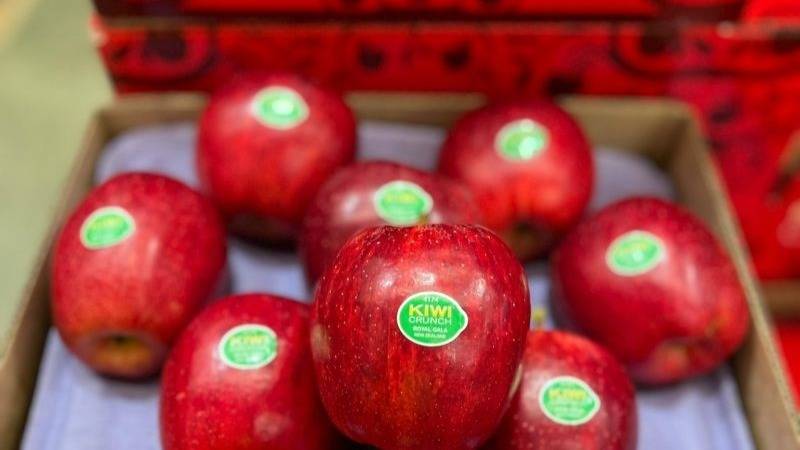
Hawke’s Bay businesses are bracing themselves for the fallout from what could be one of New Zealand’s biggest company collapses in recent years.
Hawke’s Bay apple grower Kiwi Crunch has lost its battle to stay afloat, after the IRD succeeded in placing one of its subsidiaries, Crasborn Fresh Harvest, into liquidation today.
And on Friday afternoon, ASB moved to appoint Daniel Stoneman and Neale Jackson of Calibre Partners as receivers, under the provisions of a general security deed dated March 1, 2024.
The move effectively means the receivers will be in control of any assets, with unsecured creditors having to wait until the receivership concludes.
ASB has been approached for comment.
The application to liquidate the company, owned by former Auckland accountant Wade Glass, was heard before Associate Judge Helen Wild in the High Court at Auckland today.
Cloete van der Merwe, representing the IRD, told the court the company owed $19 million.
But Isabella Hawkins, representing Crasborn, sought a four-week adjournment to the application, saying a fresh payment plan had been presented to IRD yesterday. The delay would allow IRD time to consider the plan, which included an upfront payment and weekly installments.
The proposal would see an upfront payment of $3m followed by weekly payments of $250,000.
“There is no prejudice to IRD with an adjournment,” she said. “But there is significant prejudice to Crasborn, its hundreds of employees, and the wider Hawke’s Bay community if it is not.”
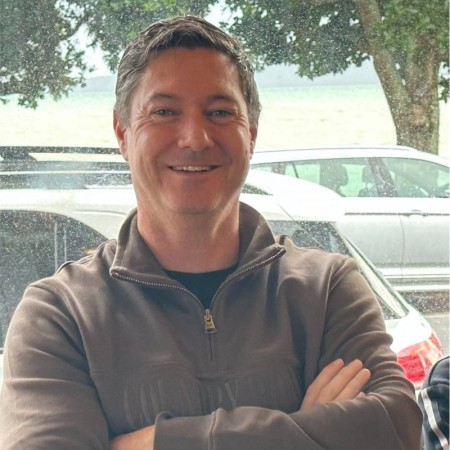
Wade Glass.
However, van der Merwe said the IRD first served a statutory demand for $6m last October. The debt had since swollen to $19m, increasing at a rate of nearly $1.5m a month.
He said promises had been made since the start of January but only $184,000 was paid in March.
“It is against the integrity of the tax system not to liquidate this company.”
The associate judge queried whether the proposal was being given serious consideration by IRD, before noting that, at a hearing last week, Associate Judge Grant Brittain had ruled any further adjournment to the matter would only be granted with consent of the plaintiff.
“That leaves me with no option but to liquidate the company today,” Wild said.
Leon Bowker and Kristal Pihama of KPMG were appointed liquidators.
Industry figures believe the wider group may owe much more than the IRD debt.
“There is a massive line of creditors burnt in Hawke’s Bay – the IRD is only one. He is hurting good people,” one told NBR this week.
Bigger ambitions than his bank account
New Zealand’s biggest company collapse last year was Auckland property developer Hobson Green Group. It was placed in liquidation in October, owing more than $31m. The collapse of cherry grower Cherri Global was initially thought to be bigger, at $42m, but it was later established that many of its debts were related-party loans.
Cherri Global was also based in Hawke’s Bay and was backed by the same private lender that also backed Kiwi Crunch, Merricks Capital. Merricks, which is owned by ASX-listed private lender Regal Partners, has had its own problems over the past year. Last year, its flagship fund, which invested in Kiwi Crunch, suspended redemptions due to a lack of “unallocated cash”.
Several creditors have questioned how Kiwi Crunch has been able to keep operating for so long, given its obvious problems. And some were flabbergasted that Glass was still attempting to buy a new business as recently as last week.
The day after his lawyer appeared in the Auckland High Court last week in an attempt to stave off the liquidation, Glass set up a new company to buy South Australia’s second-largest apple business from ASX-listed Duxton Farms.
“He appears to have bigger ambitions than his bank account,” one creditor told NBR.
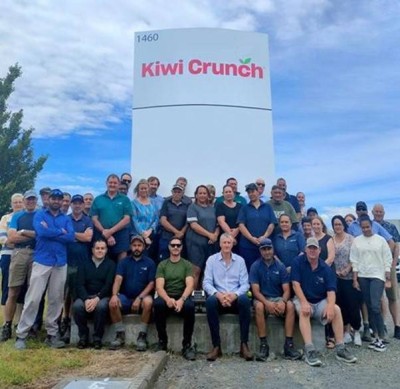
Wade Glass is in green in the front row, in this 2022 staff photo.
Speculation rife
As NBR has previously reported, the company was unable to pay staff over the Christmas period, and struggled to pay other creditors.
Earlier this year, it lost several key staff, including its chief financial officer and its head of marketing. The industry rallied to support the company in the hope it would recover, but its deal to buy Central Otago apple grower CAJ Apples finally fell over, after the settlement deadline was extended several times.
Last month, NZX-listed farmland investor NZ Rural Land Co also confirmed a related company had yet to settle on its purchase of another Otago orchard, despite announcing the deal as unconditional almost two years ago.
The collapse is yet another blow for Hawke’s Bay, which in recent years has had to deal with Cyclone Gabrielle, an oversupply of grapes, and consolidation by major local food producers such as Wattie’s and McCain’s.
However, the New Zealand horticulture industry has been keen to stress it does not believe the industry is suffering from any generic problems. It has instead pointed to what it believes were isolated financing issues at Kiwi Crunch.
While Glass’s supporters say he had good intentions, others said the writing had been on the wall for some time. “He simply couldn’t generate enough cashflow to pay the huge interest on his loans and to invest in the business,” one insider told NBR.
When Glass and his business partner Paul Southam acquired the company in 2022 from private equity firm Maui Capital, it was known as Freshmax. They rebranded it as Kiwi Crunch.
In late 2024, the pair added cherry exporter Cherri Global to their portfolio after it went bust. However, Southam later separated himself from the business, and Glass restructured the group under the name Consolidated Fruits.
Before the sale of CAJ Apples fell over, the group claimed to manage about 880 hectares of apples, pears, and cherries in Hawke’s Bay and Central Otago.
At the height of the season, it employed hundreds of staff, including seasonal workers, and exported about 1.2 million cartons of apples and pears each year to more than 30 countries.
It is believed to have few assets left, as Glass largely funded the purchase of the business through the sale and leaseback of its land.
Karyn Scherer and Hamish McNicol
Fri, 03 Jul 2026