
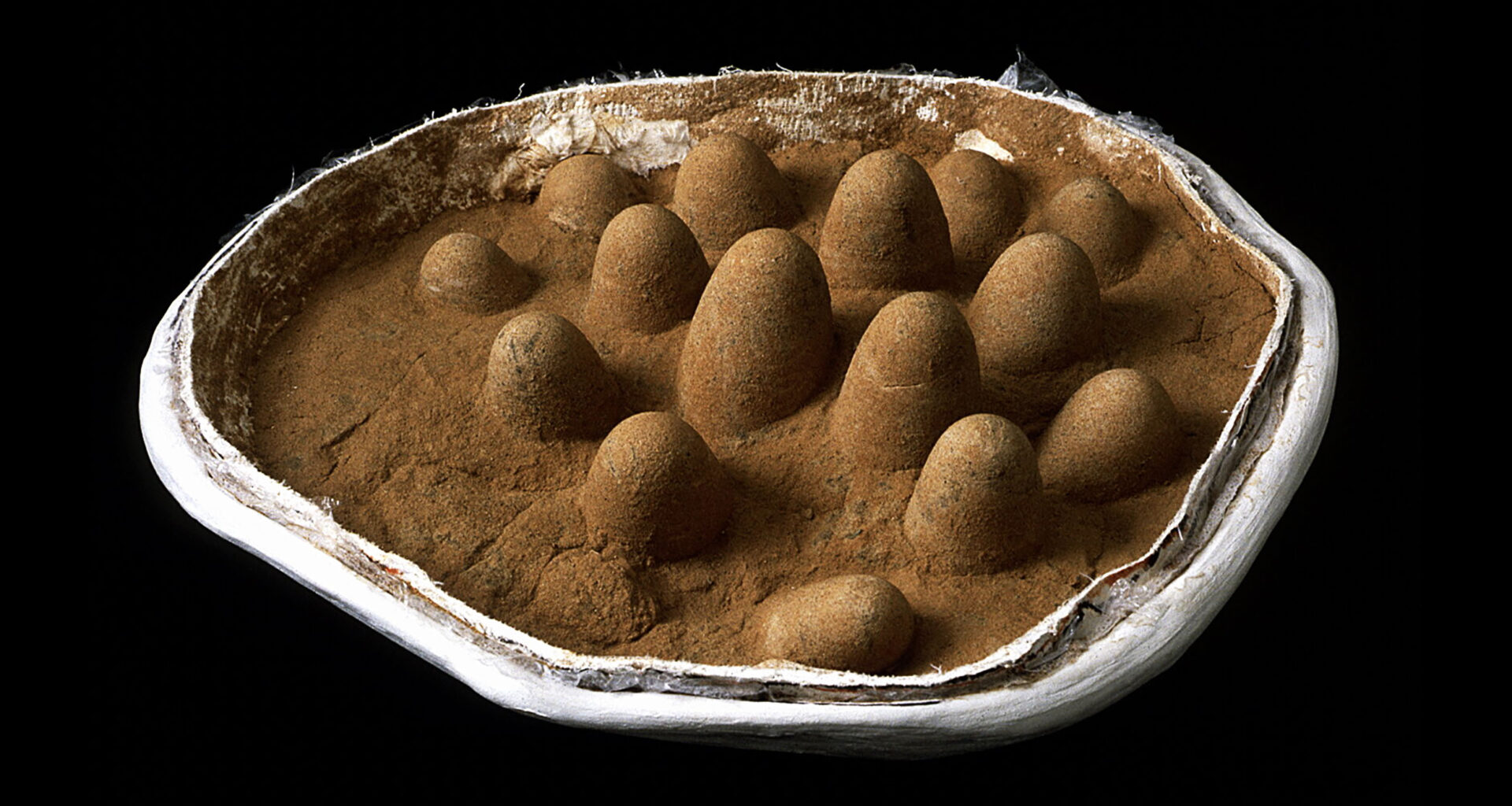
The largest egg ever laid did not belong to a dinosaur. It belonged to a bird.
Some dinosaurs ranked among the heaviest animals ever to walk the planet, yet their eggs stayed surprisingly modest in size.

A fresh explanation now connects this oddity to something unexpected. The answer appears to sit inside the skull.
Big dinosaurs, surprisingly small eggs
An ostrich egg is larger than any egg known from a non-avian dinosaur. That gap feels almost backward at first.
Plenty of dinosaurs towered over any bird alive today. Their eggs, though, never reached the scale of the biggest bird eggs.
A single sauropod could outweigh a whole herd of elephants. Even so, its eggs would fit comfortably in two hands.
Why offspring size varies
Animals follow very different reproductive playbooks. Some spread their bets across many tiny young, while others pour everything into a precious few.
A blue whale gives birth to a single calf every two to three years. That newborn can weigh around 2,500 kilograms (2.76 short tons). A hawksbill sea turtle takes the opposite route. It can lay roughly 158 small eggs in a single clutch.
Both approaches succeed in their own way. They simply sit at opposite ends of one long spectrum.
Most reptiles lean toward the many-and-small end. Birds and mammals usually drift the other way, toward few and large.
Counting clutches across species
Earlier work tended to study mammals and birds on their own. That made it hard to see what really shapes these patterns across the whole family tree.
Stephanie Lechki of Princeton University and Roger Benson of the American Museum of Natural History (AMNH) widened the lens.
Their team gathered reproductive and anatomical data from 2,857 living species, then added 35 fossil dinosaurs.
The living sample leaned on more than 500 bird species, over 800 mammals, and more than a thousand reptiles. Together, these groups span more than 300 million years of evolution.
They used a method that accounts for shared ancestry between species. That step keeps closely related animals from skewing the picture.
The brain demands more
One pattern showed up again and again. Animals with relatively larger brains tended to have fewer young, larger young, or both. A big brain is costly to build and to run.
Growing such a brain seems to demand a heavier investment in each individual offspring. Across birds and mammals alike, bigger relative brain size lined up with bigger eggs and bigger newborns.
“At first glance, this seems counterintuitive,” said Lechki, the lead author of the work. “Many non-avian dinosaurs were enormous, yet even the biggest dinosaur eggs were smaller than the largest bird eggs.”
“Our results suggest that the answer lies in brain evolution. As birds evolved larger brains, they also evolved larger offspring, which required larger eggs.”
Brain size was not the only suspect. Some had argued that metabolic rate, the pace at which an animal burns energy, might explain the same patterns.
The data offered little support for that idea. Metabolic rate showed weak and inconsistent links to how animals divided their reproductive effort.
Dinosaurs as a natural test
Dinosaurs turned out to be a useful check on this question. They ran fairly high metabolisms, closer to birds and mammals than to living reptiles.
Their brains, though, stayed small and reptile-like. Their reproduction also matched the reptile pattern of many small eggs.
That combination almost never appears in living animals. It let the team separate the effect of brains from the effect of metabolism.
If metabolism drove offspring size, dinosaurs should have looked like birds. They did not, which points the finger squarely at the brain.
 Fossil egg clutch found in the Gobi Desert of a troodontid, a type of bird-like theropod dinosaur about the size of an emu. Its eggs were about half the size they would be in a bird of equivalent size. Credit: Mick Ellison/ AMNH. Click image to enlarge.Eggs grew along the lineage
The shift toward large eggs did not happen overnight. It crept up gradually along the branch of the tree leading to birds.
Non-theropod dinosaurs laid many small eggs for their body size. Certain meat-eating dinosaurs, such as oviraptorosaurs and troodontids, laid somewhat larger ones.
The biggest relative egg sizes arrived with the first true birds. Their origin also came with a jump in relative brain size.
Larger brains needed larger eggs
“This work places those remarkable fossils into a much larger macroevolutionary picture,” said co-author Roger Benson, the Macaulay Curator of Dinosaur Paleobiology.
He explained that the relationship between brain size and offspring size may have had cascading effects throughout the dinosaur-to-bird transition.
“If larger brains required larger offspring, and larger offspring required larger eggs, then other aspects of anatomy and behavior may have evolved in response,” explained Benson.
Bigger eggs reshaped birds’ bodies
Laying a bigger egg is not a simple matter. The change rippled outward into anatomy, nesting, and parental care.
A wider egg needs a wider passage to leave the body. Over time the pelvis opened up to let larger eggs through.
Birds also ended up with a single working ovary. They release one egg at a time, at steady intervals, rather than a full clutch at once.
Nesting habits changed alongside the eggs. Larger eggs breathe less easily when buried, which may have pushed nests from covered mounds toward the open-air nests that birds build today.
Caring for a few large young also asks more of the parents. Richer nests and closer attention fit a lineage that is moving toward heavier investment in each chick.
Mammals walked the same path
Birds were not alone on this journey. The lineage leading to mammals went through a strikingly similar change.
Early mammal relatives also moved from producing many small young toward having fewer, larger ones. That shift again tracked a rise in brain size.
What remains to learn
One piece of the puzzle still sits out of reach. Fossils rarely reveal how many times a year an animal bred.
That number matters for the full reproductive picture. Future work will test whether the same pattern holds in animals that breed several times each year.
The study is published in the journal Royal Society Open Science.
—–
Like what you read? Subscribe to our newsletter for engaging articles, exclusive content, and the latest updates.
Check us out on EarthSnap, a free app brought to you by Eric Ralls and Earth.com.
—–