
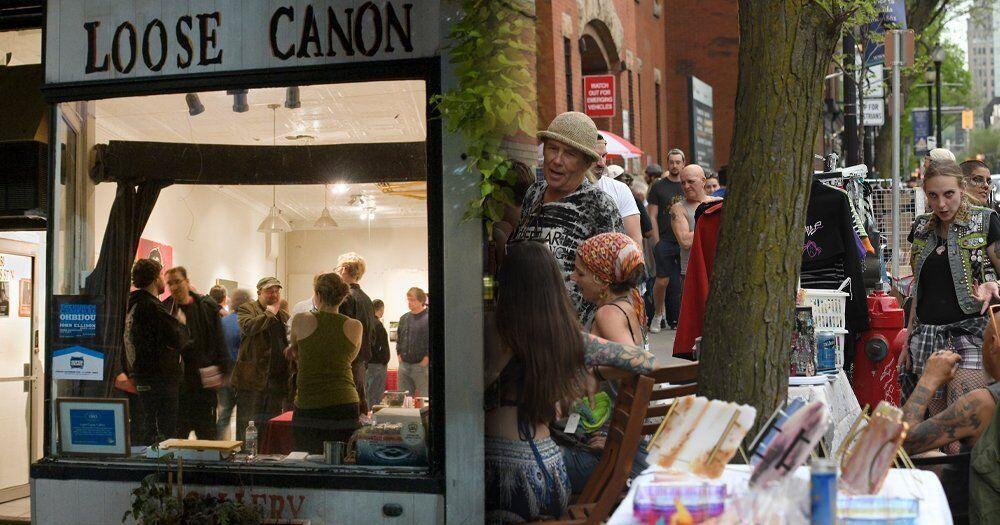
It’s a beautiful late-spring evening on James Street North — the kind of weather that feels like fresh citrus tastes.
Sunlight dapples the busy sidewalks. Tree branches sway lazily in the breeze. Colourful bunting and strings of lights hang from street lamps. In front of Christ’s Church Cathedral, a young woman with a sketch pad slashes at the page and brings a drawing of a nearby child to life.
It’s the second Friday of June, which means it’s Art Crawl. For more than 20 years, the free monthly festival has been inviting people from all walks of life to take in the sights and sounds of one of Hamilton’s most historic downtown streets.
It all started as an effort among gallerists to draw foot traffic into new exhibition and studio spaces peppering the core. The approach was loose and organic, with a handful of mavericks and outsiders leading the vanguard.
But today, Art Crawl looks and feels different.
What exactly is it now, and where is it heading?
To answer those questions, we first need to wander down memory lane.
‘The street is coming alive’
“Now there are art crawl nights on James North, the second Friday of every month. The street is coming alive.” Writing in his StreetBeat column in October 2006, longtime Spectator columnist Paul Wilson effectively captured what had been on the minds of locals in recent months.
There was indeed something happening on James Street North. New galleries and small businesses were opening. Ideas were percolating. Word was spreading that the downtown strip was becoming the new artistic centre of Hamilton.
Not long after the turn of the millennium, gallerist Bryce Kanbara bought a building on the cheap and opened You Me Gallery. He was one of the originators.

Bryce Kanbara, who opened You Me Gallery on James Street North more than two decades ago, was among the artists who helped launch Hamilton’s Art Crawl.
The Hamilton Spectator file photo
“I remember the first time I walked this far north on James Street, seeing all the vacant storefronts and deciding that it might be a good place to open a little gallery,” recalls Kanbara, a founding member of Hamilton Artists Inc.
Zena Hagerty soon followed suit with Sublimatus. She recalls early talks on the street regarding the possibility of a co-ordinated event.
“We’d had two brief meetings, to get things moving, on a very simple concept: Making a happening with collective energy by being open at the same time once a month,” Hagerty recalls. “And it worked. There were many more people than any of us expected.”
In the documentary “Hearts — A Film About Hamilton’s Art Crawl,” Hagerty mentions “Art on James” as an early name candidate, while Centre[3] co-founder Colina Maxwell says “Art Hop” was also floated. Dave Kuruc, who ran Mixed Media on James Street North for more than a decade, recalls “Art Crawl” entering the lexicon around 2005.
“At that point, you still had a bakery. There was a post office at the Shoppers Drug Mart. You had a hardware store. You had a few hardware stores, actually,” Kuruc begins. “The other thing was that you could find a space to rent on James Street that wasn’t very expensive, so that made it desirable.”
Art Crawl itself was a joyous occasion. It offered a chance for people to wander the street at dusk, sipping wine and stopping into galleries and studios to view the exhibitions and mingle. Spaces were intimate, bursting with lively conversation and open later than normal. News of the budding downtown arts scene soon reached all corners of the city and beyond.
A skating demonstration in front of the Local Skate Shop attracted crowds of onlookers during Art Crawl.
Andrew Baulcomb/The Hamilton Spectator
Within a few years, another new, annual event called Supercrawl debuted, this time with a focus on live music. “We were part of that momentum, and were fully in support of all the community members working together,” says Sonic Unyon owner and president Tim Potocic, the former festival director.
But when an event prides itself on being free and relatively shapeless, it can get harder to define exactly what it is over time. Popularity can also bring a whole new set of challenges, including higher prices.
‘Deeply damaged by gentrification’
As Art Crawl entered its second decade, the event started attracting everyone from musicians and buskers to small retailers and street-food vendors. The downtown core in general also caught the interest of investors, and real-estate prices soon reflected new speculative interest.
Internal data from real-estate brokerage Blair Blanchard Stapleton (BBS) Limited found the 2014 average price per downtown acre to be $5.6 million. By 2021, that figure had more than doubled to an average sale price for development land in the core sitting at $11.5 million per acre.
Residential real estate was no different. By 2017, home prices in central Hamilton had surged by nearly 130 per cent over the previous decade, according to a CBC report. A 2019 article in The Spectator cited “the gentrification of older, inner-city neighbourhoods that were traditionally a source of more affordable housing” as part of several related housing challenges.
In fairness, it wasn’t all driven by Art Crawl. The Social Planning and Research Council of Hamilton has cited several overlapping factors, including the erosion of existing affordable housing, a fast-growing and developer-driven market of new builds and land speculation furthered by the approval of Hamilton’s light rail transit project.
As the market surged upward, the physical makeup of James Street North also evolved. The empty and neglected Lister Block fronting James and King William Street was redeveloped for modern commercial use. The Residences at Acclamation at the corner of Mulberry Street and other major condo projects added high-end housing units. The sagging Hotel Hamilton, also at Mulberry, was converted into artist studios. CBC selected James Street North, near Cannon Street West, as the site of its new Hamilton bureau, and the Art Gallery of Hamilton opened a Design Annex on the same block.
With so much rapid change, some of the original Art Crawl hosts and patrons began to get squeezed out.
“It’s a fairly common pattern that you see,” says McMaster University’s Jim Dunn, an associate dean in the Faculty of Social Sciences. “As the art scene rises more and more, it makes a neighbourhood more interesting to a wider variety of people. They’re attracted by lower housing prices, and so they’ll move there.”
Is that enough of a reason not to embrace a budding art scene? “No, I don’t think so at all,” Dunn says. “Again, it really comes down to mitigation.” In other words, providing enough intermediate and low-rent options for the broad spectrum of society to keep the balance just right, he explains.
Depending on whom you ask, that balance may have never existed on James Street North once Art Crawl became a hugely popular draw.
“Art Crawl 10 years ago, or maybe 15 years ago now, was focused on artists, art galleries and some artist studios,” says Kanbara. “After COVID, well, maybe slightly before COVID, too, the gentrification started to happen. Artists couldn’t afford to rent the studios or the storefronts, and they left.”
“Hamilton is a city that has been deeply damaged by gentrification,” Hagerty offers. “I couldn’t afford it anymore, and now live in the woods in Nova Scotia near another beautiful artistic community. I’m one of the lucky ones,” she continues. “Many folks have been made homeless by economic factors that are wildly beyond the control of artists.”
‘It’s a night market now’
Where it heads next may come down to one question: is Art Crawl’s soul tied to the neighbourhood around it, or to the act of wandering the street?
On the arts front, Loose Canon Gallery, one of the most prominent early art galleries on James Street North, is now gone. So, too, are Sublimatus, Flagship Gallery, the AGH Design Annex and Transit Gallery. Their former spaces are now occupied by everything from beauty salons to cannabis dispensaries. Some are awaiting new development opportunities.
When “b contemporary” relocated to Barton Street East in 2019, gallerist David Brace was succinct in his explanation to The Spectator: “The rent’s cheap and the space is plentiful.”
These days, Art Crawl vendors line up on a first-come, first-served basis to claim an outdoor table and sell their wares. Goods on offer include everything from books, clothes and jewelry to food, drinks and a wide range of trinkets and curiosities. Half a city block was cordoned for a street skateboarding demonstration during the latest edition.
“It’s a night market now,” Kuruc offers. He points out that some of the original “art” focus has taken a back seat to other activities over the years. That’s not necessarily a bad thing, Kuruc feels, but it is different. “I don’t know how many artist studios even exist on James Street anymore,” he adds.
At street level, at least, some of the younger artists on the scene are not overly concerned with the future of Art Crawl. It will be fine as long as it remains open and non-exclusive, they feel.
Jude Phillips is a painter who specializes in murals and pet portraits. He began exhibiting at the event in 2025. The Burlington artist was set up near Robert Street in June, displaying contemporary works featuring colourful western motifs.
Burlington-based Jude Phillips began exhibiting at Art Crawl in 2025. His work includes murals, pet portraits and a recent series focused on western themes.
Andrew Baulcomb/The Hamilton Spectator
“There’s absolutely space for everyone, and not everyone here is looking for what I have to offer,” says Phillips, when asked about the mixture of artists and merchants populating the street.
“There’s no gatekeeping. That’s pretty special,” Phillips added. “It’s just nice having eyes on your work. And it feels very organic and alive.”
Farther south, near the John Weir Foote Armoury, ceramicist and teacher Lindsey West is seated next to a table covered in handmade mugs and bowls. With one hand raised to block the sun, West says she’s been attending Art Crawl as a spectator for several years. She recently started trying her hand at exhibiting.
“It’s definitely gotten bigger, especially with the street closure as well. It’s brought in a lot more people, like thousands more people, which is really cool,” she says, gazing at throngs of people passing in front of her table.
For West, art is still very much the central focus of Art Crawl. Like Phillips, she’s keen on promoting an environment that doesn’t necessarily dictate who can get involved — including artisans and retailers of all stripes.
Artist and teacher Lindsey West displaying her work at Art Crawl on June 12. She’s been a longtime attendee of the event, and is now trying her hand at exhibiting.
Andrew Baulcomb/The Hamilton Spectator
‘A shocking and wondrous thing’
These days, the word “crawl” is ubiquitous in Hamilton. There are Park Crawls and Thrift Crawls and, of course, the aforementioned Supercrawl. The latter attracted more than 285,000 visitors in 2024, according to the festival’s website.
Even with all the change, Hagerty is still proud of an event she helped launch decades ago. Two years ago, after a long absence, she had the chance to visit Art Crawl and reflect.
“Art Crawl today is a wonderful thing to see,” Hagerty says. “I can’t imagine how many opportunities have been created for those with the drive to make the world more beautiful and interesting. It’s a shocking and wondrous thing.”