
View(s):
By Dr Ruben Thurairajah
There is a quietness settling over the suburbs of Colombo, Kandy and Galle that has little to do with the peace of evening. It lies behind the closed doors of upstairs bedrooms, in houses where life otherwise proceeds with familiar rhythm: meals are prepared, bills are paid, the evening news murmurs in the background. Yet, behind one door, a son or daughter has not stepped outside for months. Sometimes a year. Sometimes longer. They do not attend university. They do not look for work. Friends stop calling because there is no answer.
Most Sri Lankan families dismiss it at first. A difficult phase. Stubbornness. An excess of screen time. A young person who simply needs discipline. Yet psychiatry has long recognised this extreme withdrawal as something more profound. It bears its Japanese name: hikikomori, literally “to withdraw” or “to shut oneself away.”
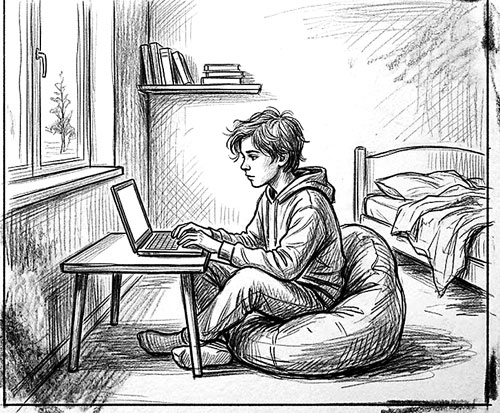
Illustration: Gemini AI
The term was introduced by Japanese psychiatrist Tamaki Saito in the late 1990s. For years it was regarded as a peculiarity of Japan, a by-product of its demanding educational culture and rigid social expectations. That assumption no longer holds. Cases have now been documented across Europe, North America and Asia. South Asia is no exception. Sri Lanka, quietly and largely unnoticed, appears increasingly vulnerable.
Retreating from the world
Hikikomori is not merely solitude. Clinically, it describes a person who remains almost entirely confined to home, usually to a single room, for at least six consecutive months. During that time they disengage from education, employment and ordinary social relationships. The withdrawal becomes their way of life.
Nor is it simply laziness, shyness or adolescent rebellion. Nor can it always be explained by another psychiatric illness. The defining feature is the decision; often gradual, sometimes almost invisible; to retreat from the demands of the outside world.
For many, the physical world is replaced by a digital one. The crowded streets, family expectations and daily obligations recede behind a bedroom door. In their place emerges an existence illuminated by a laptop or smartphone. Online games, anonymous discussion forums and endless streams of video provide interaction without exposure.
It is not that these young people reject human contact. Rather, they seek forms of contact that demand little of them and expose little of themselves.
Why Sri Lanka?
It would be comforting to imagine hikikomori as an imported Japanese condition with little relevance here. Such comfort would be misplaced.
Sri Lanka’s younger generation has inherited an unusually unsettled decade. Many grew up amid the lingering anxieties left by poor governance, only to encounter the isolation imposed by the COVID-19 pandemic during formative years. Before normal life could fully resume, the country descended into economic collapse. Inflation, shortages and shrinking opportunities transformed uncertainty from an occasional experience into a permanent condition.
The familiar milestones of adulthood no longer appear dependable. A university degree no longer guarantees employment. Professional qualifications no longer promise stability. The bargain long offered to young Sri Lankans: study hard, succeed in examinations, and life will reward you; has begun to unravel.
Yet the expectations have scarcely diminished.
From the Grade Five Scholarship examination onwards, children are measured, ranked and compared. Academic performance often becomes less a measure of learning than a measure of personal worth. Families invest enormous emotional hopes in examination results because education has long been viewed as the surest route to security.
The difficulty arises when the economy ceases to honour that promise.
For some young people, the gap between expectation and reality becomes psychologically unbearable. They confront a society demanding relentless achievement while offering diminishing certainty in return. Faced with this contradiction, a small but growing number do not rebel. They simply withdraw.
The silence within families
Perhaps the most troubling feature of hikikomori is not its rarity but its invisibility.
Sri Lankan families seldom speak openly about a child who refuses to leave a bedroom. Excuses are offered to relatives. Neighbours are told that the young person is studying, working online or simply resting. Beneath these explanations often lies something more familiar than denial: shame.
This silence makes the problem difficult to measure. Japan has spent decades documenting hundreds of thousands of socially withdrawn individuals. Sri Lanka possesses no comparable data. Indeed, it is entirely possible that we do not know the scale of the problem because we have never thought to look for it.
Our mental health services are already under considerable strain. Specialist child and adolescent psychiatric care remains scarce, while counselling services in schools vary greatly in quality and availability. Many families only seek professional help after years of isolation have already passed.
Japan offers a sobering glimpse of where prolonged neglect can lead. There, researchers describe what has become known as the “8050 problem”: parents in their eighties continuing to care for sons and daughters in their fifties who never re-entered society. When the parents die, many of these individuals find themselves alone, economically dependent and disconnected from institutions that scarcely know they exist.
It is a demographic problem born from a psychological one.
Looking beyond the locked door
The temptation is to treat hikikomori as a disciplinary problem. Parents confiscate phones, disconnect internet access or insist that the young person simply “snap out of it.” Such measures rarely succeed. More often they deepen the withdrawal.
Recovery usually begins not with confrontation but with patience. Families themselves often require support before they can support the withdrawn individual. Mental health professionals seek to rebuild trust gradually, allowing contact to develop without overwhelming pressure. The process is measured not in days or weeks but often in months.
Yet treatment alone is insufficient. Societies also shape illnesses.
A culture that leaves little room for failure inevitably creates people who come to fear participation itself. When success is treated as the only acceptable outcome, withdrawal can become less frightening than the possibility of public disappointment.
Hikikomori reminds us that loneliness is not always the absence of company. Sometimes it exists in the middle of a family home, behind a closed bedroom door, while life continues uninterrupted on the other side.
The room remains inside the house. But for the person living within it, the rest of the world has already become somewhere else.