
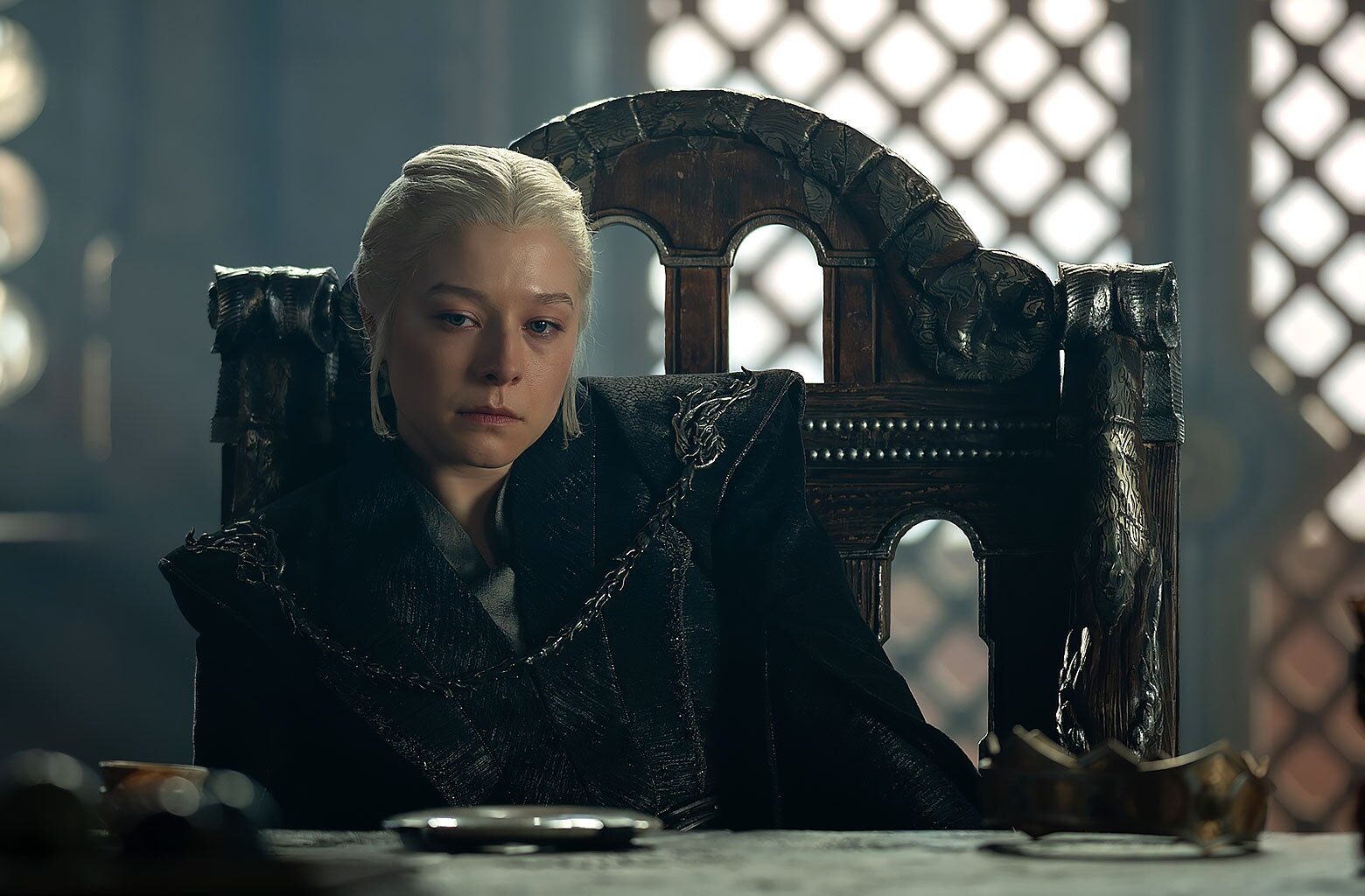
After each episode of House of the Dragon, Slate writers will gather to answer a crucial question: Who is the worst person in Westeros? This week: senior editor Jenny G. Zhang and staff writer Nadira Goffe answer the call.
Jenny G. Zhang: Hello, Nadira! We gather here to discuss another surprisingly pretty good showing from House of the Dragon. This week’s episode can best be summed up, I think, using a variation on that famous Onion headline satirizing Bill de Blasio: “Well, well, well, not so easy to find a ruler that doesn’t suck shit, huh?”
In other words, with the main bloody warfare part of the Dance of the Dragons now apparently over, our new queen must turn to the much more tedious part of the whole deal: actually ruling, a thankless job made up of an endless stream of people clamoring for their sovereign’s time, attention, money, favor, and decisions. Rhaenyra, still haunted by the death of Jacaerys and preoccupied with hunting down both Aemond and the unknown (to her) rider of Sheepstealer, suddenly has to contend with quotidian concerns like household redecorating, rat infestations, petitioners, and money—the latter of which the Crown is apparently severely lacking, with Aegon’s Master of Coin, Tyland Lannister, having stashed it all away somewhere out of reach. (Ironically, the only other people who might possibly know where it is are Lord Jasper Wylde and Otto Hightower, both freshly executed.) The treasury only has enough gold to last another week, which is certainly not enough to feed the hungry smallfolk or to pay for a coronation ceremony (which the High Septon won’t even anoint her for, by the way).
Rhaenyra must determine what to prioritize, which in turn will determine what kind of ruler she will be: Will she be one that spurns power and extravagance, like her father did? Or will she be one that chases greatness and the dream of Old Valyria, like Daemon wants her to be? Either way, “you may not rule and remain yourself,” Alicent says soberly when Rhaenyra asks how she ruled in Viserys’ stead. “You will do things that your heart would’ve recoiled from before you came to the throne.”
What do you think, Nadira? What kind of ruler is Rhaenyra shaping up to be, from what we see in this episode?
Nadira Goffe: Everyone thinks about the crime of violence and betrayal, but no one thinks about the crime of incompetence. And, if I had to answer your question of what kind of ruler Rhaenyra is shaping up to be, the answer would be: an inadequate one. This is, of course, not as bad as being an evil or malicious ruler, but it will inevitably lead to death and dissent and disarray all the same, especially considering the High Septon’s assessment of the current circumstances: “These are turbulent times.”
However, in such turbulent times as these, when you don’t have many allies and even the gods are against you, as the High Septon ominously imparts, it doesn’t help to further alienate the few friends you do have. Look, no one in this show is winning the Father of the Year award, but after the Battle of the Gullet, Lord Corlys surely is trying. The Sea Snake sits down with Rhaenyra and asks for her to legitimize his bastard sons, Alyn and Addam of Hull, as Velaryon lords to preserve his noble line. In the end, Rhaenyra refuses. Despite both Corlys and his sons dedicating their lives to her fight, she is too afraid to rock the boat by supporting bastard children (and going against the same Westerosi way of things that kept her, a woman, from the throne) so early in her tenure. Corlys points out the clear hypocrisy as Rhaenyra’s own sons are bastards, but this doesn’t win her over. Surely this won’t come back to haunt the new queen of King’s Landing, who may be in line for Worst Person in Westeros for this betrayal alone.
There is, however, another person to consider: Ormund Hightower (James Norton). Alicent’s cousin has been up to no good. At the start of the episode, Daemon tells Ormund that Rhaenyra now sits upon the throne, explaining that Ormund and his men have been offered clemency and can do as they wish so long as they bend the knee and fork over the only other Hightower-aligned heir to the throne currently in play: Alicent’s youngest son and Ormund’s ward, Daeron, a much-anticipated player in this Dance of the Dragons. However, the end of the episode reveals a stunning twist: Ormund coerced a different child (played by Charlie Gordon) to dye his hair and play royal, while keeping the real Daeron in his care. When Rhaenyra resolves to correct this sleight of hand, she learns that Ormund has taken over the town of Tumbleton, in the Reach, where he is currently holding its people (and a young dragon) hostage.
It’s a smart move on Ormund’s part, as it creates a unique bind for Rhaenyra that even dragonfire can’t get her out of. If she wants to handle things the easy way—burning all of her enemies to a crisp—she would have to also kill the innocent hostages. “My arm is long. He cannot win,” she responds as the Hightower banners taken down from the palace are dramatically ignited in a pyre behind her. But … can’t he? If Ormund is willing to endanger many innocent lives and take a dragon and send an innocent merchant’s child to death for impersonating a prince, I’m not sure Rhaenyra’s a match for him.
Jenny: Yes, this was a sly trick! One that plenty of nosy HotD obsessives already predicted months ago, but fun to see play out, regardless. I can’t really fault Ormund for being unwilling to hand over the final card he has left to play, nor can I fault the false Daeron, some poor kid who says Ormund threatened to kill his mother if he didn’t submit to a round of Targaryen-worthy bleach. If anything, you have to judge Rhaenyra a little bit here for falling for this ruse so readily. She could’ve brought “Daeron” to see Alicent immediately and discover the deception, but, in keeping with her character, Rhaenyra dithered and dallied a few days as she considered what to do with her unwilling ward, thus giving Ormund enough time to make his next move. Is he kind of the worst for holding an entire town hostage and continuing this war that will cost both sides nearly everything? Yes. Do I have to give him his props for his audacious duplicity anyway? Also yes.
I do think, however, that Rhaenyra is still our primary contender for Worst Person in Westeros this week. Her refusal to legitimize Alyn and Addam is hypocritical, as you and Corlys point out, and a poor way to repay a staunch ally who lost his wife, his heir, and his home in service to Rhaenyra. Rhaenyra is supposedly worried about what the nobles and the rest of the realm will say in relation to rumors about legitimacy and her own bastard sons, but then she shows that she’s unafraid of pissing off the highborn anyway by serving them roasted rat at the banquet she throws them.
Holding on to power is a supremely difficult balancing act, one that requires never-ending judgments and shifts and recalibrations. I can understand Rhaenyra’s fear, but also, come on—this stage perhaps calls for some of Daemon’s absolute assertion of might. You can bet someone as proud as the Sea Snake won’t forget a slight this bitter, and Rhaenyra may pay for it, going forward.
Nadira: Rhaenyra has a good heart, evidenced by her aforementioned ratty decision to pay the wealthy back for selfishly hoarding resources, by the many seasons of her trying to quell the incoming war, by her status as a far better mother to far kinder children than Alicent was or has. We see that, even now, Rhaenyra is struggling to do the worst to Alicent and Helaena, currently her prisoners, despite knowing she can’t do something good for them. Earlier you pointed out Alicent’s warning to Rhaenyra of needing to change herself to rule, but I latched on to a different warning of hers. When Rhaenyra counters that her father managed to rule unchanged, Alicent sternly reminds her that Viserys “lived in a world of his own construction.”

Sam Adams
The Bear’s Final Season Relies on a Gimmick. It’s the Smartest Thing It Could’ve Done.
Read More
An Eye-Opening New Book Offers Insight Into the Hearts and Minds of Conservative Women
This was, of course, supposed to also be the world Rhaenyra lived and ruled in. Instead, she finally arrives to claim a birthright that is in a much worse state than when it was promised to her, off the heels of war, on the verge of financial ruin, and supported by nothing but a lack of trust among all of the crown’s usual confidants. Rhaenyra was robbed of much, namely the tutelage, support, and time she was promised to become a great leader. And now, presently dealing with grief so palpable she is haunted by visions of Jace walking the palace halls, she must try to pull off a harder feat with none of the tools she was supposed to have to do it. Her incompetence isn’t her fault—but it is her burden to bear.
And, unfortunately, it is a burden that has already cost her so much! It has deprived her of the upper hand, of options, and, likely, of allies like Corlys. Soon, it will rob more innocent people of their lives. So, for that, I have to agree with you. Congratulations, Rhaenyra, on being this week’s upper crust of Westerosi disgust!
Get the best of movies, TV, books, music, and more.