
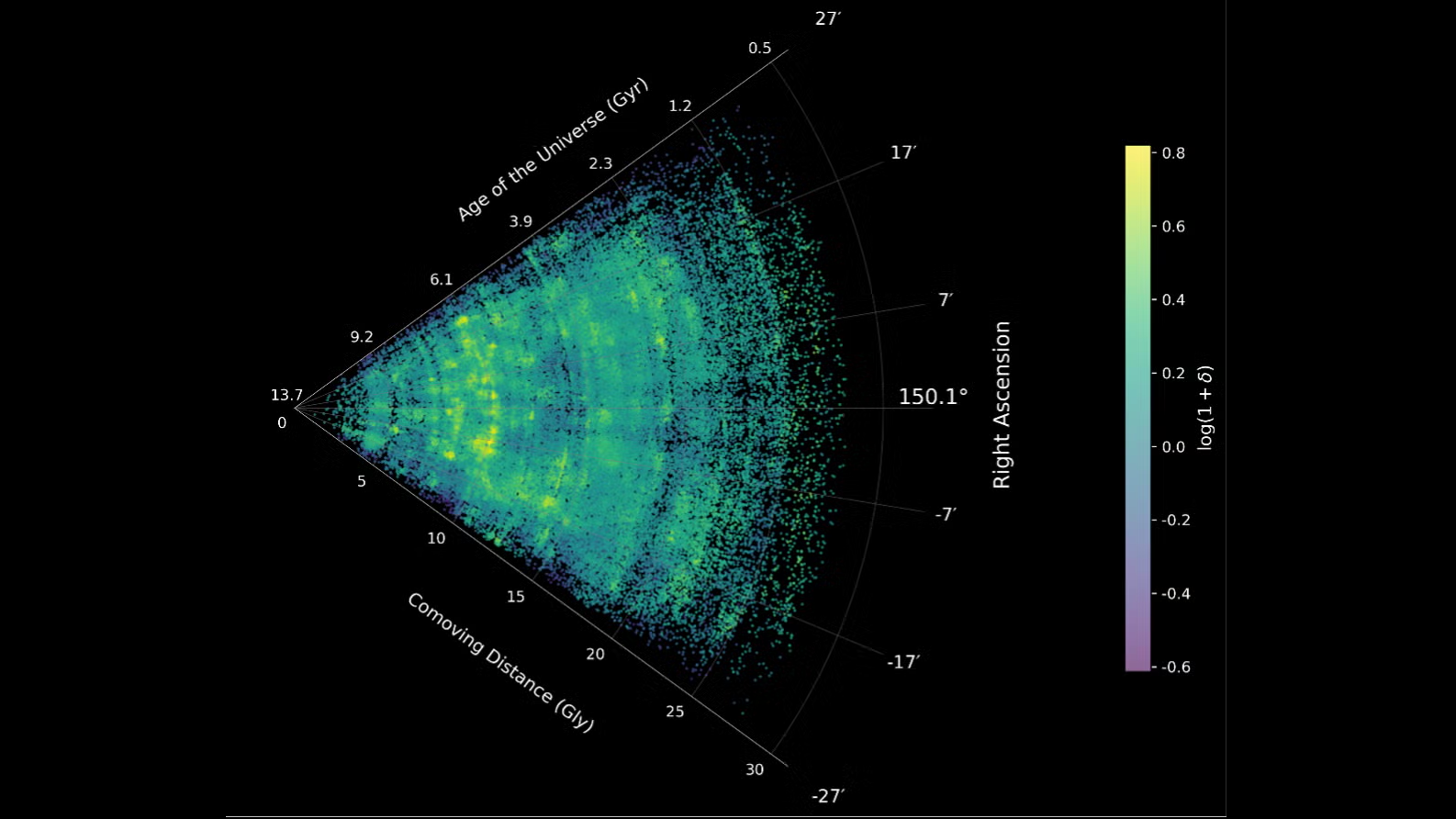
Astronomers have reconstructed the “skeleton” of the cosmos in unprecedented detail, thanks to the largest-ever survey conducted by the James Webb Space Telescope (JWST). The resulting map reveals how galaxies have evolved since the universe’s infancy around 13 billion years ago and how they fall together in a vast structure called the cosmic web.
The cosmic web is the largest known structure in existence, home to countless galaxy clusters and clusters of clusters. It is the framework of the universe, a scaffolding of gas filaments, stars, voids and sheets of dark matter that trace the entire large-scale organization of the cosmos.
Latest Videos From How to sculpt a universe from scratch
You may like
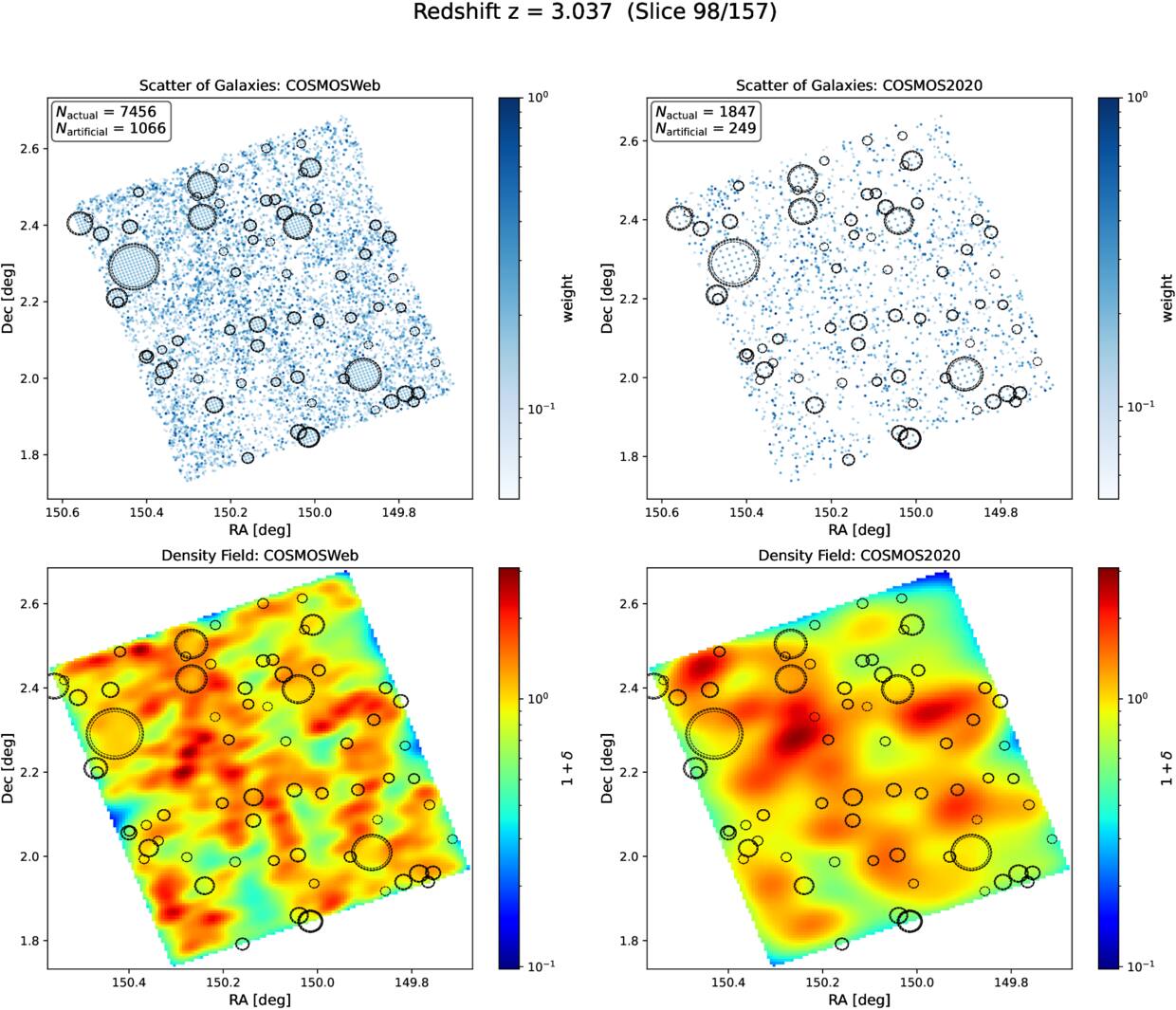
Data from the new COSMOS-Web survey (left) compared to the previous iteration (right). JWST’s sensitivity and depth has allowed scientists to map the cosmic web in unprecedented detail.
(Image credit: Hatamnia et al., The Astrophysical Journal, 2026)
What to read next
Revealing celestial birth and death
Hatamnia, H., Mobasher, B., Taamoli, S., Kartaltepe, J. S., Casey, C. M., Akins, H. B., Brinch, M., Chartab, N., Drakos, N. E., Faisst, A. L., Finkelstein, S. L., Franco, M., Giddings, F., Gozaliasl, G., Hadi, A., Haghjoo, A., Harish, S., Ilbert, O., Jablonka, P. L., . . . Yang, L. (2026). Large-scale Structure in COSMOS-Web: Tracing Galaxy Evolution in the Cosmic Web up to z ∼ 7 with the Largest JWST Survey. The Astrophysical Journal, 1002(2), 192. https://doi.org/10.3847/1538-4357/ae5bac
This article was first published May 18, 2026.
TOPICS