
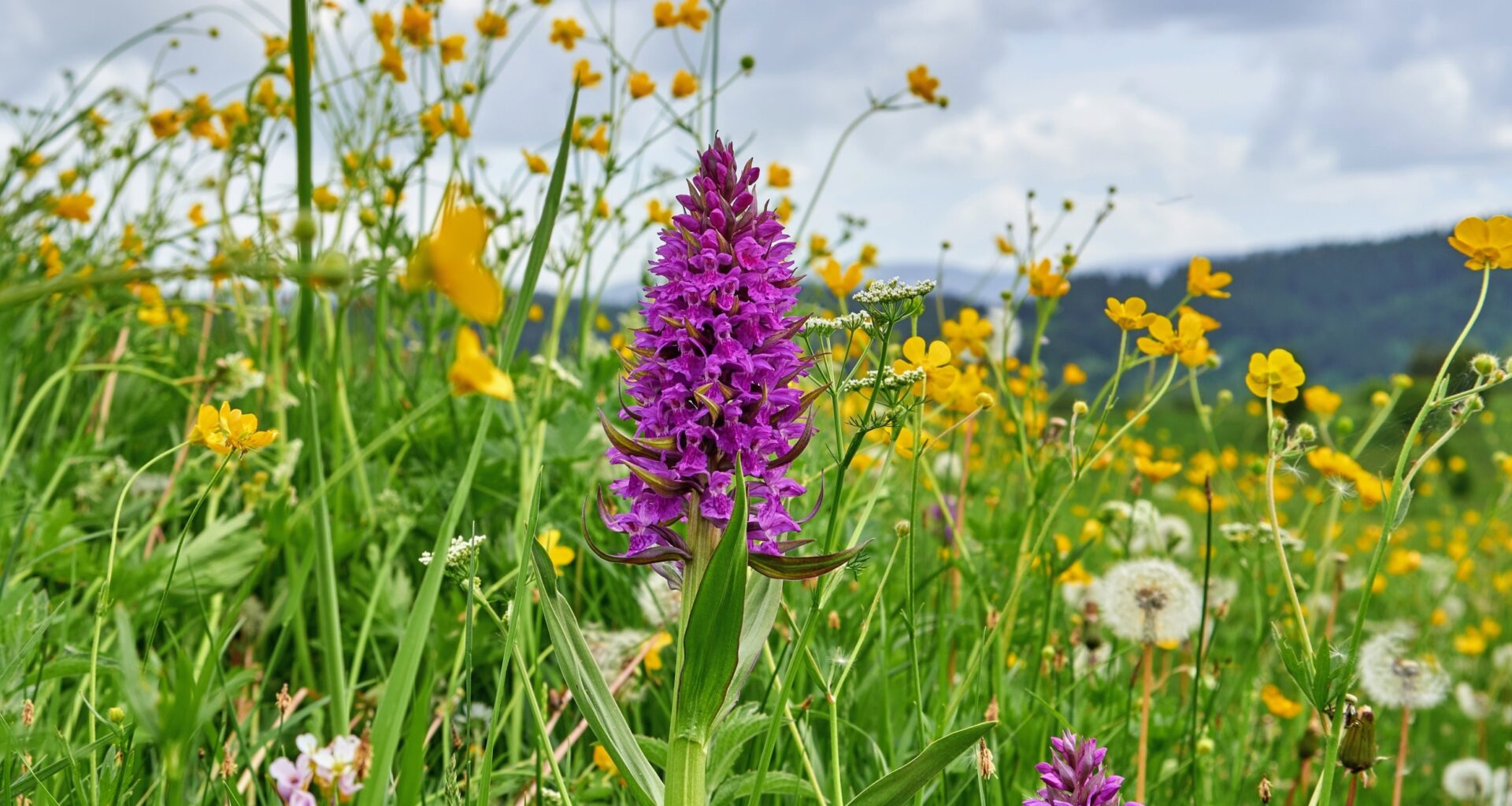
A patch of farmland left to its own devices for over a decade has quietly transformed into a thriving wildflower meadow.
It didn’t take expensive seed mixes or heavy machinery. Recovery required only patience, a yearly hay cut, and letting nature do what it does.

The find could reshape how governments approach one of conservation’s biggest and most expensive challenges.
The study was conducted by researchers at the University College London (UCL).
The team tracked vegetation changes between 2011 and 2022 across a 2-hectare tract of farmland in Norfolk, abandoned in 2005 after years of growing crops.
Since then, the only intervention has been an annual traditional hay cut, nothing else.
Nature beats the seed packet
The results run directly counter to how most government-funded conservation schemes currently operate, where commercial seed stocks are the default tool for restoring farmland into wildlife habitat.
This study suggests that approach might be unnecessary, at least in many cases.
“Our study shows that resisting seeding and allowing nature to lead may be worth trying a lot more in wildflower meadow restoration,” said lead author Carl Sayer from UCL.
“Natural plant recovery better safeguards genetic diversity than seeding and ensures that local species thrive, making meadows less generic.”
“As things stand, the UK needs nature recovery fast, at big scales. In the push to achieve this goal, our study poses the question: Should we be employing patience over seed packet more often?”
The stakes are real. UK wildflower meadows support rare plants and provide essential habitat for pollinators and other wildlife, yet they’ve declined by more than 90 percent since World War II.
Restoring them brings a wide range of benefits, from reducing pollution to supporting mammals and birds to building climate resilience.
Tracking how well farmland recovers
Wildflower meadow restoration usually comes with a hefty price tag and plenty of labor, often involving commercial seed mixes, topsoil removal, or deep plowing.
Surprisingly, almost no UK research has tracked how well abandoned farmland can recover into species-rich grassland using nothing but simple hay cutting.
That’s largely because it requires years of patient, careful monitoring that few studies are set up to provide.
This study managed it thanks to an unusually convenient setup.
Land with a detailed history
The researchers focused on Sayer’s Meadow in Bodham, North Norfolk, owned by the lead researcher’s father and co-author, Derek Sayer.
That family connection meant the annual hay cutting never lapsed over the years, and the team had access to a detailed history of exactly how the land had been used before.
Every two to three years, Sayer and a friend, Pete Robinson, carried out detailed vegetation surveys, walking the field systematically and logging every plant species they came across.
They paid particularly close attention to two dozen one-meter-square plots set along two transects.
Watching diversity double over a decade
The numbers tell a clear story. Between 2011 and 2022, the count of plant species in the meadow rose steadily year after year.
After a decade, several locally rare species had shown up on their own, including the southern marsh orchid, greater tussock-sedge, yellow rattle, and common centaury.
Meanwhile, the average number of species found in a single survey plot roughly doubled, climbing from around 10 in 2011 to nearly 20 by 2022.
The team paid special attention to orchids and yellow rattle, plants considered reliable early indicators of a meadow’s recovery.
They were recording the flowers’ precise GPS locations survey after survey, until eventually there were simply too many to count individually.
Exactly how some of the rarer species reached the field remains something of a mystery, especially given how far away the nearest known populations were.
The researchers suspect deer may have carried seeds in, though they can’t be certain.
From failed farmland to a village attraction
For Sayer, the project carries a personal dimension that goes beyond the data.
“The field belongs to my family, and after an oilseed rape crop in 2005, we stopped farming it as the land was difficult to drain,” he explained.
“I really wanted a wildflower meadow and all the advice was to seed it, but I resisted the temptation, as I have always been interested in nature’s ability to recover itself.”
“When the first orchids started appearing in our surveys, we were thrilled, and now the meadow is unbelievably diverse, with thousands of orchids that delight locals in the village.”
“Our study shows what can be achieved by a traditional hay-cutting approach combined with nature’s brilliant spontaneity. A visit to the meadow is like stepping back through time.”
What this means for restoration
With large stretches of abandoned farmland scattered across the UK and Europe, governments are actively searching for ways to turn that land back into biodiverse habitat, including species-rich grassland.
This study offers a genuinely appealing option: cheap, low-effort, and scalable, provided restoration planners are willing to wait rather than reach for a seed packet.
It won’t work everywhere, and every site carries its own quirks of soil, drainage, and local plant populations nearby.
But Sayer’s Meadow makes a strong case that sometimes the most effective conservation strategy is simply stepping back and letting a landscape turn into what it used to be.
The study is published in the journal Restoration Ecology.
—-
Like what you read? Subscribe to our newsletter for engaging articles, exclusive content, and the latest updates.
Check us out on EarthSnap, a free app brought to you by Eric Ralls and Earth.com.
——