
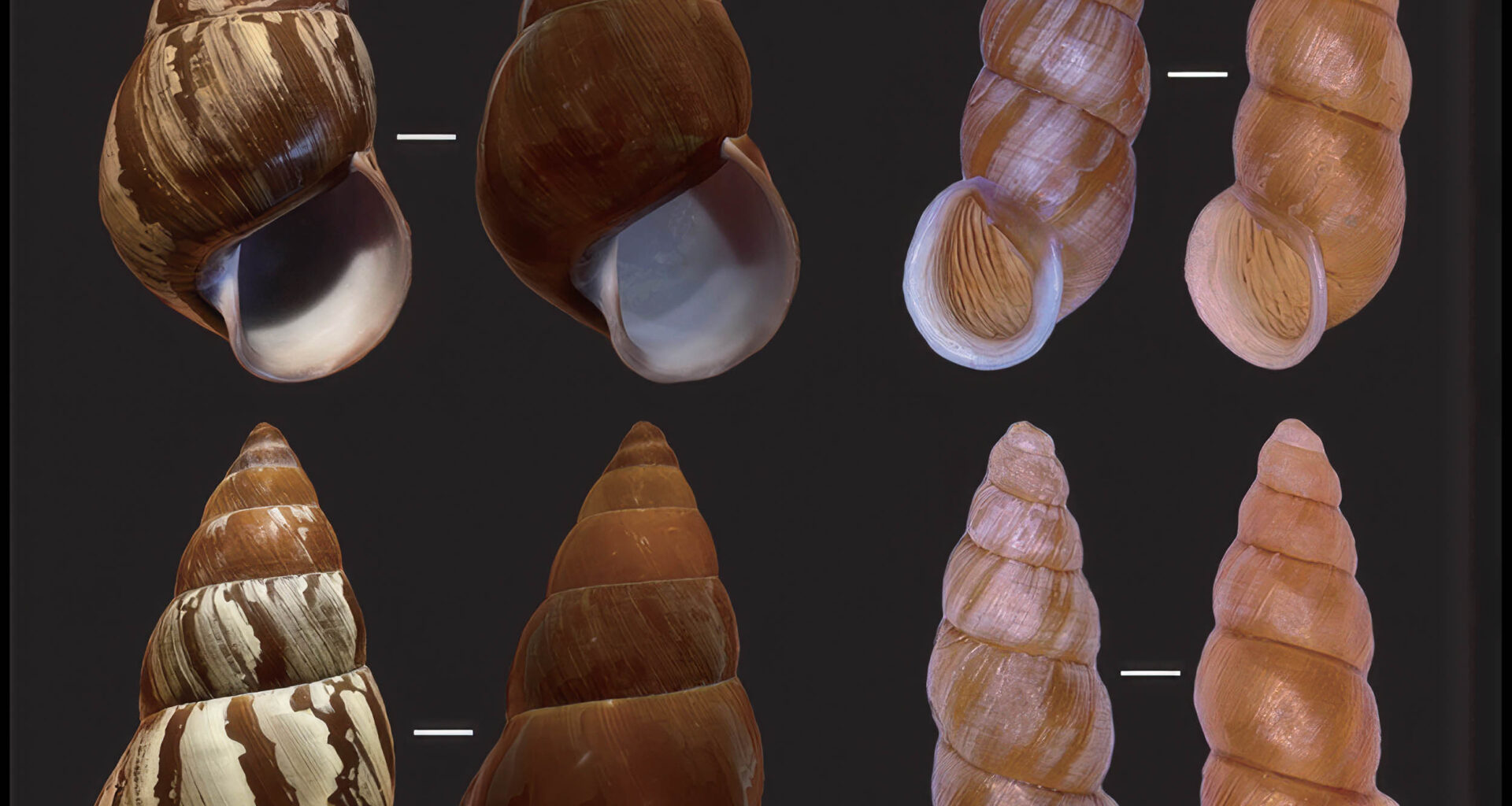
While octopuses and cuttlefish are famous for changing their appearance, a pair of tiny tree snails has been doing something just as surprising in a completely different way.
When rain falls, these snails don’t grow new colors or rearrange pigments. Instead, the patterns on their shells seem to vanish.

Their striped or mottled shells become dark brown, matching wet tree bark, helping them stay hidden from hungry birds until the surface dries again.
Hidden in plain sight
Scientists recently discovered how this unusual form of camouflage works. The two species involved are Hypselostyla camelopardalis from the Philippines and Reinia variegata from Japan.
Although they live far apart and are only distantly related, both developed the same ability on their own through evolution.
The finding challenges a long-held belief that snail shell colors and patterns remain fixed throughout the animal’s life.
Instead, these shells can change their appearance within moments as moisture levels rise and fall.
“The Philippine Hypselostyla camelopardalis and the Japanese Reinia variegata are tree-dwelling snails that both exhibit a reversible form of ‘hydrochromism,’” explained Taro Yoshimura, a researcher at the University of Tokyo.
He added, “Their mottled shell patterns completely disappear upon wetting, causing the shell to darken uniformly, and then rapidly reappear as they dry.”
Unchanging in color
The secret isn’t a chemical reaction or a special pigment. It comes from the shell’s structure.
Researchers found that the shell’s outermost protective layer, known as the periostracum, has countless tiny sponge-like pores.
When moisture fills those pores, the shell’s appearance changes because light passes through the shell differently.
“We now understand the physical mechanism driving this phenomenon: a process known as refractive index matching. The two-layered structure of the outermost organic membrane of the shell (called the periostracum) has spongelike nano- to microscale voids that absorb moisture,” explained Yoshimura.
He noted “The water-filled pores suppress light scattering, allowing light to pass through the membrane and reveal the dark pigments of the crystalline shell layer below.”
An old mystery
To figure out exactly what was happening, they examined preserved snail shells from the University of Tokyo Museum collection using several advanced imaging techniques.
A field-emission scanning electron microscope revealed the shell’s two-layer design.
A confocal laser scanning microscope captured the shell’s rapid hydration during repeated wetting and drying tests. The team also measured how much light passed through the shell.
Light transmittance jumped from roughly 37% when the shell was dry to around 85% after it became wet.
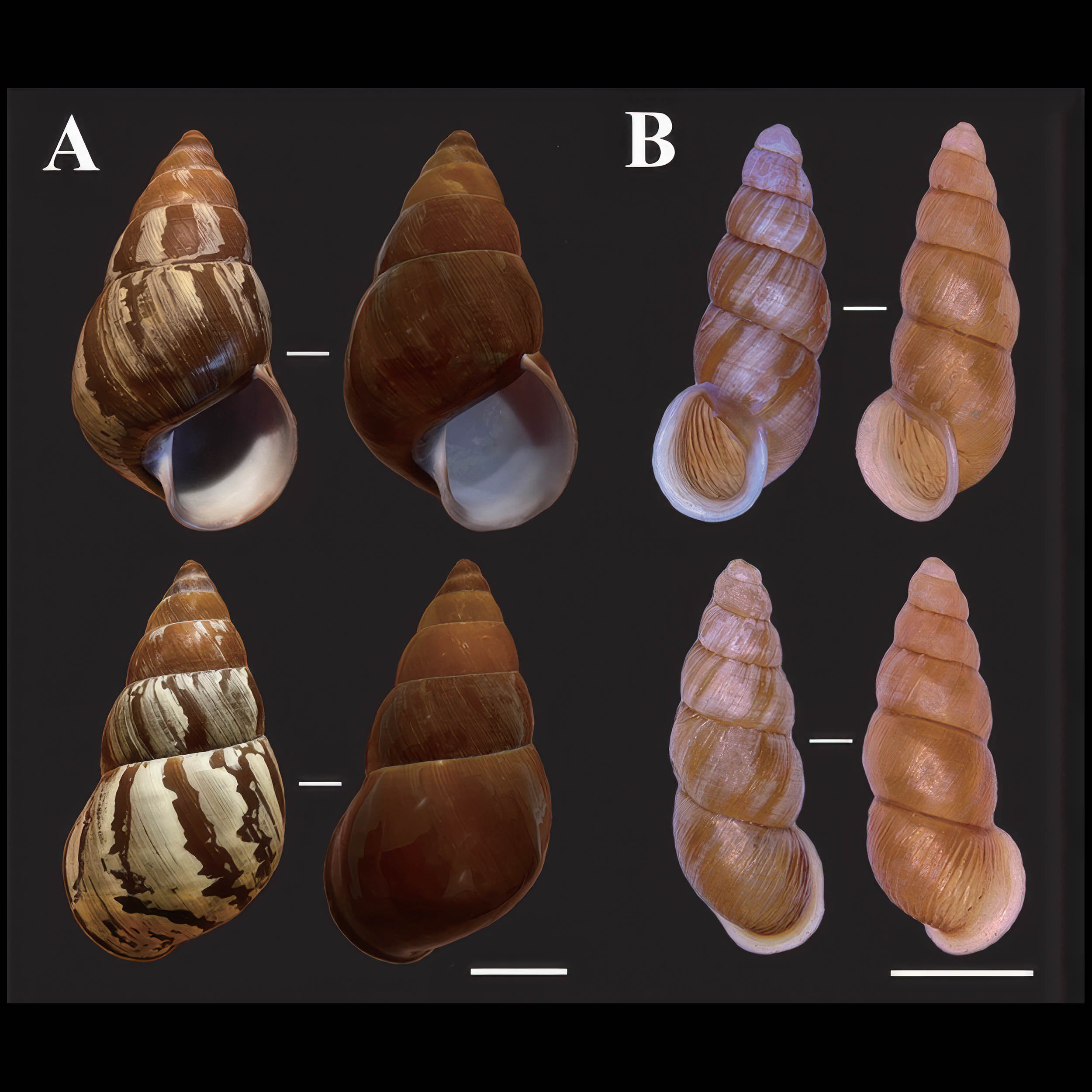 Photos of the disappearing patterns on the (A) Hypselostyla camelopardalis and (B) Reinia variegata, when going from dry to wet. The scale bar in the bottom right is 10 millimeters. Credit: Yoshimura & Sasaki (2026). Click image to enlarge.Seeing in a new way
For many years, scientists believed that shell patterns were permanent because they were created by pigments locked inside mineral layers during shell growth.
This study shows that appearance can also change because of the shell’s physical structure interacting with water in the environment.
“Conventionally, molluscan shell coloration and patterning have been considered static features, strictly determined by pigments embedded within the calcified crystalline layers,” said Yoshimura.
He added, “Our study fundamentally challenges this established paradigm, altering their appearance in real time based on ambient humidity.”
A shared path
He also noted that “witnessing natural selection can drive entirely different organisms toward the exact same elegant evolutionary solution was an incredibly exciting discovery.”
The fact that two distant species independently evolved also highlights a common pattern in evolution.
When different animals face similar challenges, they sometimes arrive at remarkably similar answers despite having separate evolutionary histories.
Inspiring new materials
This may hold value beyond biology. Materials that respond to humidity could be useful in homes, environmental monitoring, medicine, and manufacturing.
Engineers have long looked to nature for ideas, and this snail shell offers another example of how simple physical structures can perform complex tasks.
“The greatest advantage of the snails’ mechanism is that it alters their optical properties autonomously in response to ambient moisture, without any external power source,” said Yoshimura.
“My ultimate hope is to bridge the gap between evolutionary biology and material science, translating nature’s zero-energy physical tricks into the practical development and commercialization of next-generation smart materials,” he concluded.
This study was published in EurekAlert.
—–
Like what you read? Subscribe to our newsletter for engaging articles, exclusive content, and the latest updates.
Check us out on EarthSnap, a free app brought to you by Eric Ralls and Earth.com.
—–