
If a liquid is cooled slowly till its freezing point, it becomes a crystal where the constituent particles become arranged in an ordered pattern. In contrast, when the liquid is cooled very quickly, the particles are unable to arrange themselves in an ordered fashion, and it becomes glass. Glassy materials are all around us in everyday life. Common examples include window glass, certain metal alloys, polymers, foams, gels, and even soft materials like emulsions and colloids.
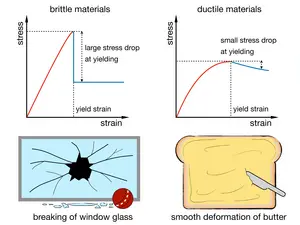
These materials can behave very differently when an external force is applied on them, such as bending, stretching, or compressing. Some materials change shape slowly and smoothly under strain (this property is called ductility). Some materials may resist deformation at first but then suddenly break or crack without warning (this property is called brittleness). Whether a material bends or breaks determines how safely and reliably it can be used in everyday objects and engineering applications.
Scientists broadly classify glasses into two types: strong and fragile glasses.
As a liquid is cooled, particles need to cross energy barriers to move around. In some liquids, these barriers increase very rapidly upon cooling. As a result, particle motion slows down dramatically, and the liquid becomes highly viscous and sluggish even with a very small decrease in temperature. These are called fragile glasses. In other liquids, the energy barriers grow more gradually with cooling, so the liquid becomes viscous in a smoother and steadier manner. These are called strong glasses.
In a study published in Nature Communications, Roni Chatterjee and Monoj Adhikari, researchers from Smarajit Karmakar’s group at the Tata Institute of Fundamental Research, Hyderabad (TIFRH) report that the “fragility” of glassy materials controls how they fail under mechanical load. The researchers find that in fragile glasses, the yield strain (the maximum load or deformation a material can withstand before breaking) increases rapidly upon cooling. In contrast, strong glasses show a negligible increase in yield strain with cooling. Moreover they observed fragile glasses are brittle and strong glasses fail in a ductile manner.
Fragility is not only about how a liquid slows down. The team asked : could “fragility” also affect how a glass responds when bent, stretched, or compressed? Whether a material bends or breaks – showing ductile or brittle behavior – has long been a central question in material science. Exploring the role of fragility in mechanical response may therefore provide new insight into these behaviors.
To investigate this, Roni Chatterjee used large-scale computer simulations to prepare different types of glassy materials across a wide range of temperatures. In these simulations, repetitive back-and-forth deformation cycles of different amplitudes were applied to each glass sample, and the resulting stress-strain curves were analyzed. Initially, the stress increases with strain and reaches a maximum value at the yield strain. Beyond this point, the material starts to fail, causing the stress to drop to a lower value. From these curves, the researchers determined both the yield strain and the magnitude of the stress drop. A larger stress drop indicates brittle failure, whereas a smaller stress drop suggests a ductile behavior.
To understand the underlying physics, the researchers connected the yielding behavior with the concept of energy barriers. In fragile glasses, the energy barriers increase rapidly as the material is cooled. As a result, larger strain is required to overcome these huge barriers and to make the material yield. So the yield strain increases rapidly with cooling. Since the material can withstand larger strain, the maximum stress also increases. This leads to a larger stress drop at yielding, which is a signature of brittle behavior. In case of strong glasses the energy barrier increases in a more steady way with cooling, leading to negligible increase in yield strain and correspondingly less stress drop, indicating a ductile behaviour.
Overall, this study shows that fragility is a key factor in deciding whether a material will break suddenly or deform smoothly. This insight can help scientists and engineers design better materials with improved safety and performance for a wide range of uses.
Link to publication: https://doi.org/10.1038/s41467-026-71157-w
[Content: Roni Chatterjee. All queries may be addressed to rchatterjee@tifrh.res.in.]
Disclaimer: AAAS and EurekAlert! are not responsible for the accuracy of news releases posted to EurekAlert! by contributing institutions or for the use of any information through the EurekAlert system.