
KeysQuestions4Explore4
The UK’s fusion ambitions just got a brutally honest reality check — Britain needs 30,000 kilometers of specialized superconducting tape to build its prototype power station, and right now, not a single meter of it is made on British soil.
The magnet demo that just came apart after 5,000+ plasma pulses hit 11.8 tesla at temperatures colder than deep space while containing plasma six times hotter than the Sun’s core — and that’s just the prototype proving the tape works.
A Downing Street signing between Tokamak Energy and Japan’s Furukawa Electric sounds like a milestone, but read the fine print and it’s actually a study to figure out if a UK factory could even exist — which means the supply chain for Britain’s 2040 fusion plant currently starts in New York State.
If this tape problem doesn’t get solved domestically, the entire STEP program — a £70 million government bet on homegrown fusion energy — runs on foreign-controlled infrastructure, and that’s a vulnerability no one in the room at 10 Downing Street was talking loudly about.
Ask The Box →
Ask The Box:
SummarizeContextWhat does it mean?Related
Energy
An American machine fires 500,000 amps down a column of gas twelve times a minute, twenty times the current of a lightning bolt, into a chamber the size of a water heater, and the fusion company that built it is now selling a fission reactor based on a Japanese design nobody ever finished
3 hours
Energy
An American drone boat just docked and recharged itself with no human aboard, the first step toward five ocean buoys that already pull their own power out of the water, one of them moored over 1,000 meters of seawater off San Diego
5 hours
Energy
Spanish researchers just grew tomatoes 40% heavier under a solar roof that stole a third of the light the plants needed, because the clear greenhouse next door was cooking at 120 degrees and the panel was working as an air conditioner made of glass
8 hours
Energy
America just lowered the final 110-ton coil into a 1,000-ton magnet as tall as a five-story building, threading it into a gap with two inches of clearance on one side, and its builder says the finished stack packs enough force to lift an aircraft carrier six feet out of the water
9 hours
AI-generated summary from reviews, comparisons and articles by AutoNotion
Fusion stories tend to be about the vessel. The chamber, the tungsten wall, the enormous thing being craned into a pit. What actually keeps the plasma off that wall is a coated metal ribbon wound into coils that sit around the outside, and a power plant needs far more of it than you would guess.
Britain has now put a figure on how much. STEP, the prototype fusion power station the UK government wants running at West Burton in Nottinghamshire by 2040, is expected to require around 30,000 kilometers of high temperature superconducting tape. That is roughly 18,600 miles, or about three quarters of the way around the equator.
No British factory makes it. On June 14, at 10 Downing Street, Tokamak Energy signed an agreement with Japan’s Furukawa Electric to work out whether one could. The signing took place at the launch of a UK-Japan technology partnership, with Prime Minister Keir Starmer and his Japanese counterpart Sanae Takaichi in the room.
Tokamak Energy is the Oxfordshire company that has to deliver STEP’s magnets. In April, UK Fusion Energy handed it a £70 million contract, about $94 million at current exchange rates, running through March 2029 to do exactly that. So the firm now holds a national fusion contract, a magnet division to fill it, and a supply chain that starts on another continent.
Thirty thousand kilometers, and the tape comes from New York
Furukawa Electric makes HTS tape through SuperPower Inc., a group company based in New York State. Tokamak Energy has been buying from them for years.
In January 2023 the two signed a deal for several hundred kilometers of tape for a prototype machine called ST80-HTS. Production ran at SuperPower’s New York facility and the first batches were delivered to Oxfordshire. That prototype turns up again further down.
The June agreement is a study, not a factory. Tokamak Energy says the two firms are exploring how to develop HTS tape capability in the UK, and that demand for the stuff runs well past fusion, into life sciences and power distribution for data centers. Nobody has announced a site, a production line or a figure.
The company’s own framing is that UK tape capability needs to be developed. Which is another way of saying it is not there.
Autonoción Newsletter
No spam. Unsubscribe anytime. Privacy policy (opens in new window)
TARGET
Tape Required
30,000 km
Estimated HTS tape for the STEP prototype plant. About 18,600 miles.
SPARC, For Scale
10,000 km
Tape needed for Commonwealth Fusion’s reactor near Boston, per the company.
Current Density
200x copper
What HTS tape carries versus the same cross section of copper, per Tokamak Energy.
Demo4 Peak Field
11.8 tesla
Reached at -243°C (-405°F), with seven million ampere turns through the centre column.
Magnet Contract
$94M
£70 million from UK Fusion Energy. Eight work packages, running to March 2029.
Prototype Plant
2040
Target for STEP at West Burton. Construction expected to start from 2030.
The magnet is the machine
The tape is REBCO, short for rare earth barium copper oxide, laid down on layers of metal. Tokamak Energy says it carries around 200 times the current density of copper, which is the entire reason anyone puts up with the manufacturing difficulty.
The temperature is the commercial argument. Older low temperature superconductors have to sit in liquid helium, a few degrees above absolute zero. Tokamak Energy’s Demo4 magnet system hit its numbers at -243°C, or -405°F, roughly 30 degrees above absolute zero. Cooling costs follow the temperature.
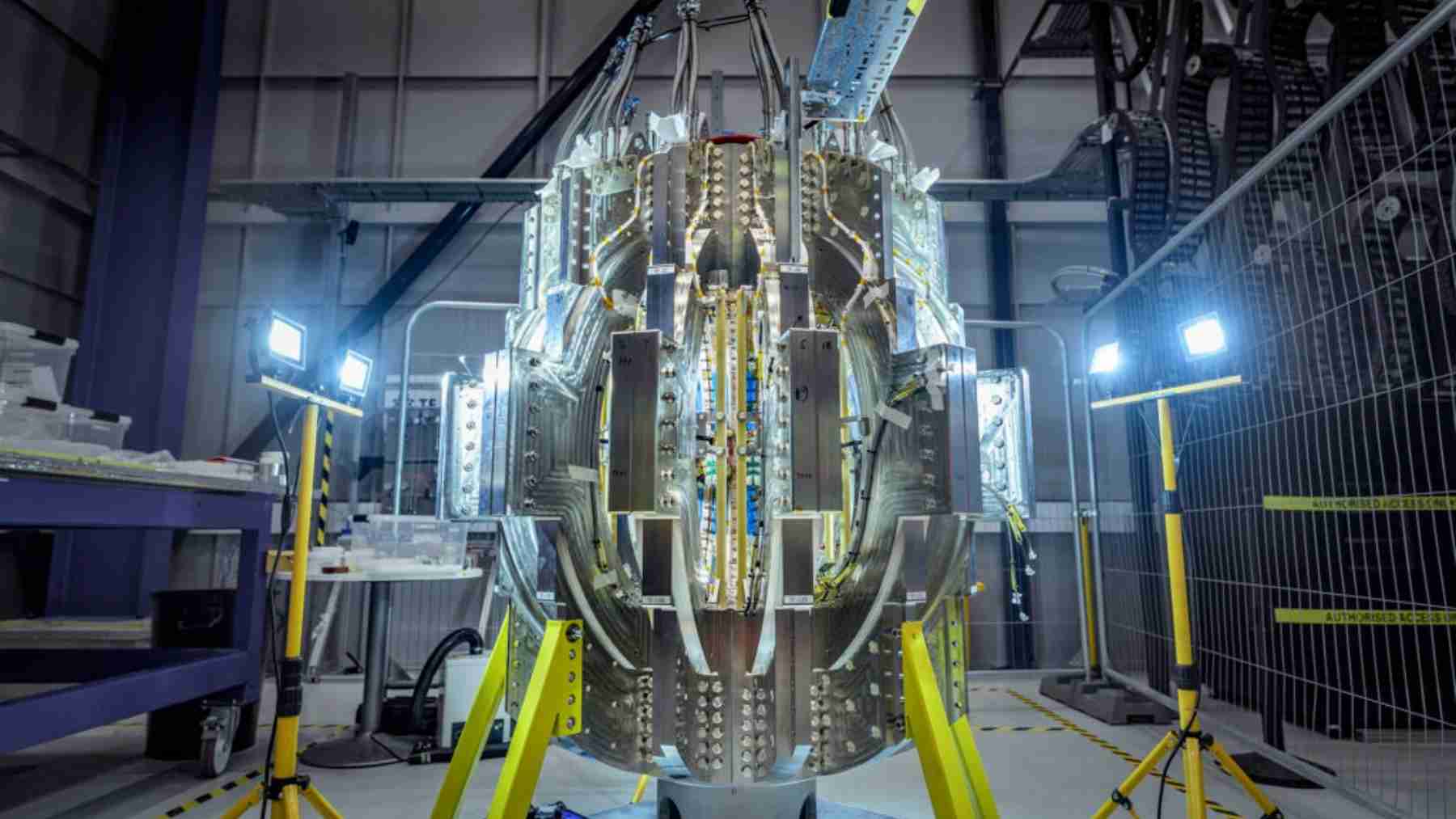
Demo4 is a complete set of HTS magnets built in a tokamak configuration at the company’s Milton Park headquarters outside Oxford. In November it produced 11.8 tesla, with seven million ampere turns of current running through its centre column. The company called it a world first for a full tokamak-configured HTS system, and said higher-field results were due in early 2026. It has not published them.
For scale, the largest superconducting fusion magnet ever built was finished in China this year, and Autonotion covered it: a single D-shaped coil weighing 582 metric tons, about 640 US tons, rated at 6.5 tesla, one of sixteen planned for a full-size reactor ring. Demo4 is not a reactor and never will be. What the two field numbers show is what the tape buys you.
Spherical tokamaks always had a magnet problem
Most fusion machines are doughnuts. A spherical tokamak squeezes the hole in the middle almost shut, leaving something closer to a cored apple. Princeton Plasma Physics Laboratory, which runs the American version, has found that energy confinement scales more favorably in spherical machines than in conventional designs.
The trouble was always the middle. Close up the hole and there is barely anywhere to put the central windings, so the magnetic field comes out weaker than a conventional machine’s. Tape that pushes far more current through far less space answers that objection directly.
Tokamak Energy has been making the argument since 2015, when its ST25-HTS held a plasma pulse for more than 24 hours on HTS magnets alone. Its current machine, ST40, reached a plasma ion temperature of 100 million degrees Celsius in 2022, which the Department of Energy describes as about six times the core of the Sun. Last December it pushed plasma current to 1 megaamp, up from a previous best of 0.85, inside a plasma volume of roughly one cubic meter.
ST40 is currently in pieces. Tokamak Energy said in late June that it had pulled the machine’s centre column out after more than 5,000 plasma pulses. Princeton is approaching the same idea from the public side and just took delivery of a 23,000-pound central magnet bundle to restart NSTX-U, the most powerful spherical tokamak in the United States.
Washington was buying this technology before London was
The ST40 teardown is part of a $52 million upgrade, and the US Department of Energy is paying a third of it, alongside Britain’s energy department and the company itself. Princeton is supplying lithium coating expertise. Oak Ridge is handling pellet fueling. Tokamak Energy Inc., the US subsidiary set up in 2019, is one of eight companies in the DOE’s Milestone-Based Fusion Development Program.
By its own accounting, the company has raised $335 million: $275 million from private investors and $60 million from the British and American governments.
According to a peer-reviewed overview of ST40 published this year in the journal Nuclear Fusion, the shutdown began in late 2025 and runs through most of 2026. The machine gets all-metal plasma-facing components, a megawatt of electron cyclotron heating, a pellet injector and a pair of lithium evaporators. The next experimental campaign is scheduled for 2027 and 2028.
Then there is the part of the business that has nothing to do with electricity. Last October, General Atomics contracted Tokamak Energy to simulate, design and fabricate HTS magnets for DARPA’s PUMP program, with HRL Laboratories developing the electrodes. An MHD pump drives seawater using magnetic fields and no rotating parts, and the British trade press did not bother being coy about the application. Silent submarines.
The prototype it promised for 2026 has dropped out of the story
Back to ST80-HTS. Tokamak Energy announced it in October 2022 as the world’s first high field spherical tokamak using HTS magnets at scale, to be built at the atomic energy authority’s Culham campus, with build completion planned for 2026. The Furukawa tape from New York was bought for that machine.
In October 2024 the company laid out the plant ST80 was supposed to inform: a spherical tokamak generating 800 MW of fusion power and 85 MW of net electricity, with a plasma major radius of 4.25 meters and a liquid lithium blanket to breed its own tritium.
It is now July 2026. Tokamak Energy has not announced ST80-HTS as complete, and the machine no longer appears in how the company describes its own route to a power plant. That route now runs through the STEP magnet contract, the ST40 upgrade, and a DOE-backed pilot plant design aimed at net energy output sometime in the 2030s.
The company has not said the prototype was cancelled, and fusion firms reshuffle hardware constantly. What sits on the books today is a magnet contract with an end date on it.
West Burton has a construction crew and a supply chain problem
The rest of STEP is moving. In March the UK government named the ILIOS consortium, led by Kier and Nuvia, as construction partner for a £200 million redevelopment of the site, roughly $268 million, on a coal station that shut in 2023 after 57 years of service. UK Fusion Energy expects around 8,000 workers on site through construction, which is due to begin from 2030.
Britain has committed £2.5 billion to fusion through 2030, about $3.35 billion, and £1.3 billion of that, roughly $1.7 billion, is earmarked for STEP.
The tape order is the piece nobody has solved. Commonwealth Fusion Systems needed about 10,000 kilometers of the same material for SPARC, the compact tokamak going together outside Boston, and spent years getting suppliers to make it. Co-founder Brandon Sorbom has said the number drew laughter when he first floated it. STEP needs three times as much.
Britain has proved it can wind the coils. It is being paid £70 million to do it again at national scale, and the magnets are the least speculative part of the whole plant. The ribbon those coils get wound from is still a feasibility study. The last time this company built a prototype, the tape arrived from New York.